Visa
About "Dunarea de Jos" University of Galati
A public university with roots in Galați's technical education
Dunărea de Jos University of Galați is a public higher education institution in Romania. Its official history distinguishes the creation of the university in 1974 from the earlier development of higher education in the city. The university was formed by bringing together the local polytechnic and pedagogical institutes, combining technical education with the preparation of teachers and other academic disciplines. It adopted the Dunărea de Jos name in 1991.
The history of its predecessor institutions reaches back to 1948, when an institute devoted to land improvement was established. A mechanical and naval institute followed in 1951, and later reorganizations brought together further technical, agricultural, fisheries, and food-industry teaching. The pedagogical institute opened in 1959. This sequence explains the university's combination of industrial specialisms and a broader educational mission: its present identity developed through several institutions responding to different regional and national needs.
Sources: University history ↗
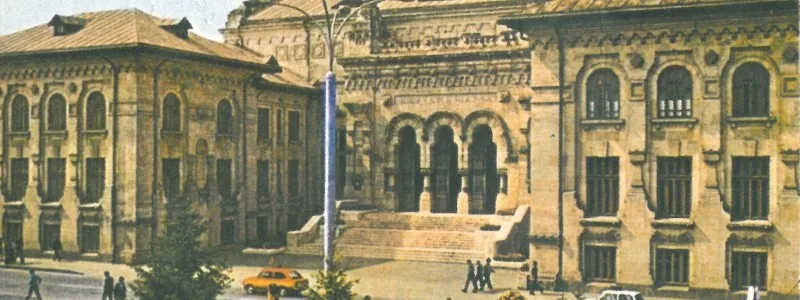
Academic breadth across several levels of study
The university's About page describes education at bachelor's, master's, and doctoral levels. Its subject range includes technical fields, humanities, economics, health, and the arts. The faculty listings show how this broad remit is organized, with areas including engineering, food science and engineering, computing and electrical technologies, letters, science and environment, economics and business administration, law, medicine and pharmacy, and artistic study.
Other listed parts of the institution include physical education and sport, education sciences, history, philosophy and theology, engineering and agronomy in Brăila, and cross-border education. This breadth means that the university cannot be understood solely through its early engineering origins. Its published organization also includes continuing education, teacher preparation, distance learning, a university press, and research-related services. These activities connect degree teaching with professional development, scholarly communication, and the continuing educational needs of different groups of learners.
Sources: About the university ↗
The university's relationship with its city and region
The university's institutional introduction places it in Galați, a port city on the Danube, and emphasizes its contribution to local technical, scientific, cultural, and social development. It describes cooperation with the surrounding economic environment through the education of specialists, consultancy, and technical responses to practical problems. The regional setting is therefore presented as an active part of the university's work, rather than simply the location of its buildings.
This description helps connect its diverse subjects with a common institutional purpose. Training in technical and professional fields supports organizations that need specialist knowledge, while cultural and social activity extends its role beyond industry. The university presents the effects of its work over different timescales, from addressing immediate questions to contributing to development over a longer period. Such links between education, expertise, and the surrounding community are a recurring theme in its official account of its place in Galați.
Sources: University introduction ↗
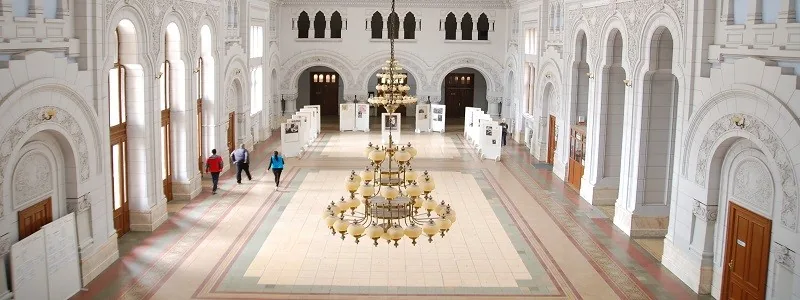
Naval architecture as a distinctive academic tradition
Naval architecture is one of the clearest continuities between the university's history and its contemporary academic offering. The faculty's official introduction traces naval higher education in Galați to the mechanical and naval institute established in 1951. It describes subsequent reorganizations of engineering education and the later separation of naval and electrical engineering into distinct structures. The faculty adopted the Naval Architecture name in 2009.
The faculty page presents undergraduate study in naval architecture and in naval systems and equipment, an English-language master's option in naval architecture, and doctoral research connected with mechanical engineering, hydrodynamics, and naval structures. These areas combine attention to vessels and marine structures with the underlying engineering questions involved in their design and performance. They provide a concrete example of how a university-wide technical heritage becomes a specialized sequence of teaching and research at several academic levels.
Sources: Faculty of Naval Architecture ↗
Undergraduate routes into engineering and applied fields
The university's English-language admissions catalogue illustrates the variety within its undergraduate engineering provision. Listed pathways include mechanical engineering, digital production systems, road motor vehicles, hydrotechnical facilities and environmental protection, industrial economic engineering, applied informatics in materials engineering, and medical engineering. The catalogue gives separate information for each program, including the field of study, duration, and teaching language.
The same catalogue includes naval architecture, naval systems and equipment, and food products engineering. The examples show several different applications of engineering knowledge, from manufacturing and materials to environmental works, transport, health-related technology, and food production. They also demonstrate why the exact program matters when comparing study options at the university. A broad faculty title covers several routes with distinct subject content, and the catalogue's program-level information provides a more precise account of what the institution teaches.
Sources: Undergraduate study programmes ↗
Library resources and international academic mobility
The university library supports study through both physical and digital services. Its website describes a unified search portal covering the library catalogue, UGAL Journals, and the institutional repository ARTHRA. The repository includes doctoral theses and other institutional documents. A separate services page identifies reading rooms and branch-specific facilities such as internet access, printing, scanning, photocopying, and catalogue access. The provision is distributed across the central library and specialist locations associated with several faculties.
International mobility is supported by a dedicated university department with responsibilities for incoming and outgoing students and for staff exchanges. The engineering faculty's April 2026 report describes Erasmus opportunities for student study and traineeships, alongside teaching and training mobility for academic staff. It also refers to institutional agreements with partners inside and outside the European Union. These resources complement subject teaching by supporting access to research materials and structured academic exchange beyond the university's own locations.
Sources: University library ↗ · Library equipment and services ↗ · International mobility and community programmes ↗ · Engineering faculty report, April 2026 ↗