Visa
About "Constantin Rădulescu-Motru" Institute of Philosophy and Psychology of the Romanian Academy
A specialist institute within the Romanian Academy
The Constantin Rădulescu-Motru Institute of Philosophy and Psychology is a Romanian Academy research institution based in Bucharest. Its organizational regulations describe a public institution devoted to advanced and fundamental work in the humanities and social sciences, particularly philosophy and psychology. Its role includes producing research and communicating its results through publications, scholarly meetings, and related academic activities.
The regulations trace the combined institute to a government decision dated December 27, 2001, which merged the Institute of Philosophy with the Mihai Ralea Institute of Psychology. Both predecessor organizations had longer histories: the philosophy institute became an independent Academy research unit in 1953, and the psychology institute was established in 1956. Their later institutional arrangements changed before the merger brought the two research traditions together. This background helps explain why the present institute maintains distinct philosophical and psychological sections within a shared organization.
Sources: Institute organization and operating regulations ↗

Organization of philosophical and psychological research
The institute's published organization chart for 2025 presents a structure built around two main sections. Philosophy includes work on logic and metaphysics, epistemology and ethics, the history of world philosophy, and the history of Romanian philosophy. Psychology is represented by laboratories concerned with development and cross-cultural questions, cognition and organizational behavior, and clinical and personality psychology.
The chart also places scholarly journals within the research organization and identifies library and administrative support. These details show that the institution combines specialist research groups with the practical infrastructure needed to maintain academic work and its publication. Because this is a dated organizational chart, it provides evidence of the documented 2025 structure rather than a guarantee that every staffing allocation remains identical today. The disciplinary arrangement nevertheless gives a useful picture of the institute's principal areas of expertise.
Sources: Institute 2025 organization chart ↗
Doctoral education in a research setting
The Doctoral School of Philosophy and Psychology operates within the institute and presents two doctoral study programs, one in each of those disciplines. Its official introduction places the school within the Romanian Academy's School of Advanced Studies, known as SCOSAAR. It describes doctoral education as preparation for sophisticated academic research and the development of disciplinary and broader transferable competencies.
The school's website provides separate routes to information about supervisors, admission, public thesis defenses, regulations, study plans, and scientific activity. It also explains that doctoral work follows both Academy-level arrangements and the school's own procedures. Ethics and quality assurance form part of this framework, including review of studies involving human participants in psychological research. For a prospective doctoral researcher, these resources are particularly useful because the relationship between a proposed topic, the available supervision, and the relevant research group is central to understanding the academic environment.
Philosophical journals and scholarly debate
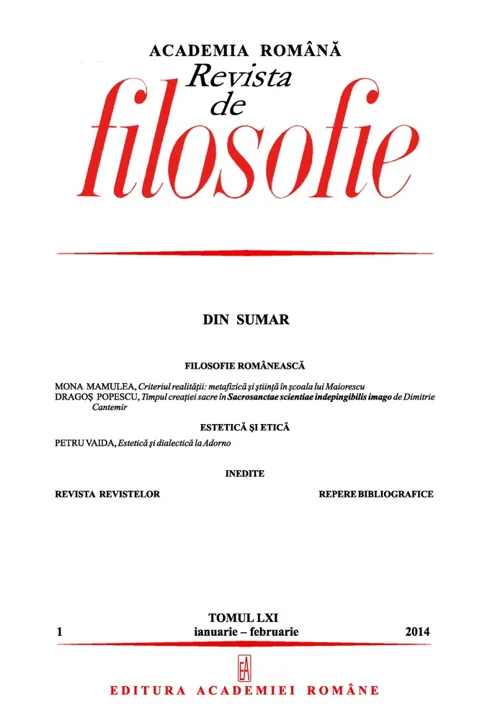
Publishing is a visible part of the institute's academic identity. Its page for Revista de filosofie describes a peer-reviewed journal appearing six times annually. The stated subject range is broad, encompassing areas such as philosophical history, logic, ontology, epistemology, ethics, aesthetics, and the philosophies of science, mind, culture, and language. The journal presents itself as a forum for reasoned discussion rather than an advocate for a single philosophical school.
The journal's listed formats extend beyond research articles to reviews, translations, bibliographies, discussions, and other contributions to scholarly exchange. A separate institutional page introduces Revue Roumaine de Philosophie, reports a publication frequency of two issues per year, and offers access to editorial information, an archive, submission guidance, and contact details. Taken together, the journals demonstrate how the institute supports both the production of research and its circulation among wider philosophical audiences. Their individual submission policies remain the appropriate reference for authors considering a contribution.
Sources: Revista de filosofie ↗ · Revue Roumaine de Philosophie ↗
Romanian philosophy in its historical and European contexts
Studii de istorie a filosofiei românești is another important expression of the institute's research interests. Its own introduction identifies it as a peer-reviewed academic publication founded within the institute in 2006. The series aims to encourage new investigation of questions discussed in Romanian intellectual culture, considering philosophical thought in both its local setting and its wider European relationships.
The publication appears annually and combines thematic issues with the possibility of other contributions. It welcomes original work using different philosophical methods, including historical, comparative, analytical, hermeneutic, and phenomenological approaches. Its stated audience includes specialist researchers, students, and other readers interested in humanities and social science scholarship. The publication also emphasizes participation by younger researchers. Since 2020 it has accepted English as well as Romanian articles, and its website describes free online access to complete articles from that period. These features connect a specialized national research subject with broader scholarly participation and readership.
Research groups, documents, and academic resources
The philosophy department's official page organizes its researchers around named groups in logic and metaphysics, epistemology and ethics, world philosophical history, and Romanian philosophical history. It also links to individual researchers and related publications. This structure makes it possible to investigate the institute through the actual areas of work represented by its research teams, rather than relying only on the institution's broad title.
The main site's download directory complements those departmental pages with a substantial range of academic and organizational material. Its categories include scholarly activity, collective works, conference volumes, research grants, doctoral studies, and doctoral methodologies. Other categories provide access to journal material and recurring publication series, including work on logic, categories, and philosophical history. These resources offer practical starting points for readers who want to examine research outputs, trace an academic discussion, or understand the institute's doctoral and organizational documentation. Their availability also reflects the central place of sustained publication and documentary scholarship in the institute's work.
Sources: Institute document and publication downloads ↗ · Philosophy department ↗