Visa

About Academia de Politie Alexandru Ioan Cuza
A specialist academy in Bucharest
Academia de Politie Alexandru Ioan Cuza is the directory name for the Alexandru Ioan Cuza Police Academy in Bucharest, Romania. The academy's official website identifies it as an institution within the Ministry of Internal Affairs. Its headquarters are on Aleea Privighetorilor in Sector 1 of the capital. The institution combines university education with the professional preparation associated with public order, law enforcement and emergency services. Its official admissions site presents undergraduate, academic master's and professional master's routes as distinct parts of this educational provision.
Sources: Official academy identity and location ↗ · Academy admissions and academic programmes, 2026 ↗
Police, law and fire-engineering programmes
The academy's 2026 undergraduate information identifies two faculties: Police and Firefighters. Within the Police Faculty, Public Order and Safety is a three-year programme carrying 180 transferable credits. The listed professional specialities include police, border police and gendarmerie. Law is presented as a four-year programme with 240 credits. The Firefighters Faculty offers a four-year, 240-credit programme in building installations for firefighters, connecting its professional focus with engineering education.
The postgraduate directory extends into public-order management, information activities, operations at the external Schengen border and international police cooperation. Legal subjects include administrative law, criminal sciences, business law, and international relations and organisations in contemporary law. The Firefighters Faculty lists emergency-management and fire-safety engineering master's study. This combination gives the academy a broader academic structure than its police title alone suggests, bringing legal analysis, public-order organisation and technical emergency-related study into the same institution.
Sources: Academy admissions and academic programmes, 2026 ↗
A professional master's pathway
A ministry publication from July 2026 describes a separate professional master's route for the initial preparation of police officers. The programme is titled Criminal Sciences in Ensuring Public Order and Safety and is organised as one year of full-time study. The published explanation addresses graduates who already hold an eligible undergraduate qualification, including relevant legal, engineering and other fields.
This route differs from entering a first degree immediately after secondary education: it builds professional preparation on an existing university education. The ministry's account also distinguishes recruitment units from the academy's teaching role, explaining that application and recruitment documents pass through the designated recruitment structure. The academy itself publishes the programme's regulation, educational offer, competition information and results. These arrangements show how academic preparation and the ministry's personnel-training system are connected while remaining separate stages of the institutional process.
Sources: Ministry publication: 2026 academic entry routes ↗ · Academy admissions and academic programmes, 2026 ↗
Professional preparation and continuing learning
In a 2026 interview published by the Ministry of Internal Affairs, its representative distinguishes officer education at the academy from training at schools for police agents. The discussion describes selection involving physical assessment and a knowledge examination, placing preparation for academic study alongside the physical demands associated with the profession. It also distinguishes the three-year public-order route from the four-year law route.
The interview emphasises that training continues after initial education. Work is described as taking place under the guidance of colleagues and managers, with responsibilities and procedures defined at different organisational levels. This gives a practical context to the academy's educational role: university study forms part of a longer process of professional learning within police structures. Initial qualifications, continuing instruction and supervised work contribute different elements to that process.
Sources: Ministry interview on police education and continuing training ↗
Library and academic documentation
The academy's 2022 external institutional evaluation describes its university library as supporting both education and research. The report identifies collections concerned with law, professional subjects and literature, together with reading spaces and library regulations. It also documents specialist library provision associated with firefighters and, in the structure evaluated at that time, archival studies. These details provide a dated account of the learning resources available during the evaluation.
For fire-related study, the report discusses books covering fundamental subjects and building-installation disciplines, alongside professional firefighting, military-preparation and civil-protection material. The evaluation also records access arrangements involving specialised libraries elsewhere in Bucharest, including university and national collections. Such resources support course reading, independent documentation and research projects. The 2022 account illustrates how the academy combined a central documentary base with subject-specific collections and access to other institutions in the capital.
Sources: Institutional external evaluation report, 2022: learning resources ↗
Conference activity and public-safety dialogue
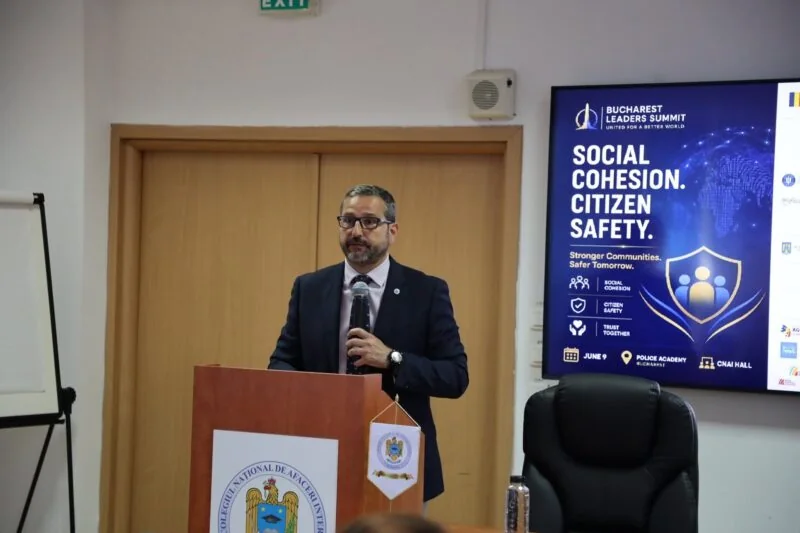
The academy hosted a conference on social cohesion, citizen safety and stronger communities within the Bucharest Leaders' Summit in June 2026. An official report from Romania's National Agency Against Trafficking in Persons records participation by public institutions, experts and specialists. The event was organised by Media Uno and used the academy as a setting for discussion of contemporary public-safety challenges.
The agency's contribution addressed human trafficking, prevention and the protection of victims. Its report highlights cooperation among authorities, non-governmental organisations and local communities, alongside education and early intervention. This event offers a concrete example of the academy's role as a meeting place for professional and institutional dialogue. It connects subjects relevant to public-order education with discussions involving practitioners and other organisations, extending academic life beyond scheduled degree teaching.
Sources: ANITP report on academic conference hosted by the academy, June 2026 ↗
The academic year and student life
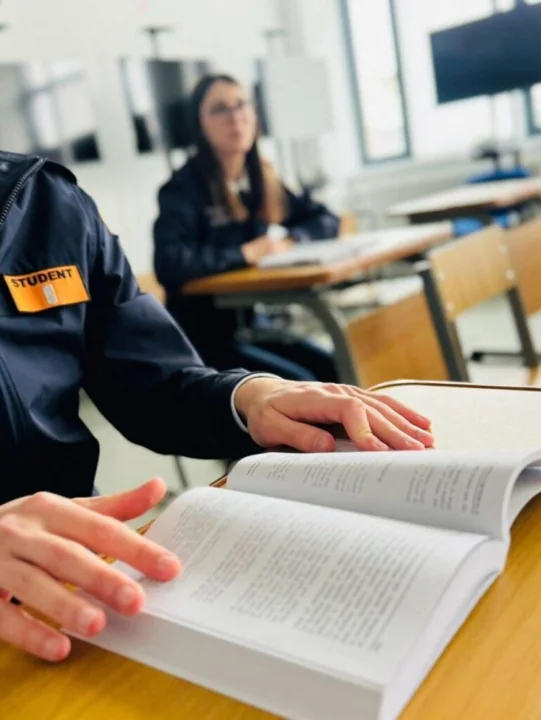
The ministry's magazine reported the opening of the academy's 2025–26 academic year on 6 October 2025. Its account places discipline, honour and responsibility within students' preparation for service in Ministry of Internal Affairs structures. The accompanying photograph shows uniformed students studying in a classroom. This everyday academic setting complements the programme directory: preparation involves reading and classroom learning as well as the professional identity associated with the academy.