Visa
About Ashikaga University
From technology institute to university
Ashikaga University is located in Ashikaga, Tochigi Prefecture, Japan. It opened in April 1967 as Ashikaga Institute of Technology, initially teaching mechanical engineering, electrical engineering and architecture at its Omae site. Master’s study in engineering followed in 1990, and doctoral programmes opened in 1996. A Faculty of Nursing was established in 2014, broadening the institution beyond its engineering origins. The university adopted the Ashikaga University name in April 2018. Its educational foundation has an earlier history: an association of seventeen local Buddhist temples established Ashikaga Jissen Girls’ School in 1925. The university’s official timeline distinguishes this foundation history from the establishment and subsequent development of the university itself, documenting the growth of its teaching and graduate research provision.
Sources: Institutional history ↗
An educational philosophy of harmony
The university’s founding philosophy centres on harmony, drawing on the first article of the Seventeen-Article Constitution associated with Prince Shotoku. It applies this principle to relations between people and to the responsibilities of professional education. For engineering, the university describes harmony with the natural and social environment as a guiding concern in teaching and research. Its nursing philosophy links ethical judgement and human relationships with scientific practice, contribution to regional healthcare and continued professional learning. These are stated educational aims rather than claims about individual outcomes. The philosophy connects the university’s Buddhist educational heritage with the different professional fields represented in its faculties.
Sources: Founding philosophy ↗
Engineering and nursing education
The engineering programme information spans mechanical engineering, renewable energy, electrical and electronic engineering, information systems, artificial intelligence, architecture and civil engineering. Mechanical study includes basic engineering knowledge and applications such as three-dimensional computer-aided design. Renewable energy teaching addresses technologies involving wind, water, sunlight and biomass. Electrical and electronic education combines theory with experimental and practical work. Information-related courses examine system design and configuration, while artificial intelligence study includes software, robotic systems and development seminars. Architecture and civil engineering connect design and infrastructure with environmental considerations. The same official programme overview identifies the Faculty of Nursing as a separate part of the university, with an educational emphasis on professional ethics and harmony. This combination reflects the institution’s expansion from a technology institute into a university with both engineering and nursing provision.
Sources: Faculties and programmes ↗
Graduate study and specialist enquiry
The master’s programme in Information Science and Manufacturing Engineering includes renewable energy and environmental engineering, mechanical systems, electrical and electronic engineering, and systems information engineering. Its curriculum describes areas such as fluid and thermal engineering, materials, energy conversion, control, power engineering and computer visualisation. Artificial intelligence, data science and system development also feature among the subjects. The programme links these areas with analysis of complex systems, identification of problems and development of solutions. Its electrical engineering provision includes magnetic applications and superconductivity, while mechanical systems draw on precision engineering and surface modification. A second master’s programme, Construction and Environmental Engineering, combines investigation of structures and materials with architectural planning and environmental questions. Its construction engineering specialism covers matters such as structural mechanics, concrete, soil and fluid mechanics. Architectural and urban design study addresses planning, landscape, building history, environmental systems and living spaces. The programmes present these subjects as routes towards advanced specialist knowledge, research capability, practical application and engineering ethics.
Sources: Master’s programmes ↗
The Omae library
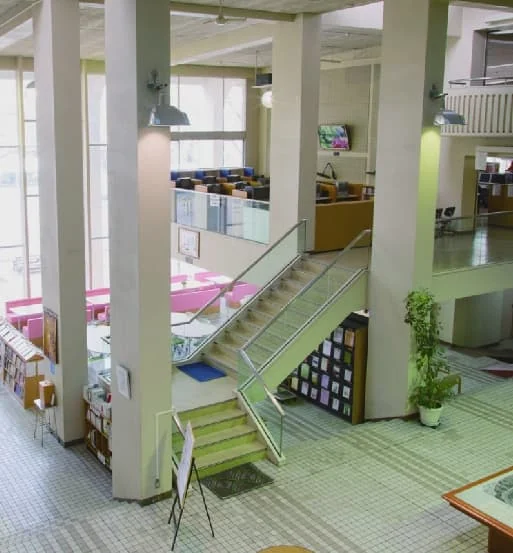
The Omae campus library organises its spaces according to different ways of learning. The first floor is a flexible study area supporting active learning, while upper floors provide individual study spaces. Engineering books are arranged on the second floor. Humanities, social sciences and foreign-language holdings are located on the third. This layout connects the university’s technical subjects with broader academic resources, while allowing students to choose between collaborative and more individual forms of study.
Sources: Omae campus library ↗
Campus life and student activity
The university’s English campus-life information describes international exchange through academic research relationships and its exchange committee. These connections form part of its effort to develop an international educational environment. Outside formal classes, students can participate in committees, sports clubs and other activity groups. The university festival brings students and local residents together for a programme of events. A student union building accommodates student spaces, a shop and dining facilities. The published campus map also identifies academic and research buildings, including computer science facilities, laboratories, engineering workshops and specialist experimental spaces for construction, hydraulics and the water environment. These facilities show the practical character of the engineering campus, alongside places for study, student organisation and social activity.
Sources: Campus life ↗
Energy research and regional collaboration
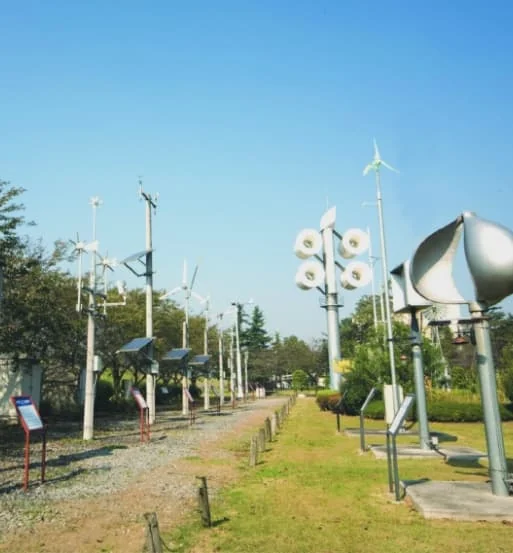
The Wind and Solar Power Park is a visible expression of the university’s interest in renewable energy. Its official description groups the exhibits around wind, light, water and wood, with equipment illustrating different uses of natural energy. Wind-generation devices and other displays give students and visitors a setting for encountering energy technologies. The exhibits also include solar and water clocks, a fountain operating without external power, and a biotope. The institutional overview also describes collaborative research with local enterprises, presenting the research centre as a link between university expertise and regional industry. Its wider activities include sharing technical knowledge and offering seminars for the public. Alongside teaching and laboratory investigation, these facilities connect specialist engineering work with opportunities for public learning and relationships with the surrounding community.
Sources: English institutional overview and facilities ↗