Visa
About Ageo Nursing College
A specialist nursing school in Ageo
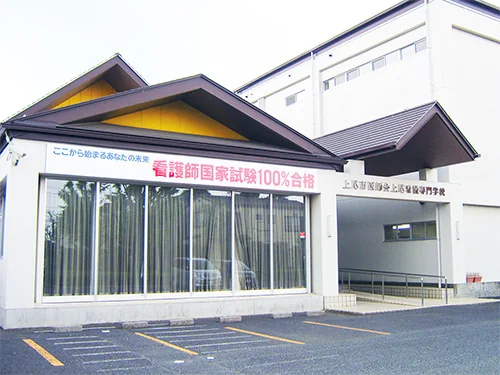
Ageo Nursing College is the English directory name for 上尾市医師会 上尾看護専門学校, a specialist nursing school operated by the Ageo City Medical Association in Saitama Prefecture, Japan. Its address is 3494-4 Haraichi, Ageo. The school offers a three-year, full-time programme of professional education through which students can become eligible to take Japan's national nursing examination. Completing the course and obtaining a nursing licence are separate steps.
The school is situated in an educational neighbourhood near Haraichi's elementary school, junior high school and community centre, with Takanodai High School also nearby. Its educational philosophy emphasizes preparing nurses who can contribute to community healthcare through scientifically grounded knowledge and skills. It also highlights cooperation with other professions and attention to people's daily lives. The sunflower, called himawari in Japanese, is the school's chosen symbol, expressing an image of upright growth, brightness and an open, generous outlook.
Sources: School overview and educational philosophy ↗
Opening and course development
The school opened on 1 April 1989 under the Ageo City Medical Association name. Its history records designation as a nursing training institution by the Minister of Health in February of that year, followed by approval for its establishment from the governor of Saitama in March.
A 1995 milestone enabled graduates to use the specialist title senmonshi under the relevant Ministry of Education notification. In 2002, the school received approval for a course change and admitted the first cohort under its three-year curriculum. The historical timeline also records changes to the use of school rooms and practical training facilities, showing the development of the teaching environment alongside the programme itself.
Sources: History of the school ↗
Building knowledge through different kinds of study
The teaching framework is divided into basic subjects, specialized foundation subjects and professional nursing subjects. Basic study develops scientific thinking, understanding of people and communication skills. The specialized foundation area connects nursing decisions with scientific evidence and introduces the social systems that support health. It also includes the basic capabilities needed to use information and communication technology.
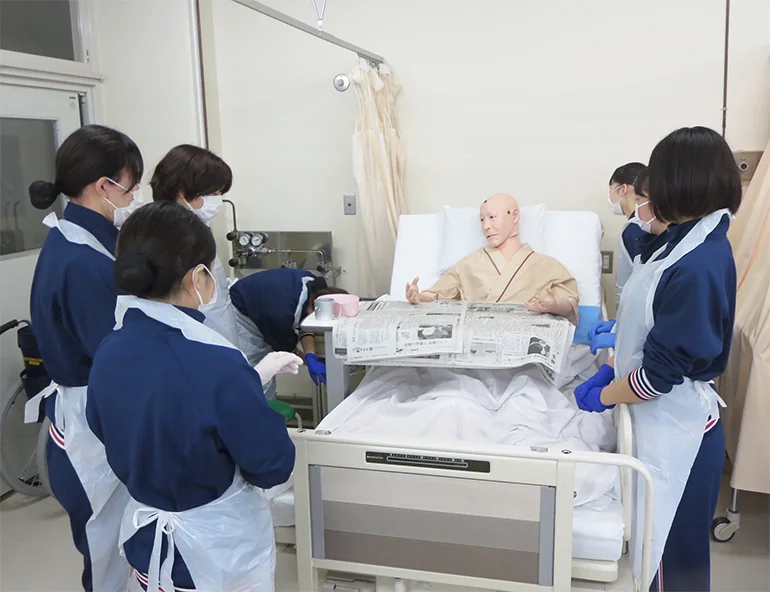
Professional study combines nursing lectures with practice within the school. Clinical learning then gives students opportunities to connect previously studied theory, knowledge and skills with actual nursing situations. The school describes this progression as a way to integrate learning rather than leaving classroom knowledge and practical experience as separate activities. Its teaching photographs include supervised work with a patient-training manikin.
Sources: Teaching and learning ↗
Small groups and varied placement settings
The curriculum page describes a two-teacher team supporting each class with both learning and personal concerns. Group work is used to expose students to different perspectives, and practical learning includes small groups of four. These arrangements support close interaction between teachers and students while encouraging learners to work with one another.
The school's placement list extends across several kinds of health and community service. Examples include Ageo Central General Hospital, Shin-Kuki General Hospital, Saitama Citizens Medical Center, the Saitama Cancer Center and rehabilitation facilities. It also names psychiatric services, maternity settings, home nursing stations, older people's care facilities and local health services. Schools, disability welfare facilities and employment-support organizations appear in the broader list. This variety gives the programme a wider community context alongside its hospital-based education.
Learning with the surrounding community
Community-linked education is a distinctive part of the school's description of its work. Students take part in visits to older people living alone in a nearby housing complex and in exercises involving the establishment of evacuation shelters with local residents. These activities connect nursing education with the circumstances of people living near the school.
The school emphasizes appropriate communication with older people and an understanding of community life. It also welcomes students who have worked before entering nursing education. Small-group guidance and interaction across year groups are intended to support personal development and learning from different experiences. This brings community participation and peer learning into the same educational approach.
The rhythm of the school year
The annual calendar combines academic milestones with ceremonies, shared activities and practical exercises. Its examples include disaster-preparedness training, a school festival, student exchange activities, case-study presentations and a first-year pledge ceremony. The festival is known as the Himawari Festival, linking it to the school's sunflower identity.
The published schedule also shows clinical learning developing across the years: introductory nursing practice appears in the earlier stages, while subject-specific and integrated practice feature later. Third-year students prepare for the national nursing examination, and graduation takes place in March. Open-campus activities allow prospective students to experience aspects of teaching and learn about the school. Together, these events provide structure around the progression from entering the programme to completing professional study.
Sources: School events and annual calendar ↗
Students describing their experience
The official student-voices page includes accounts from people who entered after work experience as well as students who came through other routes. Contributors describe frequent communication with teachers, support from classmates and opportunities to meet people through group work. One account discusses returning to study in their thirties and learning alongside classmates with employment and parenting experience.
These are individual reflections published by the school. They add a personal perspective to its description of small-group teaching and a varied student community, showing how different life experiences can become part of shared professional learning.
Sources: Student voices ↗