Visa


About Aichi Gakuin University
Historical roots and the university’s development
Aichi Gakuin University is a Japanese university with campuses in and around Nagoya, Aichi Prefecture. Its institutional roots reach back to 1876, when the Nagoya Branch Training Center of Soto Zen Buddhism was founded at Daikoin Temple. Its later history includes secondary education and the establishment of a junior college in 1950. The university itself was established in 1953 with a Faculty of Commerce.
The Faculty of Law followed in 1957 and the School of Dentistry in 1961. Further expansion brought humanities, management, policy studies, pharmacy and economics into its academic structure. The university moved to its Nisshin campus in 1974, while Meijo Koen Campus opened in 2014. These stages explain how the institution developed from a Buddhist educational foundation into a university spanning humanities, social sciences and health-related disciplines.
Its educational philosophy connects learning with practice, drawing on the teaching of Dogen, the founder of Soto Zen Buddhism. The university interprets this as a unity between developing character and pursuing truth. Another guiding idea is gratitude arising from recognition of mutual dependence, expressed through a responsibility to contribute to society.
Sources: Institutional chronology ↗ · Educational philosophy ↗
Four campuses with different academic roles
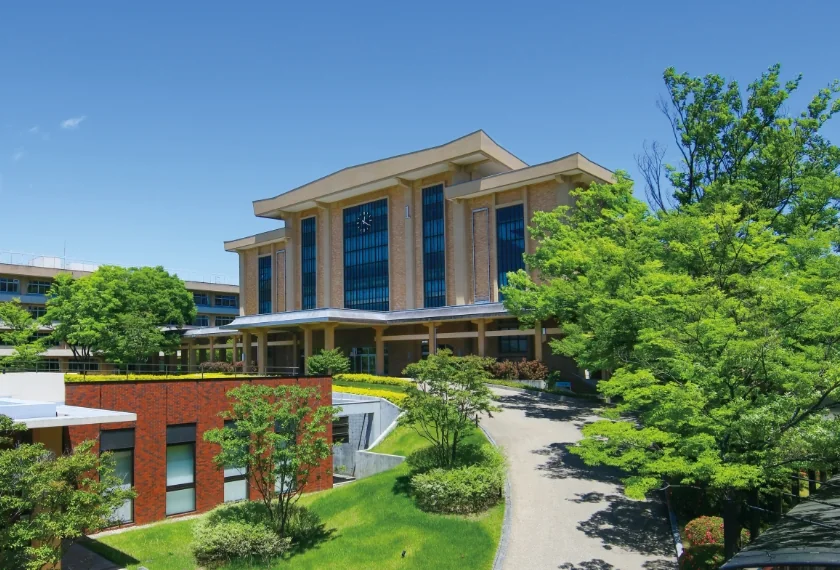
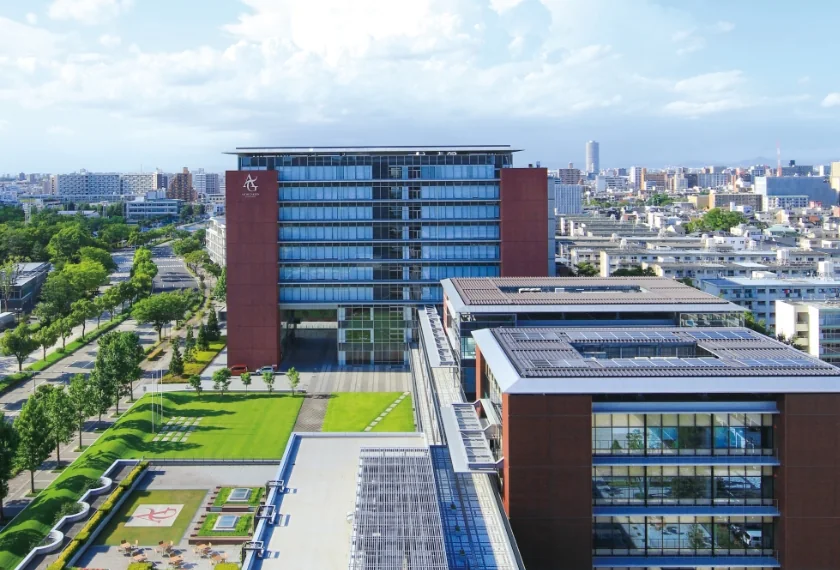
Nisshin Campus brings together letters, psychology, health science and policy studies in a setting with teaching and sports facilities and extensive green space. Meijo Koen Campus places business and commerce, management, economics and law in central Nagoya. Its location near public administration and commercial districts provides a setting for social-science education and collaboration with organisations outside the university.
Kusumoto Campus serves pharmacy, dentistry and the junior college and includes the Dental and Pharmaceutical Library and Information Center. Suemori Campus is associated with the dentistry school, junior college and dental hospital. Its newer school building, completed in 2023, provides self-study spaces and a medical library. These distinct locations reflect the different facilities required by the university’s disciplines. The campus structure combines a larger suburban learning environment with urban social-science teaching and specialised health-related education, rather than concentrating every subject in one place.
Sources: Four campuses and location ↗
Psychology through experiments and analysis
The Faculty of Psychology approaches human thought, emotion and relationships through experiments and research. Its published areas of expertise include clinical, developmental, social, cognitive and personality psychology, together with psychometrics. The curriculum connects psychological understanding with data analysis, allowing students to consider the mind from more than one perspective.
In the first year, students study fundamental subjects and the basics of analysing data. The second year broadens their experience through specialised foundations, experiments, research and statistical software. Third-year seminars provide more concentrated study through discussion and presentations. In the final year, students investigate their own theme, establish a hypothesis, undertake experiments or other research and write a graduation thesis. This sequence shows the progression from introductory knowledge to an individual research project, with practical investigation forming a continuing part of the degree.
Sources: Faculty of Psychology ↗
Policy studies and contemporary social questions
The Faculty of Policy Studies organises learning around social issues, research and proposals for solutions. Its subject clusters cover politics and administration, economy and environment, international affairs, society and culture, information and media, and human science. Data-science literacy, communication, information technology and logical thinking are presented as tools for examining evidence and participating in society.
A Research Project runs through the undergraduate curriculum. Students begin with field research and fundamental information, language and research skills. They then widen their understanding of issues in Japan and abroad before moving into specialised seminars. Later work involves analysis, possible solutions and policy recommendations, culminating in a graduation thesis. Small-group learning and collaboration with peers are part of this process, connecting a broad understanding of contemporary society with sustained investigation of a chosen question.
Sources: Faculty of Policy Studies ↗
Commerce and applied business learning
The Faculty of Commerce identifies three courses of study: logistics and marketing, accounting and finance, and business information. Students first acquire basic commercial knowledge and skills, then select a course and begin more specialised learning. Seminars provide opportunities to explore business questions in depth, while applied subjects develop the connection between academic understanding and business situations.
The programme also permits learning across course boundaries, enabling students to combine interests rather than confining every subject to a single track. Its description includes subjects relevant to bookkeeping, finance and information-related qualifications. Final-year study involves continued work on an individual theme and a graduation thesis. The structure therefore moves from common foundations towards specialised knowledge and a sustained concluding project.
Sources: Faculty of Commerce ↗
International exchange and Japanese-language learning
The Center for International Programs assists international students and university students interested in study abroad or language training. Its published services include information about exchange programmes, immigration-related procedures, scholarships offered by outside organisations and aspects of daily life. The Center for Japanese Language and Culture organises language education for exchange students, including beginners, with classes adjusted to starting ability and learning needs.
Opportunities for cultural participation include kimono dressing, traditional events and interaction with Japanese students. The English Lounge provides a place for language exchange and seasonal activities. The Nisshin campus also has a Zen Meditation Hall, connecting the university’s religious heritage with an experience available within campus life. These activities complement formal courses by creating settings in which visiting and local students can communicate, practise languages and encounter different cultural traditions.