Visa


About Asahikawa University
From Asahikawa University to a city university
Asahikawa University is now Asahikawa City University, a public university in Asahikawa, Hokkaido, Japan. The institution began its public-university phase in April 2023. Japan’s national higher-education information centre records the name change from Asahikawa University to Asahikawa City University on 1 April that year. Its campus address is in the Nagayama district of Asahikawa.
The university’s current identity builds on its predecessor’s emphasis on a university rooted in, open to and contributing to its region. Its educational framework connects practical learning with local society, while encouraging students to identify questions and develop responses through study and experience. The university offers undergraduate and graduate education; the associated junior college has its own separate academic provision, including food nutrition and childhood-related study.
Sources: Introduction to the university ↗ · National institution record and name history ↗
Economics connected with local and global questions
The Faculty of Economics’ Management Economics department combines economic theory, data and practical inquiry. Its stated approach asks students to identify problems, consider different values and work with others, including people and organisations in the surrounding community. Economics, management and accounting form its principal study routes.
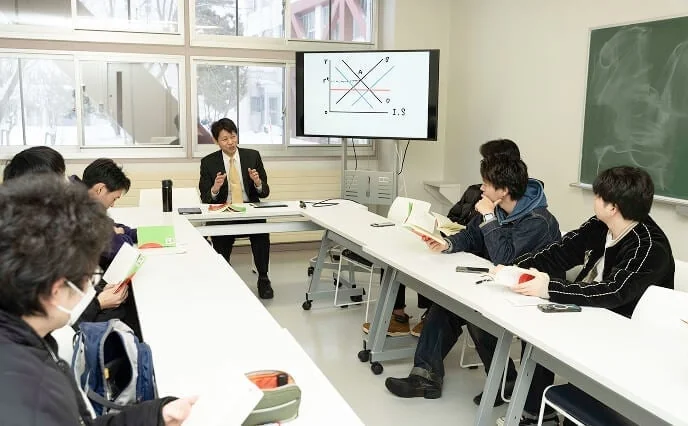
Seminars and fieldwork connect classroom knowledge with situations beyond campus. The department presents investigation and communication as important parts of learning, with students developing their perspectives through research and presentations. Seminar examples include analysing macroeconomic and international questions using data, studying collaboration between residents and public administration in community development, and examining marketing and contemporary consumers. The programme’s regional orientation is therefore combined with attention to wider economic relationships, allowing students to consider local activity within national and international contexts.
Sources: Management Economics ↗
Community welfare and field-based learning
Community Welfare examines people’s everyday difficulties through individual, community and social-system perspectives. Its teaching combines specialist knowledge with fieldwork and practical experience, encouraging students to understand welfare needs in the places where people live. Community survey training develops methods for investigating local circumstances and considering responses.
The curriculum includes social work, social security, disability welfare, older-person welfare, child and family welfare, rights advocacy and community welfare. Seminars, practical training and graduation research connect these subjects with sustained academic work. Additional areas include disaster social work, care management, communication and welfare-oriented community design. The department’s published educational purpose emphasises respect for people and the ability to identify and examine problems. This gives its welfare teaching a combination of social analysis, practical engagement and reflection on the organisation of support.
Sources: Community Welfare ↗
Nursing education and simulation
Health Nursing combines scientific knowledge, ethical judgment and practical learning. Its educational description emphasises understanding people’s lives, working within healthcare teams and communicating clearly with those involved in care. Simulation and supervised practical experience form part of its approach to preparing students for professional responsibilities.
On-campus teaching facilities support foundational and adult nursing, child and maternal nursing, and community, home and older-person nursing. Small-group exercises connect lectures with the practice of basic skills. The curriculum includes anatomy and physiology, public health, statistics, nursing ethics, mental-health nursing, family nursing, disaster nursing and research. These areas are taught alongside practical placements and integrative study, bringing different stages and settings of life into the nursing programme’s educational scope.
Sources: Health Nursing ↗
Graduate study in regional policy
The Graduate School of Regional Policy approaches questions such as population decline and demographic ageing through economics and interdisciplinary perspectives. Welfare, healthcare, law and management are included in its account of the knowledge needed to examine regional issues. Its purpose is to connect practical questions with research and the development of informed judgment.
The programme is designed to accommodate working adults through daytime and evening teaching and remote participation in many classes. In-person thesis guidance, presentations, final examination and other required occasions remain part of the graduate experience. Subjects include regional economics and marketing, public administration, agricultural economics, labour, environmental economics, taxation, finance and accounting. Lectures and seminars support research leading to a master’s degree in regional policy, linking professional experience with systematic academic investigation.
Sources: Graduate School of Regional Policy ↗
Library collections and research access
The university library holds material across economics and other social sciences, welfare, nursing, education, health, food and regional studies. General books and reference works complement specialist publications. Its description presents the library as a resource for students and citizens, supporting intellectual inquiry beyond a single academic department.
Research access includes the university’s institutional repository, which publishes scholarly outputs and bulletins. The library also directs users to Japanese academic discovery services, national-library resources and subject databases. Institutional subscriptions cover areas such as economics, law and nursing, while electronic-book services broaden access to academic texts. These resources connect the physical collection with digital literature and the preservation of university research.
Sources: University Library ↗
Regional research and continuing education
The Regional Collaboration Research Center was established with the public university in 2023, building on the predecessor institution’s regional research activities. It acts as a contact point for companies, local authorities, financial institutions, community organisations and schools seeking to work with university staff. Its activities include collaborative and commissioned research, surveys and other projects responding to local questions.
The centre also supports education linked with the region, including project-based learning, internships and continuing education. The AEL lifelong-learning programme offers public lectures on themes connected with everyday life and social issues. Outreach lectures and campus visits introduce school students and other community learners to university study. Research information and activity reports provide further links between academic expertise and organisations outside the university, making regional engagement part of both teaching and research.
Sources: Regional Collaboration Research Center ↗