Visa

About Aoyama Gakuin University
A university with Methodist educational roots
Aoyama Gakuin University is a Japanese university whose principal campuses are in Tokyo and Sagamihara. Its institutional history traces the wider Aoyama Gakuin tradition to a girls' school established in Tokyo in 1874 by Methodist missionary Dora E. Schoonmaker. Two boys' schools founded by Julius Soper and Robert S. Maclay also contributed to that tradition. Aoyama Gakuin moved to its Aoyama site in 1882. The history records extensive damage during the Great Kanto Earthquake and the wartime destruction of 1945, followed by reconstruction. The university developed under post-war educational reforms, initially providing undergraduate education in literature, commerce and engineering. Subsequent expansion introduced additional fields, including international politics and economics, cultural and creative studies, and social informatics. Its present academic breadth therefore reflects several stages of institutional development.
Sources: University history ↗
Christian foundations and responsibility to society
The university describes its education and research as grounded in the Christian educational policy of Aoyama Gakuin. That policy emphasises sincerity, humility in seeking truth, and responsibility towards other people and society. Its mission connects academic enquiry with service and a global perspective. The institution's interpretation of its biblical motto stresses the value of each person and the contribution individuals can make through creativity and humility. These are stated educational commitments that inform the university's account of its purpose. Its mission also calls for people able to identify issues and work towards solutions themselves. Faculty, staff and students are presented as participants in developing an institution responsive to the needs of its time, while respecting one another and its traditions.
Sources: Missions and values ↗
The urban Aoyama Campus
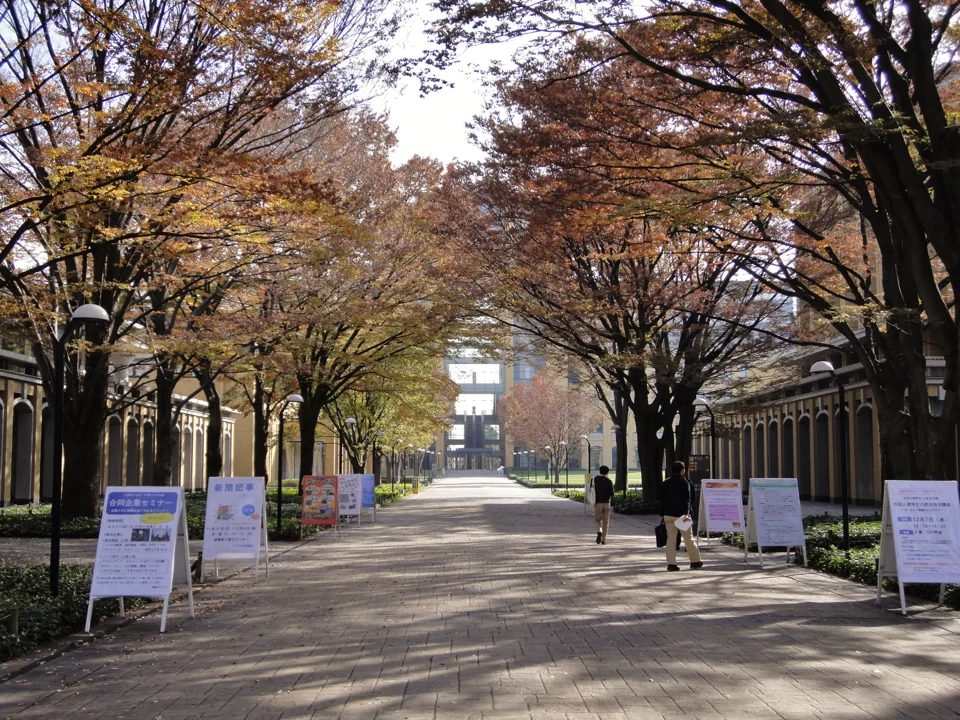
The Aoyama Campus is at Shibuya in Tokyo, close to both Shibuya and Omotesando stations. It accommodates university and graduate education within the wider educational group's urban setting. Its listed academic units include literature, education and psychology, economics, law, business, international politics and economics, and cultural and creative studies. The campus guide identifies Maclay Memorial Hall, Goucher Memorial Hall, research buildings and the Aoyama Gakuin Memorial Hall among its facilities. Ginkgo-lined avenues and shared open spaces form part of its physical character. This setting brings humanities and social-science teaching into a campus located within the Shibuya and Aoyama area.
Sources: Aoyama Campus ↗
Sagamihara and its academic environment
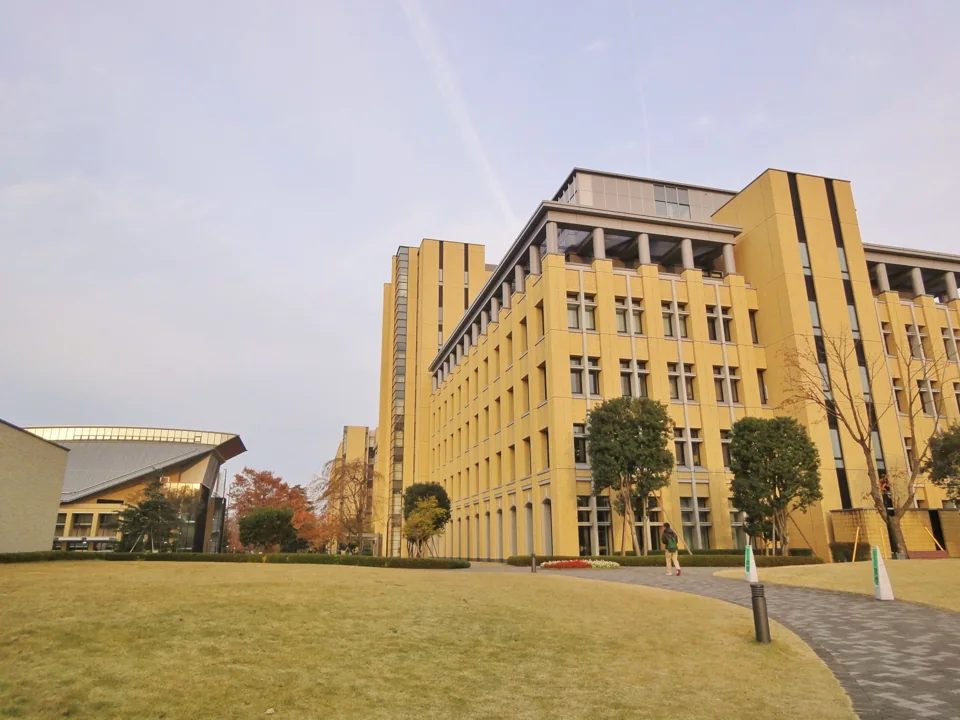
The Sagamihara Campus is in Fuchinobe, in Sagamihara City's Chuo ward, Kanagawa Prefecture. Its academic units include science and engineering, social informatics, global studies and collaboration, and community studies. The university describes an environment of lawns, substantial teaching buildings and a ginkgo-lined approach, with Wesley Chapel as a campus landmark. Its guide identifies a media centre, cafeteria, arena, experimental facilities and the Center for Advanced Technology. Fuchinobe Station on the Yokohama Line provides rail access. The campus account also describes educational and research cooperation with local companies and municipalities, placing its academic activity within the surrounding community as well as within the university.
Sources: Sagamihara Campus ↗
Shared education through the Aoyama Standard
The Aoyama Standard is the common educational curriculum taken across school and departmental boundaries. It is intended to give students basic knowledge and methods that support later specialised study. Teachers from different disciplines contribute directly to this shared provision. Its broad areas concern Christianity, humanity, society, nature and history. Examples listed in the curriculum range from philosophy, literature and cultural anthropology to data science, international relations, ecology and the history of scientific thought. The programme also addresses practical academic work: investigating a question independently, bringing ideas together, presenting a case and debating with others. Students encounter perspectives outside their own department while developing ways to examine and express their interests. The university describes this common foundation as a bridge towards professional education and further learning in their chosen fields.
Sources: The Aoyama Standard ↗
Libraries, writing and international exchange
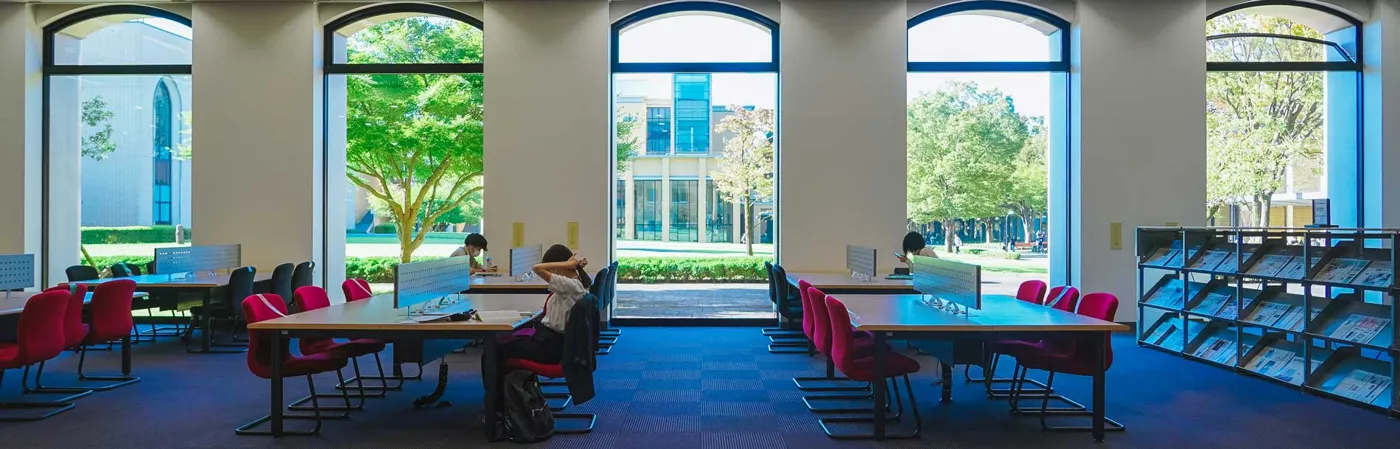
At Aoyama, the main library occupies floors within Maclay Memorial Hall. Its design combines conventional shelving with automated storage, varied study areas, group rooms and individual research rooms. The Academic Writing Center offers consultation on Japanese and English reports and manuscripts for students from undergraduate through doctoral level. International Commons, in Building 7 at Aoyama, brings together a lounge, event space and language-exchange opportunities. Its activities include social and cultural events and opportunities for Japanese and international students to study or spend time together. The university also describes a Chat Room for conversation in foreign languages. On both main campuses, the Civic Engagement Center coordinates volunteer opportunities and offers advice about participation. These facilities connect independent study, communication and engagement beyond a student's immediate academic department.
Sources: Student facilities and support ↗
Research organisation and shared facilities
The Integrated Research Organization was established in April 2018 to coordinate research initiatives across the university. Its structure brings together the University Research Institute, Project Research Institute and Liaison Center. The research institute supports academic units through internal funding, while the project institute supports externally funded work. The Liaison Center, established in 2019, connects faculty research with companies, local authorities and other potential partners. Shared technical facilities provide another form of research support. The Center for Instrumental Analysis manages equipment such as electron microscopes, X-ray instruments and Raman spectroscopy equipment for advanced scientific investigation. The Center for Advanced Technology supports work involving materials, physical properties and microfabrication. Language and media facilities also contribute to teaching and research, including audiovisual resources and computer-assisted language-learning rooms at both main campuses.
Sources: Research facilities ↗