Visa
About Aomori High School
A prefectural school with two historical roots
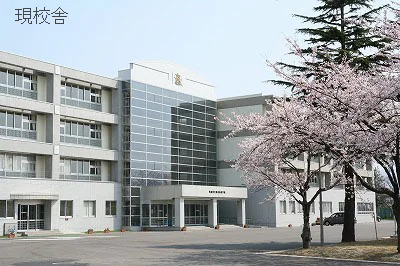
Aomori High School is Aomori Prefectural Aomori High School, a secondary school in Aomori City, Japan. Its campus address is in Sakuragawa. The present institution was established in April 1950 through the integration of the former Aomori High School and Aomori Girls' High School. Its historical roots extend further back: the boys' predecessor opened in 1900, and the girls' predecessor in 1907. Both lost their buildings during the wartime destruction of July 1945 and continued teaching in borrowed premises. After the merger, lessons initially took place across two sites. In 1951 all students were brought together at the Tsutsui premises, establishing fully shared coeducation. A later building project began in 1968, and the school's move was completed in September 1970. The institutional history also records successive reconstruction phases completed during the 2000s.
Sources: School history ↗
Educational aims and the school community
The principal's April 2026 message places the school in southeastern Aomori City, with the Hakkoda mountains behind it and Mutsu Bay in view. Its educational aims are grounded in paired principles of self-discipline and self-development, sincerity and diligence, and cooperation and responsibility. The stated goal is to develop each student's individuality alongside creative thought and the ability to act independently. The school presents intellectual inquiry and supportive relationships as complementary parts of that education. Its 2026 slogan, SMILE Seiko, connects enjoyment in taking on challenges with mutual encouragement among classmates. The message also explains the school emblem: an infinity sign surrounds the character for high school. This symbolism links the school's public identity with an ideal of continuing possibility and personal development.
Sources: Principal’s April 2026 message ↗
Science inquiry across the school years
The school's Super Science High School programme develops inquiry through a sequence extending across three years. Students move from defining a problem and proposing a hypothesis to testing it, interpreting findings and writing a paper. The programme connects subjects and draws on expertise beyond the school. Lectures bring in speakers from universities and research organisations, while science and technology seminars combine instruction with practical work. Fieldwork provides opportunities for observation and experimentation within the prefecture. Visits to companies and research institutes introduce activities beyond the classroom. An after-school laboratory offers guidance from school teachers and university staff. Students also communicate their research through presentations, including a school-wide event at which second-year students share their projects. International components involve research presentations in English and exchanges with overseas high-school or university students.
The Natural Science Club in practice
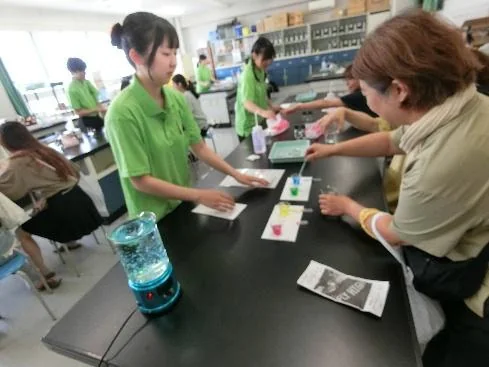
The Natural Science Club provides a further setting for sustained investigation. Its report for the 2025 academic year describes groups working in physics, chemistry, biology and earth science. Topics included small-scale hydropower using a spiral waterwheel, applications of Peltier devices, photocatalysts, tardigrade behaviour, aquatic-plant photosynthesis and water quality in the Tsutsumi River. Members accumulated data and prepared presentations for science meetings and student research events. The club also helped run the school's science classroom activities during the festival. Demonstrations and hands-on experiments included water rockets, flame reactions, bubbles, artificial fish eggs and colour changes associated with grape-skin pigments. Members taught experimental methods to other student volunteers as part of preparing these activities. The account connects patient research work with explaining scientific ideas to visitors in an accessible, practical setting.
Sources: Natural Science Club ↗
Choral music and public performance
The Music Club describes itself as a mixed choir with a history extending over seventy years. An independently organised regular concert is a central part of its activities, alongside appearances at competitions and music festivals. Members work towards understanding the music themselves and creating a coordinated performance, relating their practice to the school's principles of independence, diligence and cooperation. The club's published activity record lists its forty-first regular concert in July 2026. It also records participation by male members in a joint prefectural male choir at the 2026 national high-school cultural festival in Akita. These activities give choral singing a place in both the school's own calendar and wider cultural gatherings involving other schools.
Sources: Music Club ↗
Rowing as a team activity
The Rowing Club introduces a sporting activity centred on effort, speed and coordination on the water. Its account welcomes beginners and describes participation by students across the school years. The published competition record shows several forms of rowing, including single sculls, double sculls and coxed quadruple sculls. These formats give participants different roles, from managing an individual boat to working within a larger crew. The club reports entering prefectural spring and autumn events, high-school athletic competitions, Tohoku regional meetings and national events during the 2025 academic year. Its introduction emphasises bringing members' rowing effort together. The activity therefore combines regular practice with a competition calendar that extends beyond Aomori to other parts of Japan.
Sources: Rowing Club ↗
Investigating Aomori’s future
Aomori Sozogaku brings regional questions into the school's inquiry work. The programme uses local resources and people to explore the prefecture's challenges and possibilities. It links comprehensive inquiry and student research with education for sustainable development. Its stated aims include attachment to the region, willingness to try new approaches and the ability to participate actively in society. The school publishes annual accounts of these activities, connecting regional learning with its wider emphasis on students investigating questions for themselves.
Sources: Aomori Sozogaku regional inquiry ↗