Visa


About Aomori Chuoh Gakuin University
Graduate study connected with professional life
Aomori Chuoh Gakuin University, also written Aomori Chuo Gakuin University, is the institution known in Japanese as Aomori Chuo Gakuin Daigaku. Its graduate education brings management, law and economics into an interdisciplinary programme. The university describes this provision as serving both students continuing from undergraduate study and people returning to education after entering employment. Working professionals identified in its educational outline include company employees, public servants and teachers. Daytime and evening teaching arrangements help accommodate different study patterns. Alongside the standard two-year route, an extended study arrangement allows work to be spread across a longer period. Students whose previous education was in another field can also attend relevant undergraduate subjects to strengthen their foundations. The graduate outline distinguishes degree study from a separate research-student route.
International learning in management and law
Within the Faculty of Management and Law, the Global Human Resources Development Programme combines language learning with data science and intercultural communication. Participation involves selection using language assessment, including placement testing. The programme connects English study with seminars addressing the global economy and data analysis. Its timetable extends through several undergraduate years, bringing language preparation, special lectures and career planning into a connected sequence. The university also presents practical international experiences through accounts of students working overseas, including teaching assistance in India and regional-product market development in Singapore. These examples illustrate the different settings in which participants have applied their learning. English is therefore part of a broader educational programme that also addresses communication across cultures and engagement with economic activity.
Sources: Global human resources programme ↗
Sharing university expertise with the community
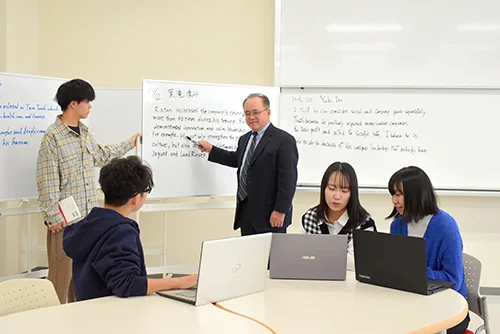
The university offers an outreach lecture service through which schools, community organisations, businesses and public bodies can request teaching from its staff. Its catalogue spans management and economics, law and administration, culture, international understanding, education and other fields. Examples include regional population decline, customer value and innovation, introductory accounting and practical data analysis. Other lectures introduce contracts, copyright and workplace law, while disaster-related offerings consider Aomori's risks and weather data. The catalogue identifies intended audiences for individual topics, ranging from school pupils to working adults. Some sessions can be delivered online through Microsoft Teams. This service gives local organisations a way to connect a particular educational interest with a member of the university's teaching community and an appropriate audience.
Sources: Community outreach lectures ↗
Using the library for individual and group work
The library separates quiet study from spaces intended for discussion and collaborative learning. Its learning commons and group rooms support students working together, while individual research rooms provide a more enclosed setting. Group rooms include tables, chairs, a monitor and a whiteboard; individual rooms have a desk, chair and reading light. The user guide also explains how the catalogue supports searching and loan renewal. Reference books, periodicals, newspapers and audiovisual materials have different circulation arrangements from ordinary lending books. When material is not held locally, users can ask about obtaining it through interlibrary services. A partnership with the prefectural library provides an additional route for requesting and returning its books. These arrangements connect study space, searching tools and access to material beyond the campus collection.
Sources: Library user guide ↗
Residential life and intercultural contact
The university's residential information treats living arrangements as part of students' wider education. It emphasises managing daily routines, maintaining shared spaces and communicating with other residents. The International Exchange Hall and Academic Exchange Hall accommodate Japanese and international students, making everyday contact across cultures part of residential life. The Academic Exchange Hall offers both individual rooms and shared arrangements in which residents have separate personal space but use common kitchen and other facilities. The International Exchange Hall has individual rooms with their own cooking and bathroom facilities. Residential rules cover communal responsibilities and personal conduct, with staff providing guidance. From the 2026 academic year, Kobushi Hall is designated for male members of the institution's specially supported sports clubs, with arrangements taking account of training and travel.
Sources: Student residences ↗
Supporting projects designed by students
A student project support scheme serves the university, its graduate school and other schools operated by the educational group. It supports activities conceived and undertaken by students themselves, including individual initiatives, seminar-based groups and established clubs starting something new. Applicants submit a plan explaining the activity, its purpose, intended achievements and budget. Selection considers originality, feasibility, interest to other students and contribution to the university or surrounding community. Reviewers also examine whether the proposed spending matches the project's content. Staff associated with the Learning Support Centre participate in assessment, with other specialists involved when the plan calls for their expertise. Selected projects can seek advice from teachers and administrative staff as they work towards their objectives. Applications are handled through the centre.
Sources: Student project support ↗
Language support as regional engagement
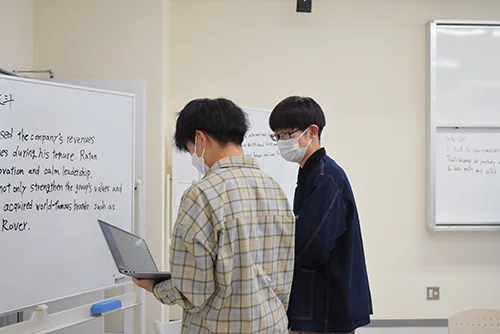
The International Language Support Centre organises opportunities for international students to assist activities around Aomori Prefecture. Its work responds to requests from schools, local authorities and international exchange organisations. Activities can include introducing students' home languages and cultures, participating in exchange events and helping with straightforward interpretation or translation. The centre links this work to earlier regional initiatives: an Aomori supporter project began in 2004, and cooperation with Towada developed through educational travel and a 2008 agreement. For requested activities, staff consider the event's purpose and select registered student supporters with suitable language abilities and interests. Preparatory discussion and training form part of the process. The centre coordinates communication between organisers and participants, connecting international student experience with local educational and cultural exchange.