Visa

About Aomori Chuo Gakuin University
A university within Aomori Tanaka Gakuen
Aomori Chuo Gakuin University is a university in Aomori, Japan, operated within Aomori Tanaka Gakuen. The university opened in 1998 with its Faculty of Management and Law. Its establishment involved reorganizing the management information department of the associated junior college, while the university and junior college retained distinct institutional identities.
The educational organization’s history reaches back to bookkeeping and sewing schools founded in 1946, followed by formal school-corporation authorization in 1956. The university’s own development continued with the Graduate School of Regional Management and a related research institute in 2004. A Nursing Faculty opened in 2014 through reorganization of the junior college’s nursing department. A separate midwifery course was added in 2018. These milestones explain how the university’s academic work developed from management and law into nursing and regional graduate education within a wider educational group.
Sources: Institutional history ↗
Studying management and law together
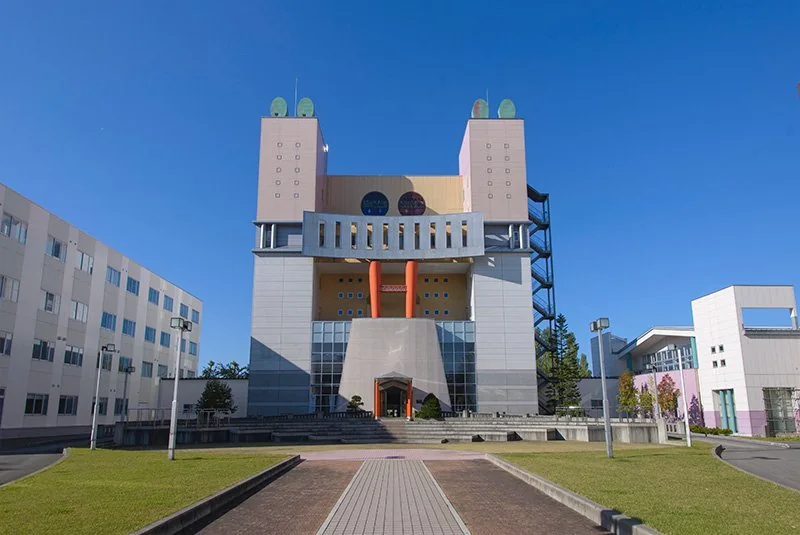
The Faculty of Management and Law presents its combination of subjects as a way to examine business and society from complementary perspectives. Management study considers business models and organizational responses to social issues, while law examines rules and possible solutions to those issues. Students therefore encounter the operation of enterprises alongside the institutional frameworks within which they work.
The faculty describes specialist programmes concerned with global careers and public-service preparation. Relevant subjects include constitutional and administrative law, politics, public finance and economics. International interaction also forms part of the learning environment, with students from Asian countries meeting through classes, seminars and exchange activities. Active-learning subjects take students beyond classroom discussion through interviews and field investigation. Regional inquiry and short overseas activities are identified as opportunities to examine social questions directly and develop practical approaches to understanding changing communities and organizations.
Nursing education through progressive practice
The Nursing Faculty emphasizes small seminars, class advisers and group learning. Teachers support students through the transition into university study, while discussions and shared research topics are used to develop communication and problem-solving skills. Active learning asks students to address questions together and work through the process of finding and assessing possible responses.
Simulation and information technology are used to create realistic educational situations. Practical learning begins with early experiential activities in the first year and progresses as students build their knowledge and skills. The faculty describes a learning environment with simulation models and on-campus practice facilities, combined with placements in different settings. Reflection on experience is an explicit part of its approach. Courses also bring regional and international perspectives into nursing study, including global society and culture, local life, international health care, health behaviour and the relationship between communities and lifestyle-related conditions.
Sources: Nursing: educational approach ↗
A shared library for independent and collaborative work
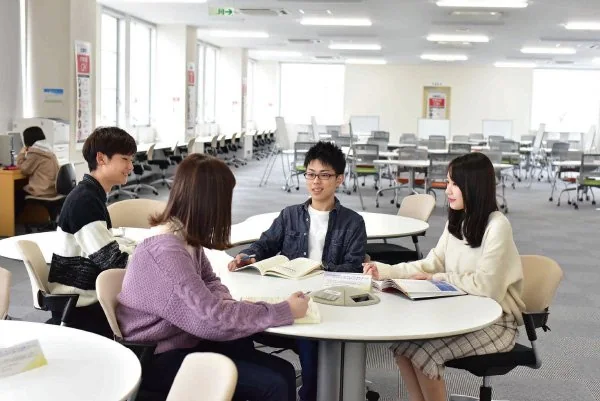
The Library and Information Center supports education and research for the university and other institutions operated by Aomori Tanaka Gakuen. It also aims to serve people in the surrounding Aomori community. Its facilities distinguish a quiet study area from learning commons where discussion and collaborative work can take place. Group study rooms, individual research rooms, computers and printers extend the range of ways students can use the building.
The collections include interactive picture books, retained for consultation within the library because of their delicate construction. Another collection brings Japanese literature to international students through Vietnamese, Thai, Chinese and Korean editions. It spans contemporary fiction and other genres, offering an additional route into Japanese writing. Bibliobattle activities invite participants to introduce books they have enjoyed to other readers, connecting reading with discussion and presentation. The library consequently combines individual study resources with spaces and activities for sharing knowledge.
Sources: Library and Information Center ↗
Support for learning and participation
The Academic Support Center assists students with foundational study, progression and extracurricular activity. For nursing students, remedial classes include biology, chemistry, mathematics and academic writing. These provide opportunities to revisit earlier subjects while building the foundations required for more specialized university work. The centre also offers information and preparation support for students considering graduate study or returning to education after graduation.
Extension courses include preparation for bookkeeping and retail-marketing examinations. Beyond formal classes, the centre helps new clubs establish themselves and supports recruitment and operation of existing groups. It circulates information on volunteering and experiential activities organized through regional partnerships. Campus work-study roles described by the centre include library assistance, learning-commons tutoring, support at university events and translation. This range places academic advice, student-led activity and opportunities for practical involvement within a common support framework serving different aspects of university life.
Sources: Academic Support Center ↗
Regional research and exchange of knowledge
The Regional Management Research Institute was established in April 2004 alongside the university’s graduate school. Its work covers regional economic and industrial questions, management, politics, public administration, law, society and culture, as well as wider global issues. The institute describes an intention to work with surrounding communities and contribute research to their development.
Its activities include conducting investigations and publishing findings, building networks with other research organizations, and undertaking collaborative research. Public lectures, symposia and seminars provide ways to discuss timely subjects beyond specialist research circles. The institute also identifies commissioned investigations and planning work for public agencies, organizations and companies, together with coordination and advice supporting regional industry and society. Publications and online communication help circulate this work. The combination connects graduate-level expertise with research cooperation, public discussion and questions arising in the wider region.