Visa

About Amman Arab University for Higher Studies
The postgraduate institution behind the historical name
Amman Arab University for Higher Studies is a historical name associated with the Jordanian institution now known as Amman Arab University. The university’s official English history renders its original name as Amman Arab University for Graduate Studies. It describes a private, nonprofit university established in November 1997 with a focus on master’s and doctoral education.
The history records approval to begin teaching in September 1998 and the arrival of the first students in the second semester of the 1999–2000 academic year. It identifies 2009 as a turning point: bachelor’s programmes were introduced and the name changed to Amman Arab University. The earlier postgraduate title therefore belongs to an initial phase of the same institution.
Today’s university is located on Jordan Street in the Mobus area north of Amman. Its historical account dates completion of the newer campus to the 2013–2014 academic year.
Sources: The postgraduate institution behind the historical name ↗

Research, community service and institutional development
The current university’s mission brings education and research together with community service and sustainable development. Local and international partnerships, as well as the use of technology, are identified as means of supporting that work. Its published goals continue to include postgraduate studies, connecting the institution’s current direction with its original specialization.
The goals also address the quality of teaching, development of staff, facilities and digital infrastructure. The university describes an environment intended to encourage innovation and creative work, while extending cooperation beyond the campus. Its stated values include transparency and accountability alongside leadership and quality in the performance of institutional work. These priorities describe the organizational framework within which the university now delivers a broader range of education than the original graduate-only institution.
Sources: Research, community service and institutional development ↗
A library for teaching and scholarly work
The library’s own account dates its establishment to 1999, during the university’s early postgraduate period. It describes subsequent growth in collections, space and services. The materials identified include books, print and electronic references, Arabic and foreign-language periodicals, dictionaries, encyclopedias, scientific theses and dissertations.
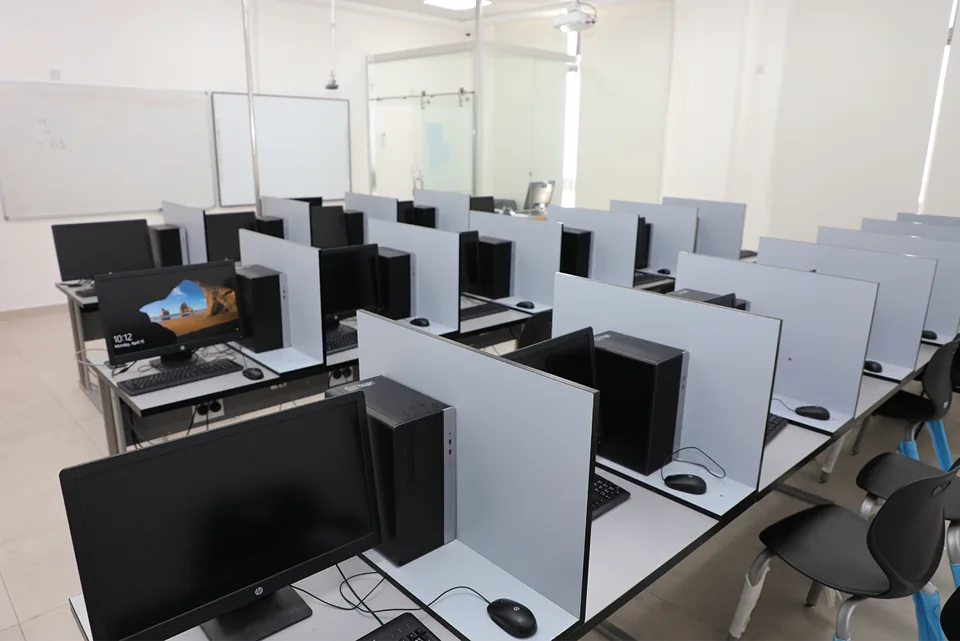
The department describes two halls with different functions. One contains books covering a range of subjects, while the other contains reference resources such as periodicals, encyclopedias, dictionaries and theses. Computers with internet connections are available for students and academic staff. These physical spaces complement electronic databases and other online materials. The library’s stated role is to support both teaching and research, making it relevant to the university’s earlier postgraduate identity and to its current academic community.
Digital systems supporting the contemporary university
The present-day Information Technology and Communication Center provides services across the academic and administrative sides of the university. Its responsibilities include maintaining and updating network infrastructure and university systems, with attention to information security. It also develops administrative and academic applications and manages the university’s official websites.
The center describes training for faculty and administrative staff, together with electronic services used by students and employees. Its published account also notes the integration of artificial intelligence services into systems under development, with the aim of simplifying processes and improving the user experience. This is an account of the current university’s digital support work. It shows how technical infrastructure and staff development accompany the teaching and research activities that have continued through the institution’s change of name and scope.
Sources: Digital systems supporting the contemporary university ↗
Language education across disciplines
The Languages and Translation Center traces its origins to 2001. It is described as an academic unit associated with the Faculty of Arts and Sciences and serving students from different disciplines. Its responsibilities include university English-language requirements and work on students’ language performance.
The published course examples include comprehensive English, conversation and translation, together with preparation related to language examinations. The center also teaches Arabic-language university requirements. Placement testing is used to determine the level of courses a registered student should take. Its organizational information identifies language teaching, translation and proofreading, and Arabic for non-native speakers among its areas of work. This makes the center a shared academic service rather than a provision limited to one degree subject.
A later addition in technical education
The Technical College represents a much later stage in the university’s development. Its official introduction states that it began its academic journey in the 2024–2025 year. The college describes an approach that combines academic knowledge with applied learning and practical training.
Its stated educational direction includes technical diploma and bachelor’s programmes, as well as BTEC programmes in cooperation with Pearson in the United Kingdom. The introduction presents this as the portfolio the college seeks to offer. It places emphasis on relationships with specialized companies and institutions and on opportunities to learn through practical experience. Innovation and changing scientific and technological needs are also part of its stated purpose. This technical-education initiative belongs to the contemporary Amman Arab University, after the expansion beyond its original postgraduate remit.
Consulting and training beyond degree study
The Consulting and Training Center provides another way in which the university connects academic work with the wider community. Its introduction states that it was established through a decision of the Board of Deans. The center’s purpose includes helping young people develop scientific knowledge and practical skills.
The same account identifies support for public and private institutions through training intended to improve employee capabilities. It describes an interest in developing human resources in Jordan and the wider Arab region, with attention to talent, ideas and the results of learning. Its published structure distinguishes training from studies and consultations. These functions extend the university’s educational role beyond the formal degree programmes that define its academic colleges.