Visa

About Al al-Bayt University
Identity, setting and establishment
Al al-Bayt University is a Jordanian university on the outskirts of Mafraq, northeast of Amman. Its campus brings academic facilities, student housing and social services together on one site. The institution was established by a Royal Decree issued on 17 August 1992. A special royal committee was subsequently formed to lay its foundations and address operational and administrative matters, followed by the appointment of the first president in 1993.
The university received its first students on 1 October 1994, after developing its infrastructure, recruiting academic staff and defining its programmes. Its formal inauguration took place on 6 March 1995. These separate milestones distinguish the legal establishment of the institution from the start of teaching. Its founding mission connects scientific approaches to teaching and research with principles including freedom, justice, tolerance, respect for different beliefs and coexistence.
English language and literary studies
The Department of English Language and Literature forms part of the Faculty of Arts and Humanities. Established in the 1995/96 academic year, it offers a bachelor’s degree in English Language and Literature and master’s study in literature and linguistics. Its academic objectives combine language proficiency with the study of literary texts and linguistic ideas.
Translation and comparative approaches to language and literature receive particular attention in the department’s description of its academic plan. This connects language study with the university’s interest in communication between peoples and cultures. The combination of undergraduate and graduate programmes allows the department’s subject area to extend from developing language capabilities to more specialised investigation of literature and linguistics.
Earth sciences and environmental education
The earth and environmental sciences academic unit dates from 2001. Its published overview connects education in these subjects with research on water, the environment and the earth. The undergraduate programmes listed are Applied Earth and Environmental Sciences, and Geographic Information Systems and Remote Sensing. Master’s-level fields include Applied Geology, Water Resources and Environment, and Geographic Information Sciences.
This group of subjects brings physical investigation of the environment together with spatial information methods. The university’s overview describes the preparation of students and specialists with scientific capabilities in earth and environmental disciplines. Its programme structure provides examples of the relationship between subject teaching, environmental questions and the tools used to study landscapes and resources.
Sources: Earth and Environmental Sciences academic overview ↗
Applied research in water and the environment
The Environment, Water and Energy Research Center was established in early 2009 to support applied research and community service. Its stated activities include studying and managing water resources, organising conferences and seminars, and providing training in water and environmental analysis. The centre identifies laboratory areas for water and wastewater, solid materials and organic materials.
Its water-analysis laboratory page lists inductively coupled plasma spectroscopy, atomic absorption spectrometry, flame photometry and ultraviolet-visible spectrophotometry. The descriptions concern identifying elements and measuring concentrations in samples, including metals and dissolved substances. These facilities give a concrete account of the analytical methods represented within the university’s environmental research structure. They complement academic programmes concerned with water resources and the environment through the examination of materials and samples.
Sources: Environment, Water and Energy Research Center ↗ · Water analysis laboratories ↗
Support for scientific research
The university’s combined research and graduate studies deanship began with the start of teaching in 1994. Scientific Research became a separate deanship in 2005. Its responsibilities include encouraging original research, developing cooperation with scientific institutions and helping researchers obtain the resources needed for their work. It proposes annual research plans and maintains information about ongoing and completed projects.
The deanship’s published objectives also cover evaluating and following up research projects, coordinating work between departments, faculties and institutes, and supervising externally supported projects. It considers requests for financial and logistical support through the Scientific Research Council. Publication of approved books, scientific reports and journal research is part of this remit, alongside supporting research groups and promoting research ethics. This provides an organisational framework for scholarly activity across the university.
Sources: Deanship of Scientific Research: responsibilities ↗
Library collections and study resources
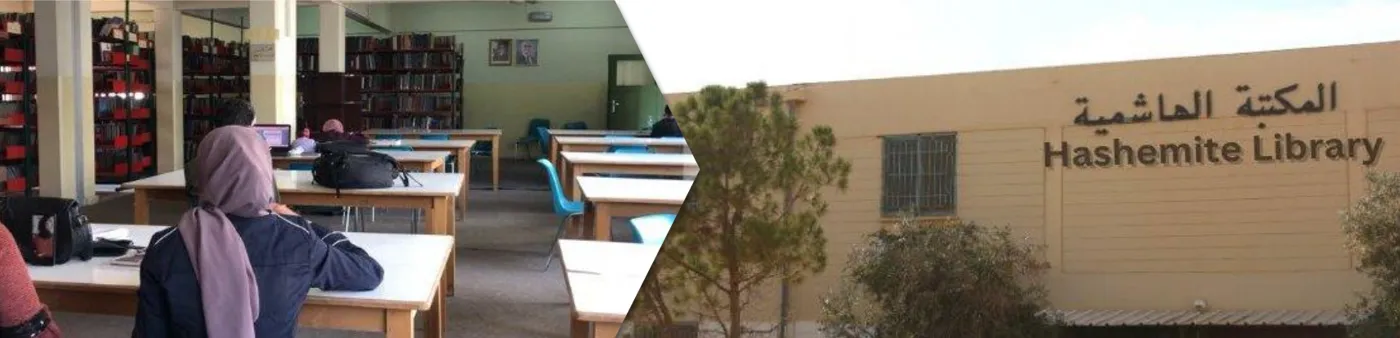
The Hashemite Library began providing services in the 1994/95 academic year. Its institutional introduction describes collections in both physical and electronic formats, including books, periodicals and electronic books. It also identifies international databases containing full-text scholarly research across different disciplines, accessible through the university’s internet network.
The library’s described physical arrangement includes a main building and a reference-hall building, together with supporting branch collections in some faculties and deanships. This links central information resources with the needs of particular academic units. Its role is to maintain access to different forms of information for university study and research, combining printed collections with electronic sources that can support work across subject boundaries.
Sources: Hashemite Library introduction ↗
Student affairs and participation
The Deanship of Student Affairs was established in 1994 to receive students at the beginning of university life and support their participation in the institution and local community. Its departments cover student services and welfare, cultural, artistic and social activity, sports, graduates, educational and social guidance, and career guidance associated with the King Abdullah II Fund for Development.
This structure brings practical student concerns together with opportunities for cultural expression, sport and community involvement. The deanship also describes maintaining communication with students after graduation. Its remit therefore extends across different stages of the university experience, from arrival and engagement in campus activities to continuing contact as graduates. These services sit alongside academic departments and research units within the university’s institutional organisation.
Sources: Deanship of Student Affairs overview ↗