Visa

About Amman Arab University
From postgraduate institution to a broader university
Amman Arab University is a private, nonprofit institution in Jordan. Its institutional history records establishment in November 1997 under the name Amman Arab University for Graduate Studies, followed by approval to begin teaching in September 1998. The first group of students arrived in the second semester of the 1999–2000 academic year. Its initial focus was postgraduate education at master’s and doctoral levels.
A second phase began in 2009 when the institution introduced bachelor’s programmes and adopted the shorter name Amman Arab University. Its campus is on Jordan Street in the Mubis area, north of Amman. The university dates completion of its new campus to the 2013–2014 academic year. Its introduction connects education with research and community service, while emphasising critical thought, creativity and cultural interaction. This history explains both its origins as a postgraduate institution and the subsequent expansion of its educational role.
Sources: From postgraduate institution to a broader university ↗
Institutional aims and values
The university’s mission connects teaching, learning and research with service to the community and sustainable development. It identifies technology and relationships with local and international partners as means of advancing this work. Its stated goals include improving teaching, strengthening postgraduate study and research, developing facilities and digital infrastructure, and supporting the people who work within the institution.
The values accompanying that mission are leadership, excellence, transparency and accountability. The university explains leadership in terms of finding creative ways to accomplish work, and links transparency with clarity and objectivity. Accountability involves accepting responsibility for decisions. These statements describe the institution’s intended priorities and standards. They bring together the academic work of a university with the organisational systems and conduct needed to support its students, staff and wider community.
Sources: Institutional aims and values ↗
Library collections and study resources
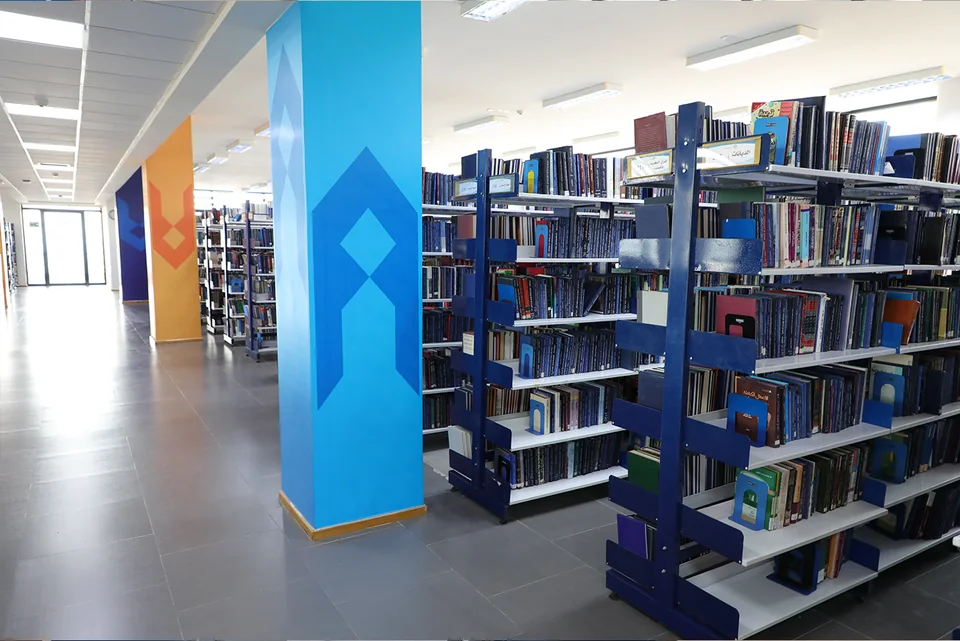
The university library supports teaching and research through a combination of printed and electronic information. Its collection description includes books, references, Arabic and foreign periodicals, dictionaries, encyclopaedias, theses and dissertations, alongside electronic databases. Computers connected to the internet provide another way for students and faculty to use information resources.
The library describes two halls with different collection functions. One contains books across fields of knowledge; the other accommodates reference materials such as periodicals, encyclopaedias, dictionaries and theses. This arrangement distinguishes general collections from materials used for consultation and research. The department’s website also provides routes to its catalogue, services, recently received material, thesis abstracts and electronic library. For students, these resources connect reading for courses with the wider process of finding published research and examining earlier academic work.
Sources: Library collections and study resources ↗
Information technology across university life
The Information Technology and Communication Center maintains digital systems used in academic and administrative work. Its responsibilities include network infrastructure, data rooms and information security, as well as developing and maintaining university systems. The centre also manages the institution’s official websites and supports electronic services for students, faculty and administrative personnel.
Its work extends beyond maintaining equipment. The centre describes training programmes for academic and administrative staff, connecting technical provision with the ability to use it. It also oversees campus access-control and surveillance systems. Its current account identifies the integration of artificial intelligence services into systems it develops as a recent direction, intended to simplify processes and improve users’ experience. The centre therefore supports both the infrastructure behind university operations and the digital interfaces through which members of the university conduct everyday tasks.
Language study and translation
The Languages and Translation Center was established in 2001 and is associated with the Faculty of Arts and Sciences. It serves students from different disciplines rather than being limited to a single degree programme. One responsibility is teaching English-language university requirements, with the aim of improving students’ ability to use English during their studies.
The centre also describes comprehensive English courses, conversation study, translation and preparation for national language examinations and TOEFL. Arabic-language university requirements are organised at different levels, with placement testing used to identify the courses a student should study. Its website identifies separate areas concerned with translation and proofreading, language study, and Arabic for non-native speakers. This provision places language development within the university’s academic support structure, alongside disciplinary teaching and other learning resources.
Sources: Language study and translation ↗
A developing technical education pathway
The Technical College began its academic work in the 2024–2025 academic year. Its introduction describes an approach that combines subject knowledge with applied learning and the development of practical skills. The college frames this work around technical education and the changing needs of employers in Jordan and beyond.
The college’s stated development aims include technical diploma and bachelor’s programmes and international BTEC study in cooperation with Pearson in the United Kingdom. Its introduction also describes practical training with specialist companies and institutions as part of its intended educational approach. These are the ambitions presented in the college’s own account of its development. The emphasis is on bringing academic study into contact with practical tasks, while encouraging innovation and responding to changes in science and technology.
Continuing education and professional development
The Consulting and Training Center adds a further strand to the university’s educational work. Established by a decision of the Board of Deans, it focuses on helping young people acquire knowledge and skills and on supporting public and private institutions with employee development. Its account links training with improving the abilities of Jordanian and Arab professionals. The centre’s structure includes a training division and a studies and consultations division, bringing organised learning and advisory work into this part of the university’s provision.
Sources: Continuing education and professional development ↗