Visa


About Alexandru Ioan Cuza University
A university in Iași
Alexandru Ioan Cuza University is based in Iași, Romania, and is commonly known by the abbreviation UAIC. Established in 1860, it combines undergraduate, master's and doctoral education with research and international cooperation. Its institutional account identifies membership in networks including the Coimbra Group, the European University Association, the Utrecht Network, the International Association of Universities and the University Agency of Francophony. These relationships support academic exchange and joint educational and research activity. The university's research portfolio encompasses nationally funded investigations and international programmes, including Horizon Europe, Digital Europe and COST cooperation. Its account also describes research training and support for young researchers alongside collaborative projects.
Sources: About the university: studies, cooperation and research ↗
From the 1860 inauguration to later reforms
The University of Iași was formally inaugurated on 26 October 1860. It initially comprised Law, Philosophy and Theology, developing from the city's longer tradition of academic and cultural activity. The university's history places this foundation in the context of nineteenth-century Romanian state formation and the growth of Romanian-language education. Its organisation changed repeatedly after 1948, as higher education was reshaped under the postwar political system. The historical account then identifies December 1989 as a turning point, followed by reconstruction involving curricula, institutional structures, communication and staffing. University autonomy and renewed European contacts form part of that account of its subsequent development.
Sources: Short history of the university ↗
The University Palace and its public spaces
A prominent part of the university's architectural heritage is the University Palace. Its foundation ceremony took place on 23 May 1893, and the building was inaugurated on 21 October 1897. Designed by the French architect Louis Blanc, it employs a French eclectic style. Inside, the Hall of the Echoing Footsteps is associated with the murals of Romanian artist Sabin Bălașa. Painted between the late 1960s and early 1980s, the series addresses themes including youth, history and poetry. Bălașa later painted The Galaxy of Love in the Mihai Eminescu Aula Magna in 2002. The palace thus combines university architecture with a substantial artistic environment.
Sources: University Palace and Hall of the Echoing Footsteps ↗
Computer science teaching and research
The Faculty of Computer Science was established in 1992. Its current official profile lists undergraduate study in computer science and artificial intelligence, including an English-language computer science option. Master's fields include software engineering, distributed systems, information security, computational optimisation and computational linguistics, alongside doctoral study. The faculty describes optional subjects such as mobile programming, cloud computing, game development, cryptography and embedded systems. Research activity includes natural-language processing, web technologies, evolutionary computing, formal methods, distributed systems and combinatorial optimisation. Lectures and seminars are complemented by conferences and activities involving the student association and local technology companies, connecting academic work with Iași's wider computing community.
Sources: Faculty of Computer Science ↗
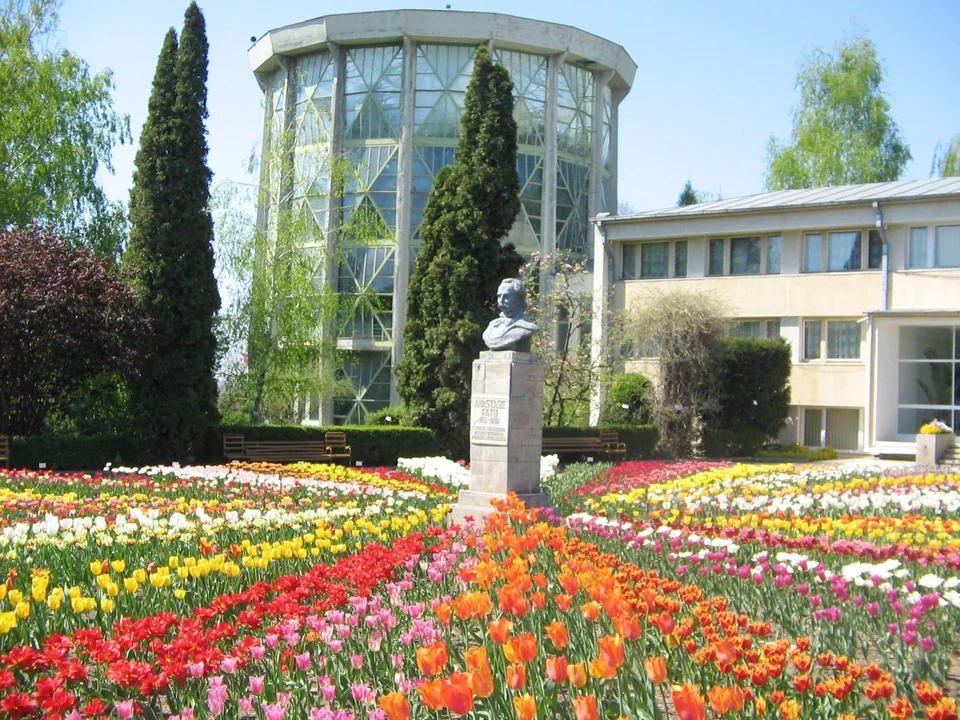
The Anastasie Fătu Botanical Garden
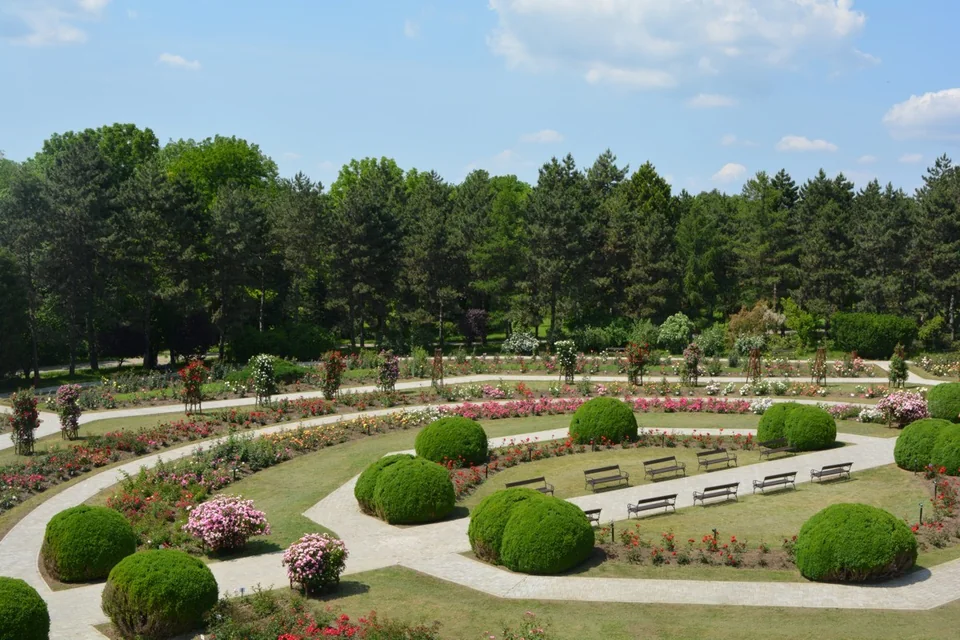
The university's botanical garden takes its name from physician and naturalist Anastasie Fătu, who founded it in 1856. Development at its Copou Hill location began in 1963. Its collections bring together plants from different geographical regions in outdoor sections and greenhouses. Sections address systematic botany, Romanian vegetation, world flora, useful plants, woody species, ornamental planting and roses. A subsection uses fragrant plants and Braille descriptions for visitors with visual impairments. Beyond public displays, the garden includes a herbarium, specialist library and museum collections of fruits, seeds and wood specimens. Its micropropagation and germplasm-conservation laboratory adds plant-tissue cultivation and preservation to its scientific activities.
Sources: Anastasie Fatu Botanical Garden ↗
A museum of academic life and archaeology
The University Museum at 12 Titu Maiorescu Street brings institutional history and archaeological research into a shared setting. Its academic collection includes documents, photographs, medals, university symbols, furniture and material illustrating the development of disciplines and laboratories. Among the historical objects are the silver hammer and trowel associated with the 1893 foundation ceremony of the University Palace. A separate collection presents the Cucuteni civilisation through material from archaeological investigations and other collections. Exhibitions explore artistic production, tools, dwellings and objects of worship, alongside the processes of excavation and restoration. The museum also describes a scholarly role involving research into higher education, academic culture, scientific meetings and publication.
Sources: Museum of Alexandru Ioan Cuza University ↗
Libraries and subject collections
UAIC's library guide introduces the Mihai Eminescu Central University Library, founded in 1835 as the library of the Mihăileană Academy. Its resources include books, electronic databases and special collections containing manuscripts, older books, maps, prints and archival material. Reading spaces and subject branches connect this wider resource with university disciplines. The guide lists libraries serving biology, physics and chemistry, mathematics, computer science, law, history, letters, economics and other fields. An online catalogue helps readers locate material before visiting. The guide also presents the affiliated Austria Library, inaugurated in 2010, with holdings centred on Austrian literature and Central European cultural history and activities such as author meetings, films and exhibitions.
Sources: University library resources ↗
Publishing academic work
The university publishing house edits, prints and distributes scientific, educational and cultural work by members of the academic community. Its description distinguishes scholarly books, lecture courses and learning materials, and periodicals such as journals, annals and yearbooks. The publishing operation also produces university-related material and distributes books through its bookshop. Its website provides information about publications, including descriptions, covers and technical details. This activity complements classroom teaching, museum scholarship and the university's broader research work by providing an institutional route for preparing and circulating written knowledge. The publishing house is listed at Pinului Street in Iași.
Sources: University publishing house ↗