Visa

About Aizu Hokurei High School
A Christian high school in Aizuwakamatsu
Aizu Hokurei High School is a secondary school in Aizuwakamatsu, Fukushima Prefecture, Japan. Its address is 3-2 Aioimachi. The school combines a general academic department with a mechanical department offering an automotive technical course. Its educational work is directed towards the three years of high school and students’ subsequent progression into further study or employment.
The school traces its foundation to 1923 and the work of its founders, the Ishiyama couple. Its founding principles centre on philanthropy, freedom and equality. Christian religious education forms part of a broader emphasis on character, independent thought, consideration for others and individual development. Its published goals connect physical health and determination with appreciation of truth and justice, and with the ability to set clear goals and work towards them.
Sources: School profile, founding principles and learning environment ↗
General academic study
The special advancement course within the general department provides humanities and science choices connected with students’ intended progression. The school describes small-group teaching and additional practice in Japanese, mathematics and English. These arrangements support subject development while giving students opportunities to work on the demands of university entrance examinations.
Saturday courses, holiday study sessions and digital learning materials supplement ordinary lessons. The course page identifies Study Sapuri as a resource for preparation outside school, including work associated with external mock examinations. University visits and talks form another part of the programme. Bible classes, language qualification study and opportunities for overseas learning also appear in its description of active learning, placing academic preparation within a wider educational setting.
Automotive and manufacturing education
The automotive technical course combines vehicle-related learning with manufacturing skills. Its published practical work begins in the first year and includes computer-aided design, technical drawing, milling, turning, casting and welding. These subjects give students experience of making and examining components as well as learning about completed vehicles.
The course description also recognises the importance of computing in modern vehicles, including engine control and driver-support systems. It identifies information technology and CAD-related study alongside mechanical practice. Vehicle disassembly, fault identification and reassembly are described as elements of the teaching. Preparation for relevant industrial and automotive examinations forms part of the course’s professional orientation, while the curriculum remains a high school programme with both theoretical and practical components.
Sources: Automotive technical course ↗
Clubs, creativity and school events
The school’s clubs extend across sport, technical interests, culture and community activity. Its automotive club connects vehicle construction with participation in competitions, while the science inquiry club describes experiments, robot building and applications created with JavaScript and Python. A manga and animation group works with digital illustration, computer graphics and costume production.
Other published activities include handbells, English, poetry-card games, volunteering and Bible study. Sports provision includes baseball, basketball, badminton, soft tennis and table tennis among other activities. The annual events outline brings together entrance and graduation ceremonies, school competitions, study sessions, excursions and disaster-preparedness exercises. These opportunities give students settings for teamwork, creative practice and participation beyond their timetabled subjects.
Sources: Clubs and school events ↗
Planning the next educational step
Career support is described as a process running through all three school years. The school identifies self-analysis, future planning, problem finding and problem solving as part of helping students consider their direction. Guidance includes university visits, talks and advice about both further study and employment. The published approach therefore connects choices after graduation with reflection and preparation during high school.
A report on September 2026 visits shows how this operates in practice. Second-year special advancement students visited Fukushima University, general-course students visited Tohoku Gakuin University and automotive technical students visited Niigata Institute of Technology. Activities included institutional explanations, facility visits and opportunities to encounter university teaching or research. These were exploratory educational visits, giving different student groups a closer view of possible future learning environments.
Sources: Career and further-study support ↗ · Second-year university visits, September 2026 ↗
Learning through local Christian history
First-year students visited Aizuwakamatsu Church in an activity reported in October 2026. The visit connected the school’s Christian educational setting with the history of the surrounding city. A pastor introduced the students to the relationship between Aizu, Doshisha founder Joseph Hardy Neesima and his wife Yae, and the development of the local church.
The school’s account describes students seeing an example of Yae’s handwritten poetry and asking questions during the visit. For some, it was their first experience of entering a church. The activity brought historical material and a local religious institution into the students’ learning, extending discussion beyond the classroom and the school’s own grounds.
Sources: First-year local church visit, October 2026 ↗
A cultural lecture and questions about peace
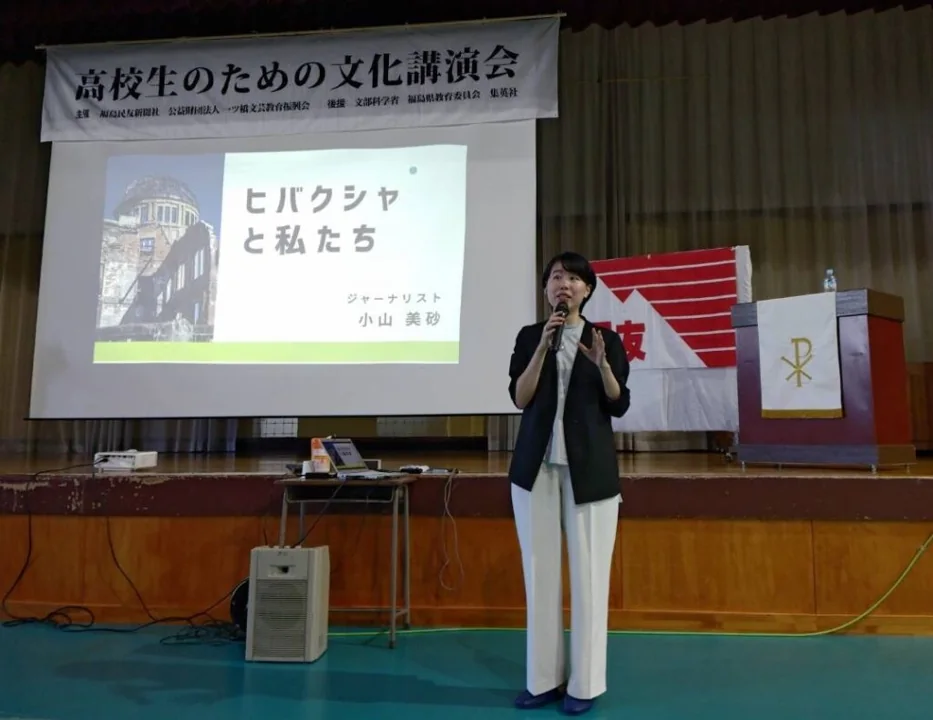
A September 2026 cultural lecture brought journalist Misa Koyama to the school to speak about people affected by nuclear weapons and their continuing experiences. Her presentation included reporting from overseas, giving students material for considering the subject beyond a solely domestic perspective. Students asked questions about nuclear weapons and peace education after the talk.
The report also records the donation of the speaker’s books, a selection of paperback titles and a Japanese dictionary. This connected the event with reading resources students could use afterwards. The lecture illustrates the school’s use of invited speakers to introduce public issues and encourage questions, alongside its regular academic, technical and religious education.
Sources: Cultural lecture by journalist Misa Koyama, September 2026 ↗