Visa
About Aino University Junior College
History and current identity
Aino University Junior College is a nursing-focused junior college in Osaka, Japan. Its current official campus is the Osaka Abeno Campus in Fuminosato, Abeno Ward. The college’s campus introduction records its move and renewal in April 2025.
The junior college opened in 1985 as Aino Gakuin Junior College. An advanced course was established in 1993, and a second nursing department followed in 2007. In 2012 it adopted the Japanese name now used for Aino University Junior College. The operator’s history records the establishment of the current two-year and three-year nursing courses in 2025. The junior college and the four-year Aino University have separate academic provision within the same educational organisation.
Sources: 沿革 | 学校法人藍野大学について | 学校法人 藍野大学 ↗ · 藍野大学短期大学部:阿倍野キャンパス ↗
Learning at the Abeno campus
The current campus address is 3-15-47 Fuminosato, Abeno Ward, Osaka.
The official interactive tour covers five floors and a cafeteria. It provides panoramic views of the library, a lecture room and the learning commons. These spaces show the combination of scheduled teaching and places for independent or collaborative study. The library and learning commons are presented as identifiable facilities within the current Abeno campus, rather than as resources at the separate university campus.
Sources: 藍野大学短期大学部:阿倍野キャンパス ↗
An educational philosophy centred on people
The college’s philosophy connects professional knowledge with concern for people. Its parent organisation describes its founding spirit through the idea of loving wisdom, combining intellectual enquiry with human understanding and continuing self-development. The associated educational tradition asks healthcare professionals to consider both a person’s illness and their experience of suffering.
Another central idea is cooperation across professions. The organisation uses the term Sym-medical for patient-centred teamwork involving nursing, rehabilitation, health and welfare specialists. Within the junior college, this translates into educational goals that extend beyond technical procedures. Understanding another person, responding with empathy and considering the social circumstances surrounding health are part of the college’s stated approach to nursing education.
Sources: 教育理念 | 藍野大学短期大学部 大阪阿倍野キャンパス ↗
The three-year nursing route
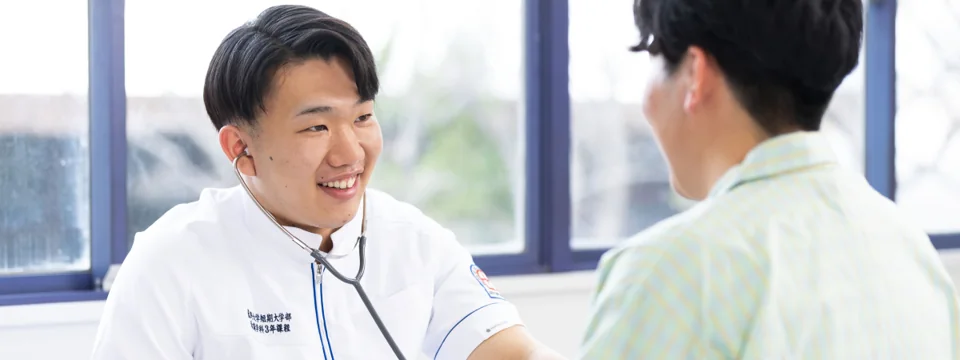
The three-year nursing course is designed for students beginning their nursing education after secondary school or other life experience. Its published programme totals 102 credits and combines professional nursing study with general education. Subjects such as human studies, Japanese culture and flower arranging sit alongside scientific and clinical foundations.
The first year includes anatomy and physiology, biochemistry, psychology, statistics and introductory nursing. The second year develops more specialised study, including public health, counselling psychology and disaster and international nursing. Third-year learning brings together nursing research, management and substantial placements in different areas of practice. The course description explains that students use their placement experiences in research classes to develop and examine their own understanding of nursing. Classroom learning, exercises and supervised practice therefore form successive stages of the programme.
Sources: 看護学科3年課程 | 藍野大学短期大学部 大阪阿倍野キャンパス ↗
The two-year nursing route
The two-year course serves a different starting point: students progressing from Japan’s assistant-nurse route. It concentrates professional learning into two full-time years while retaining attention to ethics, human relationships and the role of nursing within a healthcare team.
First-year subjects include medical mathematics, written expression, information science, anatomy and physiology, pathology, pharmacology and nursing foundations. Students then undertake more extensive practice across areas including adult and older-person care, children’s nursing, maternity nursing, mental health and community or home nursing. The published second-year curriculum also includes nursing management and international and disaster nursing. Teaching draws on the college’s own staff and specialist practitioners. Tutor support accompanies the programme, giving students a means of discussing their progress as they move from foundational study to more integrated practical work.
Sources: 看護学科2年課程 | 藍野大学短期大学部 大阪阿倍野キャンパス ↗
Community health nursing after initial training
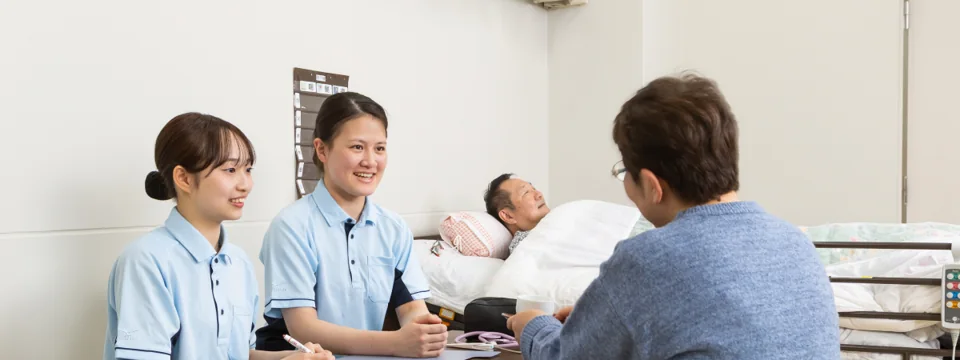
The advanced course in community health nursing provides a one-year programme for people moving from nursing into public health nursing education. Its academic range includes epidemiology, health statistics, health and welfare administration, community health nursing methods and research.
Learning takes place across community, workplace and school settings. The published placement structure includes continuing visits to people living locally, experience in public health offices or municipal health centres, and study of health-management activities in workplaces and schools. Students consider how organisations and professions cooperate as well as how individuals and families experience health. A research component asks students to investigate a public health nursing topic, produce a paper and present their findings. Health-education exercises also involve group preparation of plans, scenarios and teaching materials.
Support for study and student wellbeing
The college’s student-support arrangements recognise that learners arrive with different backgrounds, including recent school experience and previous working lives. Scheduled office hours make full-time teaching staff available for questions about classes, course choices and future plans. This provides a defined opportunity to seek help outside a timetabled lesson.
A school counsellor, described as a clinical psychologist, offers consultations in a private setting. Academic support also includes online learning tools accessible by computer, tablet or smartphone. These are intended for preparation and revision, allowing students to return to material outside the classroom. Together, the arrangements address academic questions, everyday concerns and flexible access to learning resources.
Sources: 学生サポート | 藍野大学短期大学部 大阪阿倍野キャンパス ↗
The rhythm of the academic year
The annual calendar combines academic milestones with opportunities to meet classmates and participate in college life. April includes the entrance ceremony, a social gathering, health checks, evacuation training and the beginning of first-semester classes. The calendar places first-semester examinations in July and the summer break in August.
Later activities include sports recreation, the college festival and further practice periods. Community health nursing research presentations appear in December, followed by second-semester examinations in January. Degree and completion ceremonies close the cycle in March. This pattern places social events, research reporting, practical learning and formal assessment within the same academic year.
Sources: 年間スケジュール | 藍野大学短期大学部 大阪阿倍野キャンパス ↗