Visa


About Aikoku Gakuen Junior College
A women’s junior college in Tokyo
Aikoku Gakuen Junior College is a women’s junior college at 5-7-1 Nishikoiwa in Tokyo’s Edogawa Ward. Its education is centred on home economics, practical life skills and food and nutrition. It belongs to the Aikoku Gakuen educational organization, which also operates other schools. The junior college’s Koiwa campus is distinct from Aikoku Gakuen University in Yotsukaido, Chiba.
The educational organization traces its origins to a foundation established in 1938 and a girls’ commercial school opened in 1939. The junior college opened in Edogawa in 1962 with home economics provision. Its original Japanese name included the word women’s; the present institutional name was adopted in 1970. Home economics was divided into separate home economics and food nutrition specializations in 1985. The former became Life Design in 2018, reflecting an evolving approach to everyday living and practical education.
Sources: Institutional history and educational organization ↗
Educational purpose and values
The college’s founding philosophy connects women’s knowledge and technical skills with economic independence and participation in family and community life. Kindness and honesty form its school motto. Its statement of educational purpose places practical abilities for work and daily life within that wider ethical outlook.
The Life Design specialization’s stated purpose is to develop the ability to propose and put into practice richer, more sustainable ways of living. Food Nutrition focuses on specialist food knowledge and practical abilities relevant to supporting health. These are institutional educational aims, expressed through subjects that combine classroom understanding with practical work. The college treats everyday settings, from the home to community organizations and workplaces, as contexts in which learning can be applied.
Food and nutrition through practical study
Food Nutrition combines the study of food, the human body and meal preparation with laboratory and practical classes. Published subjects include food science experiments, food processing, applied nutrition, anatomy and physiology, nutrition education and cooking practice. Experiments introduce ways of analysing food components such as proteins and fats and examining the properties of enzymes.
Cooking classes progress from basic techniques toward a wider repertoire, including Japanese and international dishes, bread, cakes and food for special occasions. Students also consider food presentation and hospitality. Graduation-related fieldwork allows students to choose a theme connected with a teacher’s expertise and investigate it through making, testing or research. The programme page gives examples such as developing an allergy-conscious cream puff and creating meal-service recipes. These examples illustrate the relationship between food knowledge and repeated practical investigation.
Sources: Food Nutrition specialization ↗
A planned development for April 2027
The college’s current programme page presents a planned Life Produce specialization beginning in April 2027, developing from Life Design. It explicitly labels the plan as under development and subject to change. The published proposal comprises Food Design, Craft Design, and Medical Administration and Care courses.
Food Design brings together cooking, confectionery, food coordination, menu planning and café-related study. Craft Design combines making accessories and other objects with digital communication and the presentation of work. The Medical Administration and Care course connects administrative knowledge with introductory study of care and welfare. The proposed structure allows students to explore foundational subjects before choosing a course after entry. Its emphasis is on planning, proposing and realizing ideas in response to people’s needs, extending the college’s established practical approach to daily life.
Rooms for cooking, experimentation and student life
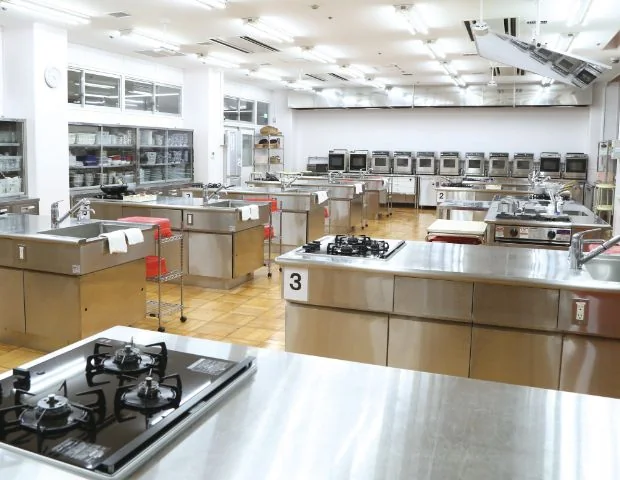
The campus’s facilities support both classroom teaching and hands-on practice. Cooking laboratories provide workstations and equipment for developing basic and applied techniques. A separate meal-service management room is used for large-scale cooking, while food and nutrition rooms support processing, breadmaking and confectionery. Laboratory spaces accommodate component analysis and instrument-based food experiments.
Other teaching spaces include a clothing practice room, an information classroom and an active learning room for group activities. A manners room is used for tea ceremony and flower arrangement teaching with visiting instructors. The library holds specialist material alongside fiction and magazines. Students also have a hall for meeting, eating and studying, and access to a career support office for individual consultations about work or further study. The wider educational complex includes a cafeteria and an auditorium used for ceremonies and events.
Sources: Campus facilities ↗
Local product development
In May 2026, the college announced a collaboration with Blueberry Farm Tokyo on a blueberry jam developed for public sale. Food Nutrition students and teachers used their subject knowledge and repeated tasting evaluations to work on the balance between sweetness and fruit content. The project connected classroom study with a local farm and a product intended for everyday use.
The college’s announcement set the launch for 6 June 2026, coinciding with the farm’s blueberry-picking opening. Its description explains that the recipe retained pieces of fruit and was considered for uses beyond spreading on bread. The educational significance lies in students taking part in recipe development, assessment and collaboration with a community business.
Sources: Blueberry product-development announcement, May2026 ↗
Learning with the local community
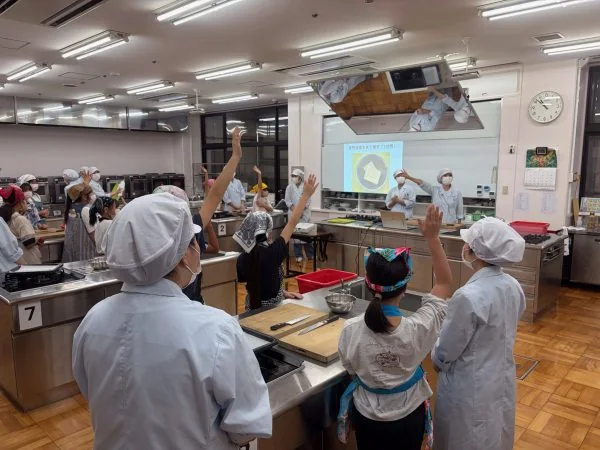
A cooking class held with Edogawa Ward on 17 October 2026 provides another example of practical community involvement. Twenty-three primary and junior high school children participated alongside second-year Food Nutrition students. The session focused on reducing food waste through recipes devised by the college students, including dishes using ingredients that might otherwise remain unused at home.
Students first explained the dishes and preparation methods, then supported participants working in groups. The event combined making and tasting food with learning about food waste and local sustainability efforts. For the college students, the report identifies opportunities to practise clear explanation, communication and attention to safety while helping younger participants cook.
Sources: Community cooking class, October2026 ↗