Visa
About Aichi University of Technology Automotive Junior College
Identity and current status
Aichi University of Technology Automotive Junior College is an automotive-focused junior college in Gamagori, Aichi Prefecture, Japan. Its campus address is 50-2 Manori, Nishihazamacho. It belongs to the Denpa Gakuen educational organisation and is distinct from the four-year Aichi University of Technology, with which it shares a campus and educational connections.
A notice issued on 1 May 2026 states that the governing board decided to stop recruiting students from the 2027 academic year, making the 2026 entrants the final intake. The notice commits the institution to continuing education, guidance and career support for enrolled students through graduation. It also addresses arrangements for issuing certificates after graduation. This is a recruitment change, rather than an announcement that teaching had already ended in 2026.
Sources: Recruitment cessation notice, 1 May 2026 ↗ · Institutional history ↗
Development of the college
The institution opened in April 1987 as Aichi Technical Junior College, with departments of electronic engineering and automotive engineering. It was renamed Aichi University of Technology Junior College in April 2000. The present automotive junior college name dates from April 2007, identifying its particular concentration on automotive education.
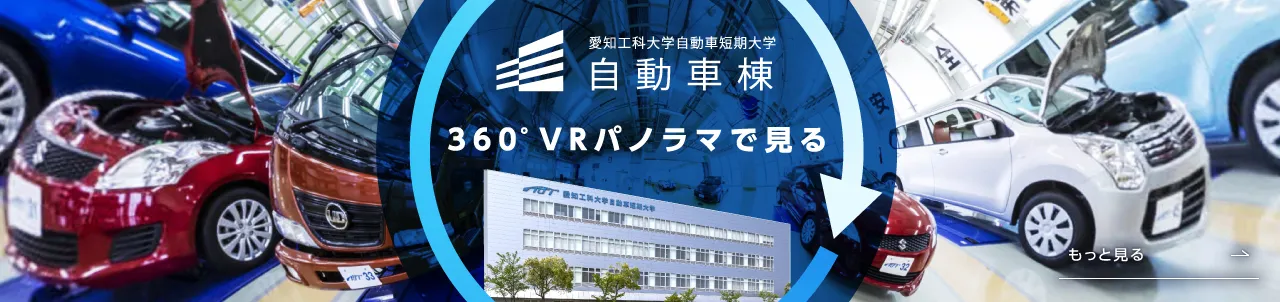
Its physical facilities developed alongside those changes. The official history records completion of renovations to Buildings 1 and 2 in March 2009 and completion of the automotive building in January 2011. These developments provided a dedicated setting for teaching that brings engineering principles together with the inspection, diagnosis and maintenance of vehicles.
Sources: Institutional history ↗
A staged automotive curriculum
The published curriculum progresses from first-year foundations to more integrated second-year work. Early subjects include engineering fundamentals, gasoline and diesel engines, chassis systems, automotive electrical systems and mechanical drawing. Practical classes introduce measurement, tools and safe working before students move into more complex assemblies and systems.
Later study includes engine maintenance, automotive materials, regulations, fault investigation and vehicle inspection. Practical topics range from transmissions and suspension to wheel alignment and electronic control systems. The curriculum also includes electric, hybrid and plug-in hybrid vehicles. This sequence connects understanding the structure of a component with observing its operation and evaluating its condition in a workshop.
The practical syllabus includes dismantling and reassembling engines, examining cooling and lubrication systems, and working with starting and charging equipment. Chassis exercises address steering, braking and differential mechanisms. Second-year inspection work introduces the handling of inspection instruments, tyre-changing equipment and wheel balancers, while truck-related teaching expands the range of vehicle systems encountered beyond those of passenger cars.
Sources: Automotive curriculum ↗
Diagnosis and communication
Fault investigation is treated as a practical process of reasoning and verification. The college’s example focuses on automotive electrical systems, including lighting, washers and wipers. Students work in small groups, consult circuit diagrams, identify possible causes and compare measurements with expected values. The purpose is to connect classroom knowledge of circuits with the process of locating an actual fault.
The assessment described on this page also considers how students explain their findings. An instructor takes the role of a customer, and students must communicate the identified problem as well as demonstrate technical accuracy. Care for the vehicle during workshop work is another part of the exercise. Technical diagnosis and professional communication are therefore taught together.
Hybrid systems and additional interests
The hybrid vehicle practical page describes learning about systems that combine an internal-combustion engine with an electric motor. It identifies control computers, the hybrid battery and battery-control systems as subjects of instruction. Its photographs and explanations place these components within actual training vehicles, linking system knowledge with supervised workshop learning.
The second-year One More Seminar, abbreviated OMS, offers elective exercises that extend students’ earlier knowledge. Published examples include comparing imported vehicles with domestic models, motorcycle maintenance, body repair and drone study. These activities cover different kinds of structure, operation and maintenance, allowing students to pursue a particular technical interest alongside the main automotive curriculum.
Sources: Hybrid vehicle practical training ↗ · One More Seminar ↗
Connections with industry
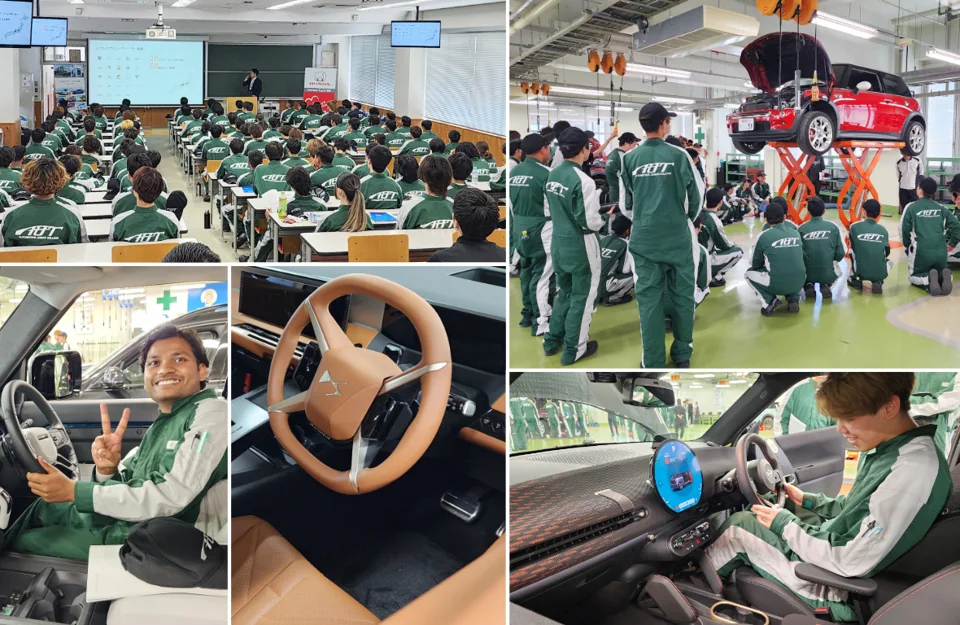
Technical workshops bring outside specialists and vehicles into the students’ learning environment. On 20 July 2026, a workshop supported by White House Group companies introduced first-year automotive students to imported cars and motorcycles. The report describes classroom explanation and practical observation of vehicle structures, equipment and maintenance considerations, with multiple manufacturers represented.
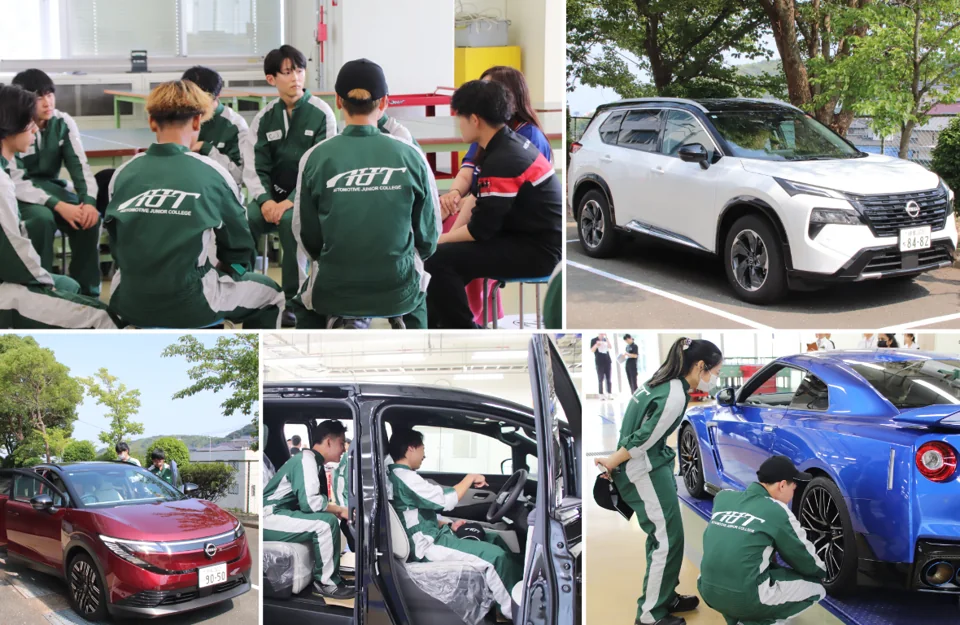
A separate Nissan workshop on 22 July 2026 involved instructors from Nissan and regional sales companies. Activities included electric-vehicle teaching, introductions to driver-assistance technologies and experience of a parking-support system using actual vehicles. A discussion with graduates added an account of day-to-day work. These dated events illustrate the college’s use of industry participation during the final intake year.
Sources: Imported vehicle workshop, July 2026 ↗ · Nissan technical workshop, July 2026 ↗
Campus facilities and educational connections
The automotive building provides a setting for work on passenger vehicles and trucks, including vehicle lifts and areas for inspection and maintenance. Elsewhere on the shared campus, the hall building includes student gathering space, an event hall and a training room. The campus facilities page also describes a manufacturing workshop with dedicated staff and computer-aided design resources.
The college’s course-pathway information connects automotive study with different educational interests. It describes both preparation for vehicle-service work and routes towards further university study. Its connection with the sister university includes opportunities for designated university subjects and individual support in mathematics, physics, chemistry and English through the general education centre. These arrangements link practical automotive education with a broader engineering foundation.
Sources: Campus facilities ↗ · Course pathways ↗