Visa
About Aichi University
Origins and educational purpose
Aichi University is a Japanese university established in Toyohashi on 15 November 1946. Its founding brought together staff and students associated with Toa-Dobunshoin University in Shanghai after that institution closed at the end of the Second World War. Kiichi Honma, its last president, played a leading role in establishing the new university in Japan. Aichi University's own foundation is therefore distinct from the earlier history of its overseas predecessor.
In 1949 the institution developed under the new university system, with law, economics and letters forming its early academic organisation. Its founding ideals connect education with cultural development and peace, an international outlook and contribution to the surrounding community. The institution subsequently expanded across several locations in Aichi Prefecture. Its history helps explain the continuing importance of China-related scholarship and international exchange alongside the social sciences, humanities and regional studies.
Sources: University history ↗
An urban campus in Nagoya
The Nagoya campus opened in April 2012 in the Sasashima Live district near Nagoya Station. It brings law, economics and business administration together with modern Chinese studies and international communication. The campus comprises research, lecture and welfare buildings and the Global Convention Hall, combining teaching, academic work and shared student spaces in an urban setting.
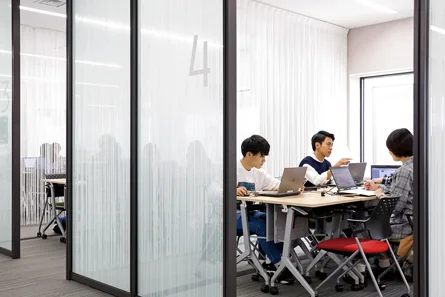
The campus guide describes classrooms of different sizes, audiovisual teaching facilities and a Learning Commons for group investigation and presentations. The Global Lounge provides opportunities for conversation with language teachers and international students. A Media Zone offers computers and group workrooms. The covered Campus Mall links buildings and accommodates community events, while the Sky Lounge supplies another place for informal interaction. The guide also identifies multilingual campus signs and natural-ventilation features as parts of the design.
Sources: Nagoya campus ↗
Toyohashi and the wider campus network
Toyohashi remains an important setting for the university's humanities and regional studies. The campus combines green grounds and historic structures with facilities for teaching, research, sport and student activities. Aichi Daigakumae Station on the Toyohashi Railway's Atsumi Line is immediately beside the campus entrance. The university also maintains a Kurumamichi campus in Nagoya for graduate and professional education.
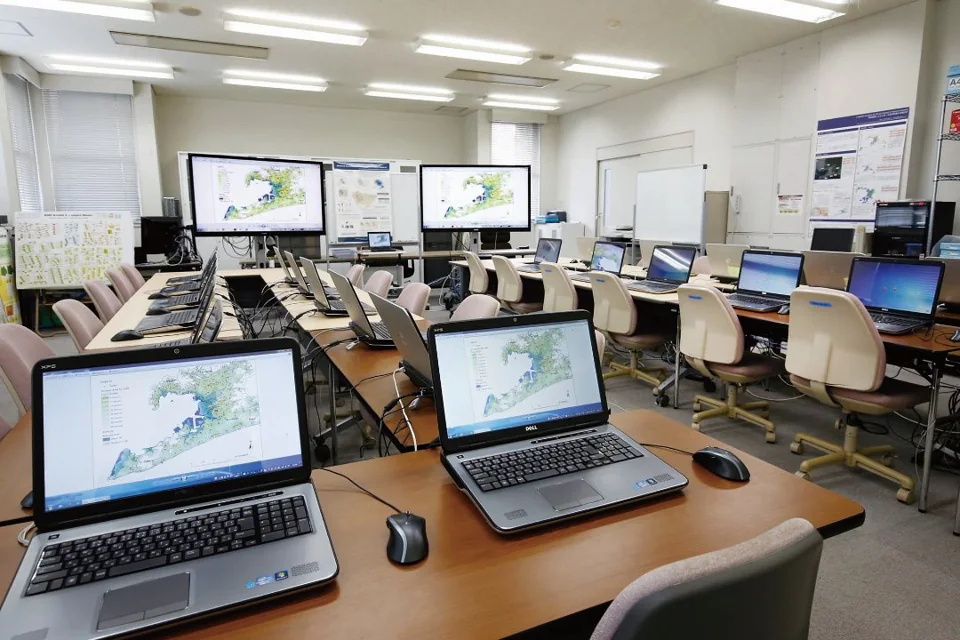
Facilities at Toyohashi include a Language Center, learning commons, media-arts studio and a geographic-information-system laboratory. The language centre provides books, visual materials and electronic learning resources. Presentation equipment and group spaces support discussion and preparation of assignments, while the media studio provides a setting for practical creative work. The GIS laboratory supplies computing and scanning equipment for spatial analysis. A university memorial hall preserves the former main building, connecting everyday campus life with the institution's historical surroundings.
Sources: Toyohashi campus ↗ · Libraries and resources ↗
Libraries and specialist collections
Libraries on the Toyohashi, Nagoya and Kurumamichi campuses serve different academic communities within the university. The published library account describes expanding digital access, networked information services and an institutional repository. At Nagoya, discussion rooms accommodate seminars, group study and presentations, while individual booths provide quieter places for sustained work. Course-related reserves and a business-support collection supply materials for particular learning purposes.
Toyohashi's collections have a strong humanities and social-science character. China-related holdings include the Kazan Collection, Chinese classics and reports produced by students during Toa-Dobunshoin research expeditions. These resources connect the library with the university's scholarly heritage. Open shelves, periodicals, reference materials and media resources support ordinary study alongside specialist research. Learning commons and movable furniture provide settings in which students can discuss material and practise presentations. The Kurumamichi law-school library has a more restricted role serving its own students and faculty.
Sources: Libraries and resources ↗
Law through analysis and practical exercises
The Faculty of Law connects legal knowledge with fair judgement, awareness of human rights, logical thinking and negotiation. Its educational account begins with foundations and develops towards specialist subjects and seminars. Students examine problems from different perspectives and learn to gather information, explain a position and apply what they have studied.
Mock Trial classes provide a concrete example. Students examine cases and legal literature, decide which aspects to reproduce and organise proceedings with help from community members acting as lay judges. The activity connects criminal-law study with procedure, planning and public presentation. Another published example is a political-science lecture series involving Aichi prefectural officials. Their contributions explain how laws, ordinances and public plans relate to administrative work. These activities place legal ideas in settings where decisions, institutions and responsibilities can be examined directly.
Sources: Faculty of Law ↗
Regional policy through fieldwork
The Faculty of Regional Policy studies questions facing communities, including population change, local economies and relationships with wider society. Its published fields bring together community development and regional culture, regional economics, public policy, health and sports, and food, agriculture and the environment. The faculty combines theoretical inquiry with practical investigation.
Small-group seminars run across the undergraduate years and introduce literature review and social-survey methods before graduation research. Fieldwork and proposals to local authorities connect academic questions with places and organisations outside the university. Geographic information systems provide another research method: maps can combine information about terrain, population, disaster risks and evacuation sites to make relationships easier to examine. Student-led regional projects add opportunities to select a question, work with others and consider how research can contribute to a community.
Sources: Faculty of Regional Policy ↗
International exchange and student support
The International Exchange Office assists incoming international students and university students preparing for study abroad. Its published provision includes exchange, semester-long and shorter programmes, with guidance intended to help international students adjust to life and study in Japan. Offices at both Nagoya and Toyohashi provide points of contact for questions and concerns. This support connects the university's international educational aims with practical assistance for students moving between different academic and cultural settings.
Sources: International Exchange Office ↗