Visa

About Aichi Sangyo University
A private university in Okazaki
Aichi Sangyo University is a private university in Okazaki, Aichi Prefecture, Japan. Its campus is at 12-5 Harayama, Oka-cho. The university opened in April 1992 with a Faculty of Art and Design offering industrial design and architecture. Its educational corporation has a longer history, reaching back to a private sewing school established in 1905. The four-year university and Aichi Sangyo University Junior College are separate institutions within that wider educational group.
The university added a business faculty in 2000. Graduate architecture study began in 2005, followed by graduate design in 2007. The Smart Design department opened in 2019. Across these developments, the corporation’s stated educational philosophy has emphasized broad intellectual development and sincerity, connecting specialist learning with contribution to society. Its institutional history therefore brings together design, the built environment, business and, increasingly, information technology.
Sources: Mission and institutional history ↗
The approved 2027 informatics development
A notice issued on 29 October 2026 records that the university received ministerial approval on 27 October for a Faculty of Informatics opening in April 2027. The faculty will comprise departments of Intelligent Informatics and Applied Informatics. This is a forthcoming development, distinct from the programmes already described for existing students.
The published Intelligent Informatics framework covers intelligent information systems, intelligent robots and product design, and media information processing. It combines foundational information science with practical work involving artificial intelligence, data and manufacturing. Applied Informatics brings information technology together with business and wider social applications. Its published fields include business creation, manufacturing digital transformation, digital games, and sports and health. The university presents these areas as opportunities to investigate problems through data and information systems across both technical and nontechnical settings.
Sources: Faculty of Informatics approval notice, October 2026 ↗ · 2027 academic development ↗
Architecture and making
Architecture education combines the study of buildings and urban space with practical design and material-based work. Its published fields encompass architecture and urban design, interior and exterior design, architectural innovation, and timber construction and making. Students encounter subjects extending from houses and public buildings to the relationship between design, local history, culture and community.
Digital methods feature alongside physical models and woodwork. The department describes building information modelling, artificial intelligence, virtual reality and digital fabrication among the tools relevant to its teaching. Interior and exterior design considers furniture, lighting, gardens and outdoor space, drawing on ergonomics and material characteristics. The timber-related field connects traditional Japanese wooden construction with contemporary timber structures. This range places the experience of handling materials alongside the ability to visualize and assess proposals digitally.
Sources: Architecture department ↗
Smart design and digital expression
The Smart Design department describes design that is useful to society as its starting point. Its teaching links the foundations of design and design thinking with information-processing technologies. Areas discussed on the official programme page include computer graphics, application interfaces, user experience and media-based expression. The emphasis is on understanding what people need and deciding how information or a product can respond.
One example is interface and user-experience design for tourism applications. The department explains that such work involves more than appearance: it also requires choosing information that has value for the user and considering ease of use. Through these examples, digital design is presented as a way to investigate everyday situations and turn ideas into forms that other people can understand and interact with.
Sources: Smart Design department ↗
Graduate education and flexible study
The Graduate School of Art and Design includes architecture and design specializations. Shared graduate subjects allow students to combine specialist work with management perspectives. Architecture study considers regional planning and development, including area management, local branding, industry and technology, as well as the design of individual buildings. Design students develop research through seminars, from planning a master’s project to presenting its results.
The graduate school provides several teaching formats. Seminars are arranged through coordination between students and teachers; other learning takes place through campus classes, on-demand teaching, hybrid delivery or a blend of remote and face-to-face sessions. Its long-term study system allows eligible working students to plan a three- or four-year period rather than the standard two years. These arrangements form part of its provision for continuing education and reskilling.
Sources: Graduate School of Art and Design ↗
Library and learning resources
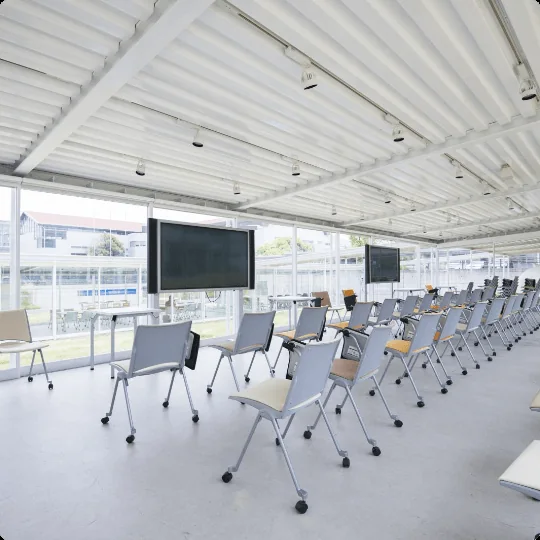
The university and junior college share a library in Building 2. Its specialist resources cover art, design, architecture, business, law, languages and artificial intelligence. Students can borrow books and use available loan computers, while audiovisual materials, newspapers, magazines and designated reference materials are handled under separate rules.
An online catalogue helps users identify holdings. The library also provides links to research discovery tools, journal information and other library catalogues. Members of the public can apply to consult materials, use audiovisual resources and request permitted copying of library holdings. Opening arrangements vary between teaching periods and vacations, with changes shown in the library calendar.
Spaces for campus life
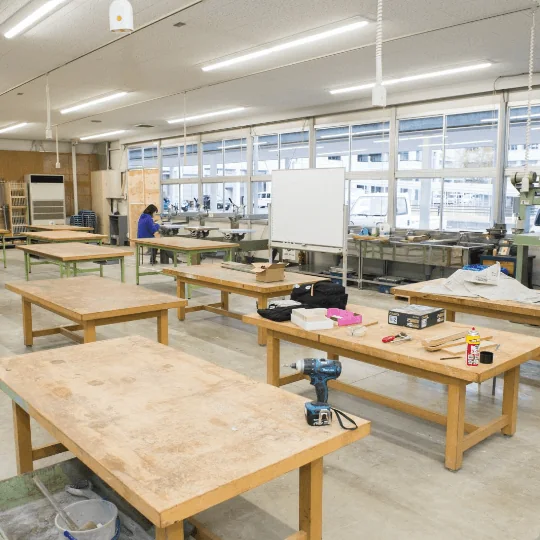
The Okazaki campus includes the PLASU Language and Information Co-education Center, a community hall, a student square and a modelling studio. The studio provides space for woodwork, sculpture and large practical projects. The student square combines a student hall with a gallery, while the community hall houses dining and bookshop facilities. Sports spaces include arenas, training facilities, a baseball ground and an archery range. A university shuttle links the campus with Fujikawa Station on the Meitetsu Nagoya Main Line.
Sources: Access and campus facilities ↗