Visa
About Aichi Prefectural Tsurugi hill high school
Kakujogaoka High School in Nishio
The institution listed as Aichi Prefectural Tsurugi hill high school is Aichi Prefectural Kakujogaoka High School, written 鶴城丘高等学校 in Japanese. It is located in Kamezawa-cho, Nishio, Aichi Prefecture. Its history began in 1909 with an agricultural and sericultural school established by Hazu County. The school later developed as Nishio Jitsugyo High School, retaining a strong connection with agricultural and industrial education.
In April 2004 it adopted the Kakujogaoka name and became a comprehensive-course high school. This reorganisation brought general academic pathways together with specialist agricultural, industrial and commercial fields. The principal's account describes that combination as central to the present institution. Students encounter different areas before selecting a pathway, and later study combines subject teaching, career education, research projects and activities involving the surrounding community.
Sources: 校長挨拶 – 鶴城丘高等学校 ↗
Educational aims and personal responsibility
The school's educational aims emphasise respect for life, willingness to take on challenges and continuing personal development. Its policy links these aims with respect for different people and the capacity to work and live together. Foundational knowledge and skills are intended to support students in identifying questions and taking an active role in solving problems.
The school's traditional principles include sincerity and diligence, self-discipline and courtesy, straightforward conduct and resilience, mutual respect, and cooperation. These are explained through everyday responsibilities rather than only as abstract ideals. The policy also identifies communication, social manners and collaborative learning using information technology as important capacities. Learning is organised through smaller teaching groups, elective subjects and practical experience so that students can take responsibility for choices and develop their interests through active participation.
Sources: 学校案内 – 鶴城丘高等学校 ↗
Choosing among seven fields
Kakujogaoka's seven pathways are Humanities, Natural Sciences, International Business, Information Systems, Mechatronics, Agriscience and Environmental Design. First-year students study industry, society and human life while experiencing the different fields through a general foundations subject. Pathway selection follows this introduction, with specialist study beginning in the second year. Cross-pathway elective subjects allow students to study beyond their principal field.
Humanities covers literature, languages, geography, history and social questions, while Natural Sciences gives additional attention to mathematics and science. International Business introduces marketing, management, information use and accounting. Information Systems covers computing and electrical foundations; Mechatronics connects mechanical, electrical, electronic and programming study. Agriscience addresses cultivation, animal care and agricultural processing and distribution. Environmental Design brings together civil engineering, design and landscape construction. The range reflects the school's combination of general education with its earlier specialist traditions.
Sources: 鶴城丘高等学校 ↗
Engineering through workplace experience
A July 2026 school report describes company training involving students from the Mechatronics and Information Systems pathways. Their Craftman III experience at Mechamate included robot modification, three-dimensional computer-aided design, design exercises and safety education. Practical activities also involved making and assembling designed parts and checking operation.
The published outline connects classroom fields with a workplace where design and production take place together. Robot work involved components such as servo motors, circuit boards and sensors, while design exercises introduced the equipment the company was developing. The report presents this as a particular training experience undertaken by participating students, giving a concrete example of the school's relationships with local industry.
Sources: 企業研修に参加しました。 – 鶴城丘高等学校 ↗
Programming connected with physical devices
The Information Systems pathway has also used programming drones within the DX High School initiative. A report published in March 2026 describes students carrying out practical exercises that connected a programming language with a physical object and its movement. This extended the activity beyond writing instructions on a computer screen.
The school's explanation highlights both the enjoyment and the difficulty students encountered when moving from code to operation. The exercise gives an example of information education in which students can observe the result of their instructions in a physical setting. It sits alongside the broader computing, hardware and electrical subjects described in the pathway overview.
Sources: [DXハイスクール事業]プログラミング用ドローン – 鶴城丘高等学校 ↗
Landscape construction and observation
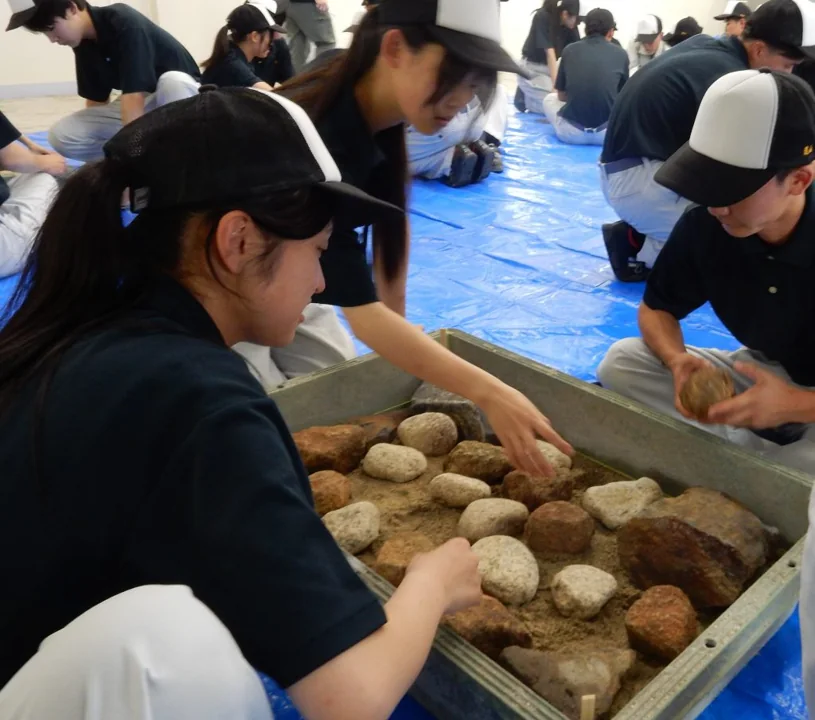
Environmental Design students practise techniques associated with the creation and maintenance of outdoor spaces. In a July 2026 lesson, third-year students worked in teams to arrange stones into original designs. The exercise concerned nobedan, a stone arrangement used for pedestrian paths. Students considered which stones to place, constructed their arrangements and then examined the work produced by other teams.
Comparison and mutual evaluation formed part of the activity, linking practical decisions with observation and discussion. A separate report records second-year students visiting the Tokai Junction construction site on National Route 247 in September 2026. That visit extended their experience from school lessons and practical exercises to an active civil-engineering site. Together the two examples show different scales of learning within Environmental Design.
Sources: 石組み実習を行いました!【環境デザイン系列】 – 鶴城丘高等学校 ↗ · 現場見学会に参加しました【環境デザイン系列】 – 鶴城丘高等学校 ↗
Cultivation and seasonal practical work
Agriculture and Environment lessons provide Environmental Design students with experiences of cultivation as well as landscape work. In September 2026, second-year students harvested sweet potatoes they had grown. The school's report notes that the condition of the training plot had initially raised questions about the crop, making the eventual harvest a point of interest for the class.
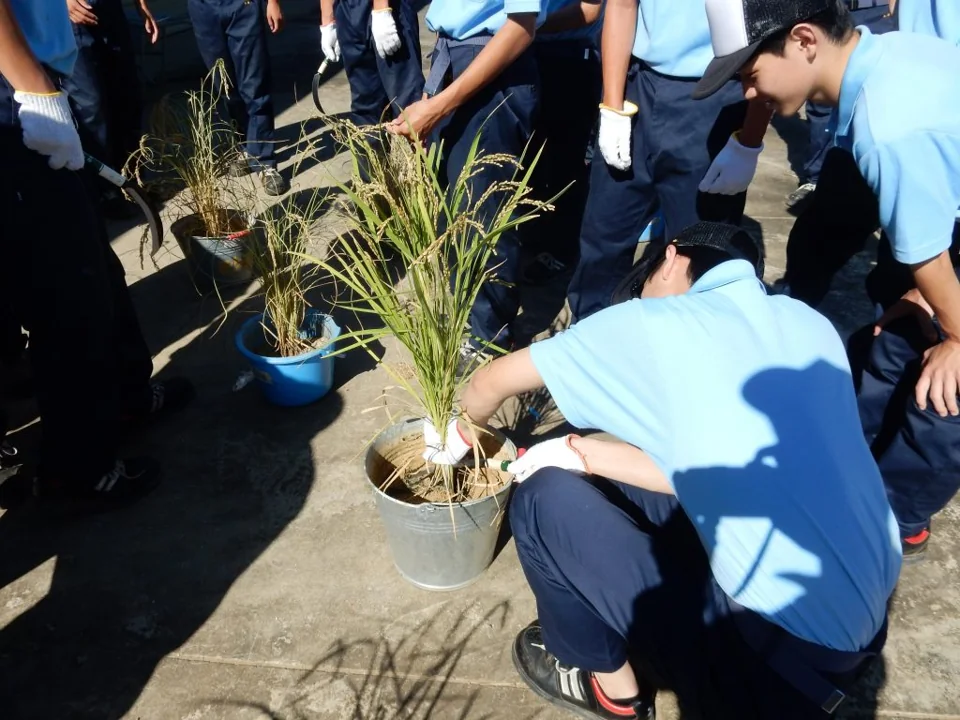
On 2 October 2026, students harvested rice grown in buckets and practised hasagake, hanging the cut rice to dry. The lesson introduced a traditional drying method alongside the modern use of machinery. These reports document activities from cultivation through harvest and post-harvest handling. They give concrete examples of how agricultural learning is incorporated into the pathway's teaching, with students working directly with plants and observing the results of their earlier work.
Sources: 稲のはさがけを行いました!【環境デザイン系列】 – 鶴城丘高等学校 ↗ · サツマイモの収穫を行いました!【環境デザイン系列】 – 鶴城丘高等学校 ↗