Visa
About Aichi Prefectural Narumi High School
A prefectural high school in southern Nagoya
Aichi Prefectural Narumi High School is a secondary school in Sakyo-yama, Midori Ward, Nagoya, Japan. It opened in April 1976 following requests from people in the surrounding community. Its location in southern Nagoya places it beside the greenery of Odaka Ryokuchi Park and within a short walk of Meitetsu Sakyo-yama Station. The school's published introduction connects this setting with its history and everyday educational environment.
The official chronology records successive tenth-, twentieth-, thirtieth- and fortieth-year commemorations, followed by the school's fiftieth-year celebration in 2025. Its name has remained Aichi Prefectural Narumi High School since opening. The chronology also records changes in class organisation over time, while the current school introduction emphasises courses and elective subjects responsive to students' interests. Academic learning, school events and club activities form the main strands of its published account of school life.
Sources: 学校案内 – 鳴海高等学校 ↗ · 沿革 – 鳴海高等学校 ↗
Purpose, judgement and practical action
Narumi's motto is Nasu, associated with taking time to think, reaching a judgement and putting that judgement into practice. The school mission set out by Aichi's education board emphasises purposeful learning, independent thought and action. It also identifies self-discipline, a public spirit and responsibility as qualities students should develop through their education.
The school's own policy links these aims with respect for one's own life and the lives and ideas of others. Its account of learning combines a firm grounding in basic knowledge with broad understanding and general education. Students are expected to help one another develop the capacity to solve problems. The policy therefore places intellectual work within a social setting: learning involves both developing an individual judgement and engaging constructively with other people.
Sources: スクールミッション・スクールポリシー・校訓 – 鳴海高等学校 ↗
Curriculum and subject choices
The curriculum table for students entering from 2022, linked from the school's official curriculum page, identifies a full-time general course. It presents a progression from common foundations towards humanities and science groupings, with further humanities options in the final year. Japanese study includes contemporary language, language culture, logical Japanese, literary Japanese and classical inquiry. Geography, history, public affairs, politics and economics appear alongside mathematics and the natural sciences.
English communication is accompanied by logic and expression subjects, while physical education, health, home economics and information studies provide other parts of the programme. First-year arts options include music, visual art and calligraphy. The table also identifies school-designed subjects such as foundational mathematics, integrated mathematics, integrated science and practical English. Homeroom activity and time for integrated inquiry are included in the overall framework. Subject selection thus builds on shared learning while allowing different combinations as students develop their interests.
Sources: Curriculum table for entrants from2022, linked by current curriculum page ↗
Clubs across sport, culture and science
The school publishes a broad club directory spanning sporting and cultural activities. Sporting examples include rugby, football, baseball, athletics, tennis, basketball, badminton and table tennis. Equestrian activity and fencing are also listed, giving the programme interests beyond the more familiar team sports. The school introduction specifically draws attention to these distinctive opportunities.
Cultural clubs include wind ensemble, koto music, home economics, art, photography, tea and flower arrangement, go and shogi, literature, drama, natural science and international exchange. These activities offer different settings for sustained practice, creative work and shared interests outside lessons. The directory links individual club information as well as giving an overview of the range. Club participation sits alongside classroom study and school-wide events in the school's presentation of student activity.
Sources: 部活動紹介 – 鳴海高等学校 ↗
Tensho Festival and student organisation
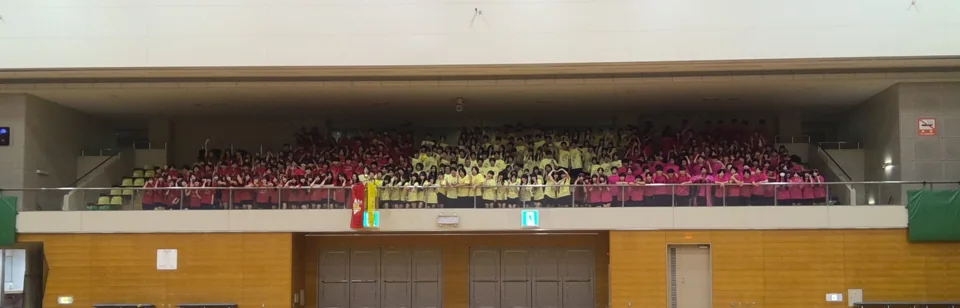
Tensho Festival combines a sports meeting with a cultural festival. The school's introduction describes classes developing their own displays and activities, sharing ideas and preparing together. On the sporting side, students from different year groups are organised into blocks, creating connections across the school rather than only within a single class.
A concrete example is the sports meeting held on 5 June 2026 at Midori Sports Center. Nine mixed-year blocks took part, with the programme including relays, tug of war, ball-tossing and long-rope events. The student council played a central role in organising the meeting. The school's report records both the competition and the cooperation needed to run the event, providing a recent example of students contributing to a collective school project.
Sources: 学校案内 – 鳴海高等学校 ↗ · 天翔祭(体育大会) – 鳴海高等学校 ↗
Marking fifty years
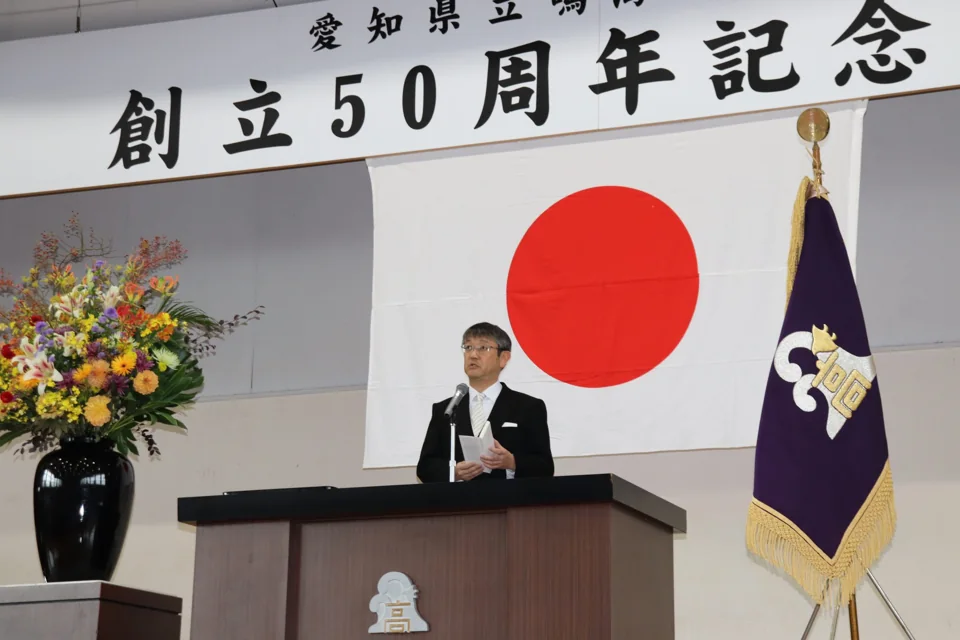
The school's fiftieth-anniversary ceremony took place on 31 October 2025. Former principals, vice-principals and PTA presidents attended alongside the current school community. The wind ensemble opened the occasion, followed by addresses from the principal and student council president reflecting on the school's development and future.
The commemorative programme also included a lecture by Sayaka Kobayashi, known for the story associated with Birigal. Her talk considered making seemingly impossible goals possible. The event brought music, student representation, school leadership and invited guests into a single occasion. It marked a link between the school's earlier generations and the students attending at that point in its history.
Sources: 創立50周年記念式典を行いました – 鳴海高等学校 ↗
Disaster preparedness in school life
A school report published in September 2026 describes a disaster drill held on 1 June. Students first heard the dedicated earthquake-warning sound over the school broadcast system and practised protective action. The school registered its participation in Aichi's prefecture-wide ShakeOut initiative, connecting the exercise with a broader programme of preparedness.
The exercise then moved from immediate protective action to evacuation along designated routes and assembly on the school grounds. A roll call included all students and teaching staff so that attendance and safety could be checked. The report encouraged families to discuss how they would respond to a disaster as well. This activity shows how school-wide organisation and shared responsibility are practised beyond lessons and celebratory events.
Sources: 防災訓練を行いました – 鳴海高等学校 ↗
The school emblem
Narumi's emblem uses waves, a shorebird and an overall triangular composition around the character for high school. The official explanation associates these elements with three guiding ideas: rigour, enjoyment and an engaging school. Repeated waves represent persistence as well as rigour, while the shorebird expresses openness and richness of experience.
The triangular arrangement is explained in terms of stability and harmony. The design also draws on the area's remembered coastal landscape, linking the school's visual identity with Narumi's local setting. Together with the motto, the emblem provides a compact expression of ideas that recur in the school's policies and activities.
Sources: 校歌・校章 – 鳴海高等学校 ↗