Visa
About Aichi Prefectural Higashiura High School
A prefectural high school in Higashiura
Aichi Prefectural Higashiura High School is a secondary school in Higashiura, Chita District, Aichi Prefecture, Japan. Its official address is in the Ikuji area of Higashiura, and the school provides access information from Higashiura Station on the JR Taketoyo Line. This places it in the Higashiura community rather than in Okazaki.
The school opened on 1 April 1973, following prefectural planning and preparation during the preceding years. Its name and initial establishment were announced in November 1972, and an opening commemoration took place in June 1973. The school marked its fiftieth anniversary in November 2022. Its history also records the development of an information-related course, beginning in 2010 and undergoing later revisions. These milestones trace an institution that combines general high-school education with changes in its academic options over time.
Sources: Official school history ↗ · School access and address ↗
Educational policy and participation
The school's published policy identifies consideration for others, independent judgement, cooperation and persistence as qualities it seeks to develop. It connects academic progress with the way students participate in their school and community. The policy also describes an expectation that students recognise one another's individuality and take part in learning, events and club activities.
For teaching, it emphasises small-group instruction and attention to individual students. Elective classes are intended to accommodate different future directions, while tablets and other tools support active and inquiry-based learning. Career education is planned across the three school years. Moral and human-rights education also appears among its priorities. School events and clubs are treated as parts of this wider educational programme, alongside academic lessons. The policy's community element includes an interest in students who are concerned about their local area and wish to contribute to it in the future.
The principal’s account of school purpose
The principal's April 2026 greeting places everyday habits within the school's educational purpose. It identifies greeting other people, being punctual and completing assigned work as examples of responsibilities that continue to matter after school. The account presents teachers' guidance as concerned with students' longer-term lives as well as their immediate classroom experience.
The greeting also distinguishes between enduring values and the need to respond to changing circumstances. Its approach is to preserve important habits and relationships while helping students remain adaptable. This adds a practical dimension to the school's educational policy: responsibility is discussed through things students can do each day, rather than solely through abstract aspirations. The emphasis links academic work, interaction with others and the gradual development of independence during the high-school years.
Sources: Principal’s greeting, April 2026 ↗
General study and information-related options
Higashiura describes three academic routes responding to different future plans. A special university-preparation stream is intended for students aiming at university study, while the general stream accommodates a wider range of directions. Students in the general stream can choose an information-use course from their second year.
An official notice published in April 2026 explains that the former Information Business course changed to an Information Use course with the revised curriculum for students entering from that year. The notice places greater emphasis on information subjects, including information processing and knowledge related to generative artificial intelligence. The school's stated purpose is to develop practical understanding of information from several perspectives as digital technologies change. This represents a specific curriculum development within a general high school, with the course forming one option rather than defining the education of every student.
Sources: Academic streams and information-use course ↗ · Information-use course change, April 2026 ↗
The organisation of a school day
The school's day begins with the school song before the opening bell, followed by a short morning meeting. Its published timetable sets out six fifty-minute lessons, with four before lunch and two afterwards. Lunch falls between the fourth and fifth periods. Cleaning time and a further short meeting follow the last lesson.
The accompanying account describes lessons as the centre of school life and highlights small-group teaching during many class periods. It links this arrangement to detailed guidance that takes individual students into account. The timetable provides a concrete picture of how academic teaching and shared responsibilities fit together: morning organisation, classroom study, a lunch break, afternoon lessons and care for the school environment all have a place in the published daily structure.
Sources: A school day at Higashiura ↗
Clubs and interests beyond lessons
The school's club directory includes both sporting and cultural activities. Sports represented in the list include Japanese archery, kendo, judo, table tennis, volleyball, basketball, soft tennis, handball, baseball and football. Some team sports have separate boys' and girls' clubs.
Cultural clubs include tea ceremony and flower arrangement, art, wind ensemble, home-related activities, guitar and broadcasting. The range gives students several ways to participate beyond scheduled lessons, from individual creative interests to team activities. Clubs appear alongside school events in the institution's educational policy, connecting extracurricular participation with cooperation and engagement in school life.
Sources: School clubs ↗
Disaster preparedness through direct experience
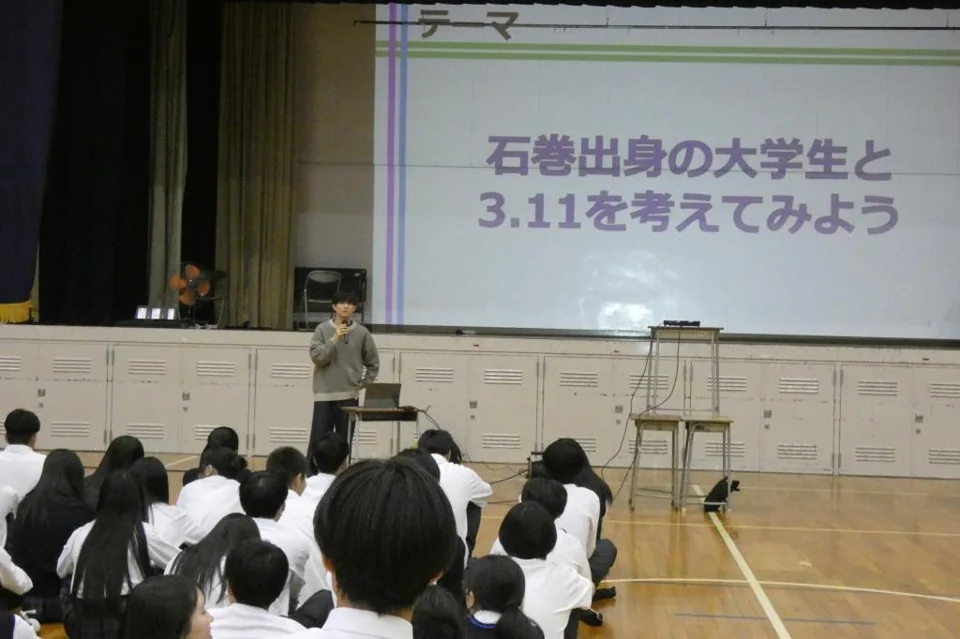
Two reports from 2024 illustrate learning connected with the surrounding community. In November, first-year students heard from a Nagoya University student who had experienced the Great East Japan Earthquake in Ishinomaki. The talk formed part of regional inquiry and disaster-preparedness and welfare learning. The speaker described affected places and evacuation experiences, bringing a personal account into the students' study.
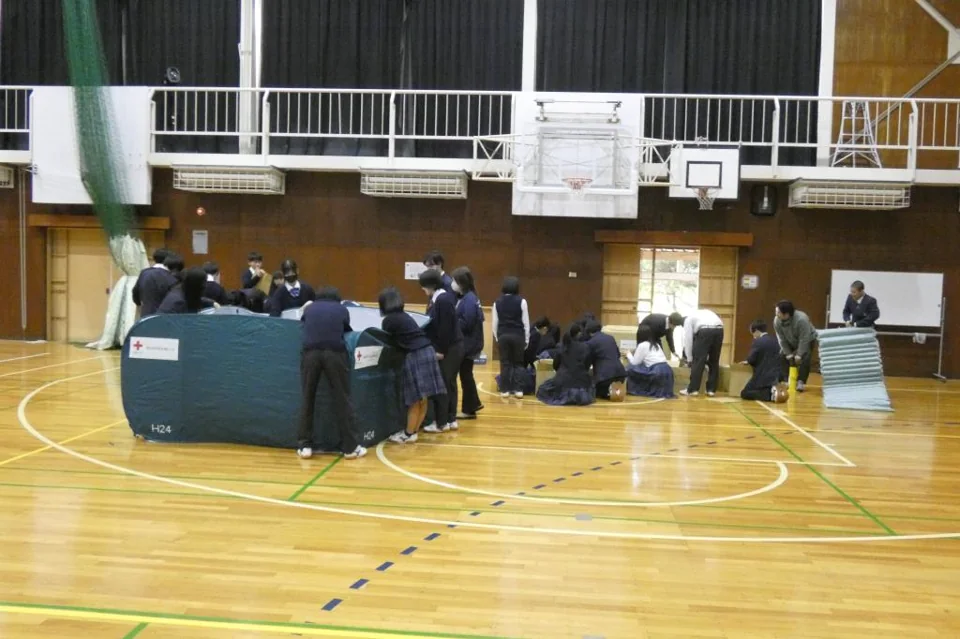
In December, first-year pupils took part in an evacuation-shelter management experience within a welfare-learning programme. Activities included assembling temporary toilets and cardboard beds, practising wheelchair evacuation and blanket-stretcher transport, and considering shelter reception work. The school described the experience as an opportunity for students to think about what they could contribute during a disaster or at a shelter. These dated activities connect community awareness with discussion and practical participation, adding another setting for learning beyond ordinary classroom lessons.
Sources: Evacuation-shelter management experience, December 2024 ↗ · Disaster-preparedness and welfare learning, November 2024 ↗