Visa

About Aichi Institute of Technology
Origins and technical education
Aichi Institute of Technology is a Japanese university with its Yakusa campus in Toyota, Aichi Prefecture. Its history is connected with Nagoya Denki Gakuen, whose origins date to electrical education established in Nagoya in 1912. The university itself began in 1959 as Nagoya Denki University, initially offering electrical engineering. It adopted the Aichi Institute of Technology name in 1960, when electronics and applied chemistry were added.
Mechanical and management engineering followed in 1962. Graduate engineering education began in 1966, and the institution subsequently developed additional disciplines and research facilities. The move to its present Yakusa setting was completed in 1974. Later milestones included doctoral engineering programmes in 1992 and the development of management and information-related academic structures. This history explains the institute's combination of an electrical-engineering origin with a broader contemporary range of technological, information and management education.
Sources: Institutional history ↗
Campuses in Toyota and Nagoya
The Yakusa campus is located in Yakusa-cho, Toyota. Its official campus information identifies engineering and information-science teaching there, alongside graduate engineering and management-information-science programmes. The campus guide connects it with Yakusa Station, served by the Linimo and Aichi Loop Railway, and describes both walking access and a university shuttle service.
The institute also operates Jiyugaoka and Motoyama campuses in Nagoya. Its history records the opening of Motoyama in 2005 and Jiyugaoka in 2010. Jiyugaoka is close to the station of the same name on Nagoya's Meijo subway line. These locations are parts of the same university rather than separate institutions. They place its educational activity both in the Toyota-area Yakusa setting and within Nagoya, with campus-specific facilities and academic uses.
Sources: Yakusa campus ↗ · Jiyugaoka campus ↗
Engineering across several disciplines
The Faculty of Engineering brings together electrical engineering, applied chemistry, mechanical engineering, civil engineering and architecture. Its electrical programmes address energy use and electronics and information-network technologies. Applied chemistry focuses on materials and their relationship to manufacturing, with both chemical and biological or environmental perspectives represented.
Mechanical engineering includes study organised around foundational technologies and creative approaches to machines and products. Civil engineering addresses infrastructure such as roads, bridges, tunnels, water systems and urban planning, considering planning, construction and maintenance. Architecture includes design and planning, structures and materials, and environmental systems and equipment. The faculty's description connects these areas through practical technical knowledge and the creation of products, systems and built environments. It also identifies sustainability as an important context for engineering work. The combination provides several routes into technological study rather than treating engineering as a single uniform subject.
Sources: Faculty of Engineering ↗
Robotics as a research and learning setting
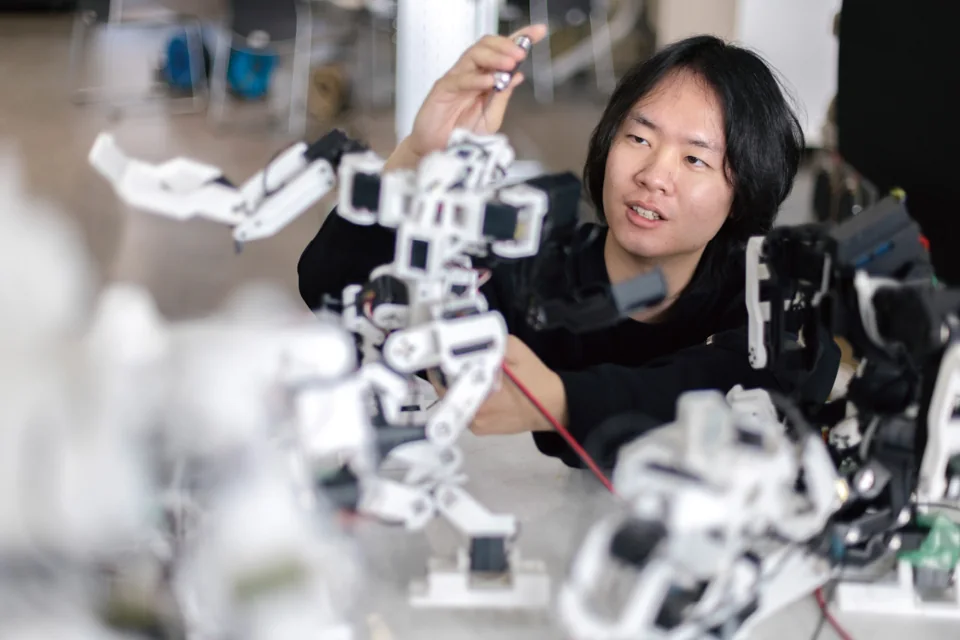
The Robot Research Museum is a university facility organised around education, research and engagement with society. It supports robot-building environments, instruction and participation in competitions, including opportunities for students early in their university studies. The university describes bringing robotics-related laboratories together to encourage interaction between research groups.
Research areas include mobility, rescue systems and artificial intelligence. The facility's listed projects encompass humanoid robots, underwater robots, remotely operated vehicles, distributed artificial intelligence and embedded systems. Glass-fronted laboratories allow visitors to see aspects of the work, while outside events and outreach classes extend its educational activity beyond the facility. The museum also identifies consultation with companies and collaborative research among its functions. This makes it a place for active technical work and communication about robotics, alongside its role in presenting research to visitors.
Sources: Robot Research Museum ↗
Student projects and making things work
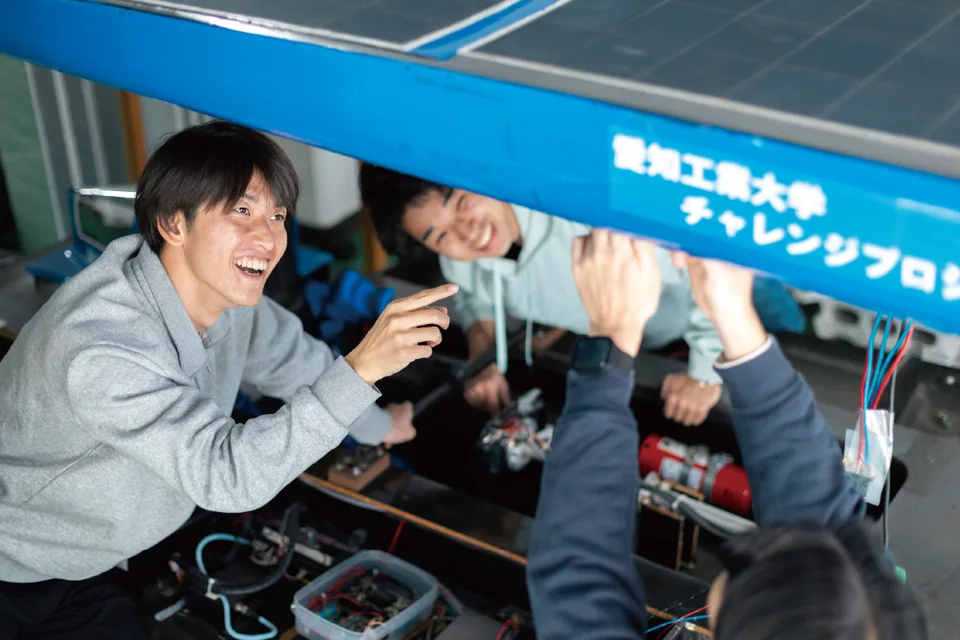
The institute's Student Challenge Projects provide examples of students working together on practical problems outside ordinary lectures. Its published project features include humanoid robotics, solar vehicles, indoor flying robots, placemaking and visual design for a game-show exhibition. These activities connect different disciplines with the process of producing, testing and improving something tangible.
A solar-car feature describes the team's return to activity in the 2025 academic year and preparation for the Shirahama Solar Car Challenge. Students discussed vehicle construction and energy management and had to respond to mechanical trouble during the race. Other features describe students preparing competition robots or contributing to the reuse of spaces in Seto through community and arts-related work. The accounts emphasise the development process, cooperation and responses to difficulties. They show practical learning through iteration and shared tasks rather than only a finished competition result.
Sources: Student Challenge Projects ↗
Library and academic information support
The university library describes its purpose as collecting, organising, providing and preserving academic information for education and research. Collections relevant to the university's specialist fields are complemented by databases, electronic journals and other digital resources. Library orientation and database workshops contribute to information-literacy education, helping students learn how to locate and use scholarly material.
Facilities include the library at Yakusa and multimedia information-library provision at Jiyugaoka. Published user services include catalogue and discovery searches, interlibrary borrowing and document-copy requests, purchase suggestions and requests to obtain materials between the Yakusa and Jiyugaoka locations. The library also links users to an academic information repository and research tools. These services provide routes from discovering a reference to obtaining the material needed for study, while learning spaces and guidance complement access to collections.
Sources: University library user guide ↗
Creativity and responsibility in engineering
The institute explains its educational motto through the combination of creativity and humanity. Since May 2003, it has used the manga robot Tetsujin 28 as an institutional image character. Its account connects the character with persistence in making and improving machines and with the importance of the people who control technology.
The university uses this example to encourage students to attempt difficult projects without treating failure as the end of learning. It also relates the character to its founding ideals of freedom, love and justice, and to an engineering education attentive to people and the environment. This provides cultural context for the institute's emphasis on making things, practical challenges and responsibility alongside technical knowledge.
Sources: Institutional image character and educational purpose ↗