Visa


About Aichi Gakusen University
A university in Okazaki with roots in Anjo Gakuen
Aichi Gakusen University is located in Okazaki, Aichi Prefecture, Japan. Its current official address is 28 Kamikawanari, Hegoshi-cho, Okazaki. The institution belongs to the Anjo Gakuen educational tradition, whose history begins with a girls’ sewing school established by Sanzo and Dai Terabe in 1912. The university’s own establishment is a later milestone: Aichi Women’s University opened in 1966.
The institution became Anjo Gakuen University in 1968 and adopted the Aichi Gakusen University name in 1982. Its Faculty of Home Economics became coeducational in 1987. More recent changes include a reorganisation of that faculty into three departments in 2020. The current departments are Lifestyle, Nutrition and Children’s Life. The university and its sister junior college share the Okazaki campus, while maintaining distinct academic programmes and institutional histories.
Sources: University history ↗ · Current university address and access ↗
Lifestyle studies and projects with the community
The Lifestyle Department studies everyday life through three related areas: business and regional revitalisation, spatial and information design, and food development and management. These bring together subjects such as business, fashion, interiors, digital design and food. Students can choose across the areas or develop a stronger specialisation aligned with their interests.
A central practical component is the third-year Living Studio, a year-long experience in which students use previously acquired knowledge and skills in collaboration with communities, companies and shops. Projects can involve proposing ideas in fashion or interiors, developing products or organising events connected with local revitalisation. The department describes this as a setting for trying ideas, responding to problems and learning from both success and failure. Its account therefore connects the study of lifestyles with the ability to plan and communicate proposals in real social and commercial settings.
Sources: Lifestyle Department ↗
Nutrition education through different practice settings
The Nutrition Department organises specialised practical learning around three broad interests: nutrition associated with disease treatment and preventing deterioration, disease prevention, and food education and food environments. These provide different contexts in which students apply nutritional knowledge, from understanding the needs of healthcare settings to communicating the importance and enjoyment of food.
The department’s examples include parent-and-child cooking classes, nutrition classes for older people, health activities incorporating exercise, and projects addressing issues in local food culture. It also describes menu and product development as settings for creative proposals and communication. Alongside nutrition, students can encounter subjects concerning sports and exercise, food allergies and food development. The teaching approach links scientific knowledge with activities that require planning, teamwork and attention to the people for whom food or educational programmes are intended.
The healthcare-oriented practical strand addresses assessment using clinical information, observation of progress and the selection of nutritional support methods. The department also emphasises communication within healthcare teams and the ability to respond flexibly. These are presented as areas of professional learning within the curriculum.
Sources: Nutrition Department ↗
Children’s development, education and practical experience
The Children’s Life Department considers learning and growth across the period from infancy to the end of elementary education. Its published description connects early-childhood care and education with primary schooling, allowing students to examine development over a longer span rather than treating these stages as unrelated.
School internships and early-childhood externships take students into nearby elementary schools, kindergartens and childcare settings, with cooperation from child-rearing support organisations. Activities include assisting lessons and interacting with children. Sustained participation is intended to help students understand educational and care environments through experience. The department also provides staged preparation for recruitment examinations, including general knowledge, interviews, essays and practical components. Group study and individual guidance are described as parts of this preparation, connecting academic courses with students’ plans to work in education.
Sources: Children’s Life Department ↗
Problem solving as an educational approach
The university describes an approach combining independent learning with learning alongside others. Its educational model brings knowledge and problem solving together with ethical character, physical development, sensitivity and action. The founding values are expressed as sincerity, effort, service and gratitude.
The development of skills for working with others is another stated priority. The university groups these around taking action, thinking issues through and teamwork, including communication, listening, flexibility, planning and creativity. Its problem-solving framework involves obtaining information, using what has been learned and applying those resources to challenges encountered in real life. This shared approach provides a connection between the different subjects in the Faculty of Home Economics.
Sources: Educational approach ↗
Campus facilities, participation and regional activity
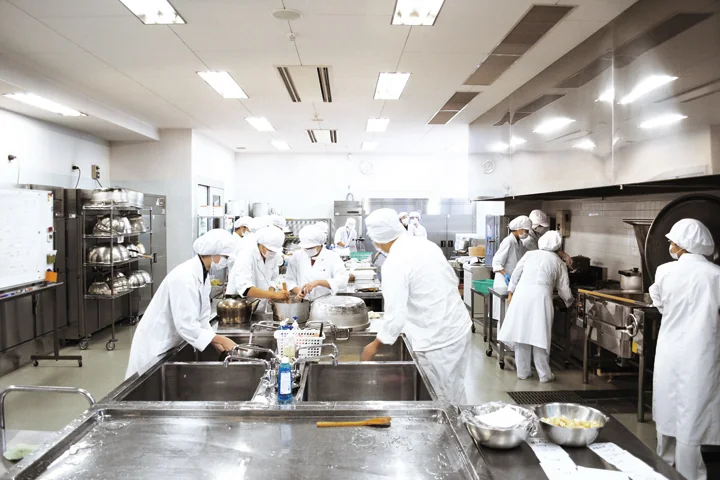
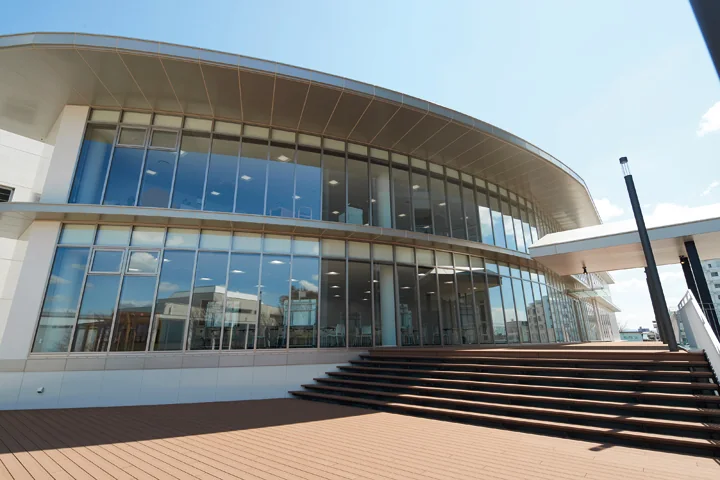
The Okazaki campus is arranged around a courtyard with teaching buildings, including Building 6 and its broad steps towards the central outdoor space. Its facility guide identifies a library, cafeteria, lounge, tennis courts, music facilities and a food-service management practice laboratory. The library includes individual study desks, while the teaching kitchen supports learning about the operation of group meal services.
The university’s regional-contribution activities include collaborations with businesses and public bodies, food and recipe development, child-rearing programmes and health-related learning events. Examples connect particular departments with local partners and community questions. Student participation also extends to clubs and societies in sport, music, reading, calligraphy and other interests. The student association takes part in regional activities and exchanges, while the festival committee plans campus celebrations. A women’s residence on campus and assistance with finding local accommodation form part of the university’s published student-life provision.
Sources: Okazaki campus facilities ↗ · Social and regional contribution ↗ · Campus life ↗