Visa
About Accademia di Belle Arti di Venezia
Origins and artistic heritage
Accademia di Belle Arti di Venezia is a higher arts institution whose origins reach back to the Venetian Republic. On 24 September 1750, the Venetian Senate provided a room in the Magistrato delle Farine where young people could study under recognised masters. Training included drawing, the figure, portraiture, landscape and sculpture. The academy’s statute was formalised in 1756, and Giambattista Tiepolo became its first president. Perspective and architecture entered its teaching in 1768.
In 1807, the institution was reorganised as the Accademia Reale di Belle Arti and moved into the former religious complex of Santa Maria della Carità. Teachers, donors and bequests helped create a collection of earlier masters that became the nucleus of the Gallerie dell’Accademia. Museum and teaching functions later separated, although they continued to share premises for many years. The academy’s history thus connects artistic education with the preservation and interpretation of Venetian art.
Sources: Academy history ↗
Academic pathways and artistic languages
First level academic diplomas normally require three years of study and 180 academic credits. The academy’s visual arts department covers painting, sculpture, decoration and art graphics. Applied arts and design provision includes scenography, with pathways addressing stage architecture, costume and stage technology. New Technologies of Art brings multimedia and the languages of communication into the curriculum. Education, mediation and communication of art provide another route focused on how artistic knowledge reaches different audiences.
Second level diplomas require two years and 120 academic credits. Their stated purpose is advanced command of artistic methods and techniques through laboratory activity and theoretical study. Provision includes painting, sculpture, decoration, art graphics, scenography and new technologies. Art and public space, new media and integrated artistic practices extend the range of approaches. Across these pathways, the academy describes a formation open to different artistic languages and laboratory experiences, connecting individual research with visual arts, performance and cultural work.
Sources: First level academic diplomas ↗ · Second level academic diplomas ↗
Studying on the Zattere and beyond
Since 2004, the academy’s main site has been the former Ospedale degli Incurabili on the Zattere, facing the Giudecca Canal. The sixteenth century complex has a long white façade and an Istrian stone base. Its monumental entrance opens into a large courtyard surrounded by a colonnade. Before becoming an educational setting, the building served several different civic purposes, including hospital, orphanage, military district and juvenile court.
Restoration and adaptation have provided studios, workshops and teaching rooms equipped for audiovisual use. The main hall can be divided for different activities and includes videoconferencing facilities. The library and historical collections also occupy the complex. The academy’s sites page additionally lists Cantiere Giudecca, the former church of Santa Marta, Forte Marghera and ABAVE Education & Research at Deposito Herion. These locations place its teaching and research within several distinctive parts of Venice.
Sources: Teaching sites and facilities ↗
The library and its research resources
The academy library has occupied the former Incurabili complex since late 2001. Its modern collection includes books and periodicals published after 1850, slides, audiovisual material and digital resources. The library reports approximately 36,000 inventoried books, mainly concerning the arts. Readers can search the Venetian SBN library network’s online catalogue, while the reading room offers reference works, dictionaries, encyclopedias, catalogues and selected periodicals on open shelves.
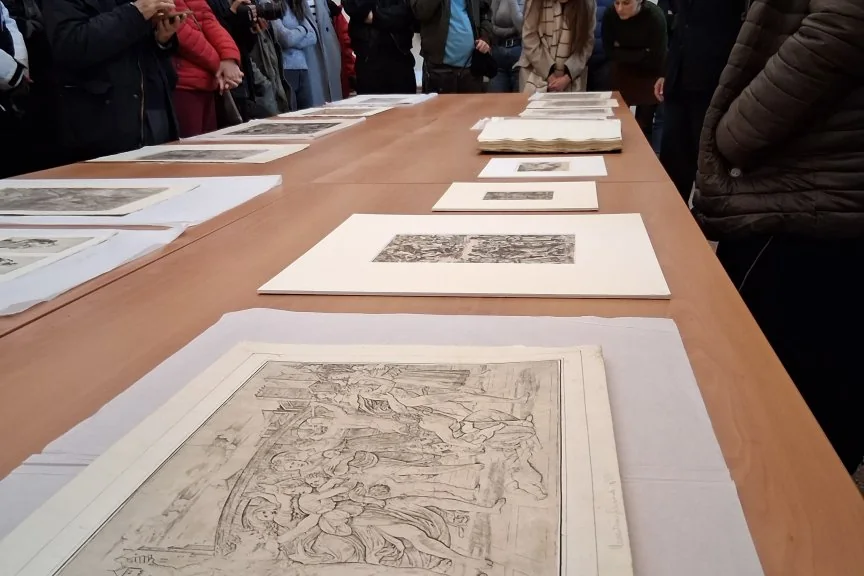
Consultation is available to people who request access, while external borrowing is reserved for academy students and staff. Registration and activation through the library network support the use of its services. Computer workstations assist catalogue searches and research, and a dedicated workstation supports students with specific learning difficulties. In 2026 the library introduced access to JSTOR. Its illustrated activities also include a David Landau workshop using prints from the historical collection, showing how library resources enter discussions and teaching encounters.
Sources: Library, collections and services ↗
Archives as a record of artistic education
The historical archive preserves evidence of the academy’s activity from the eighteenth century into the twentieth. Its records concern teaching, school organisation, exhibitions, student registration and the conservation of artworks in Venice and the Veneto. Inventoried holdings include administrative papers, student registers, school catalogues and documents associated with the institution’s former museum responsibilities. Researchers arrange access by appointment and identify the purpose of their enquiry.
A wider historical collection brings together early books, drawings, prints, plaster casts and sculptures. Its rare books include a 1485 edition of Leon Battista Alberti’s architectural treatise and Francesco Colonna’s Hypnerotomachia Poliphili of 1499. Drawings and prints preserve material connected with architectural practice, student competitions and teaching. The plaster collection reflects nineteenth century collecting and educational interests, including acquisitions associated with Antonio Canova and Leopoldo Cicognara. These holdings give the academy a substantial material record of how artists were trained.
Magazzino del Sale 3 and public exhibition
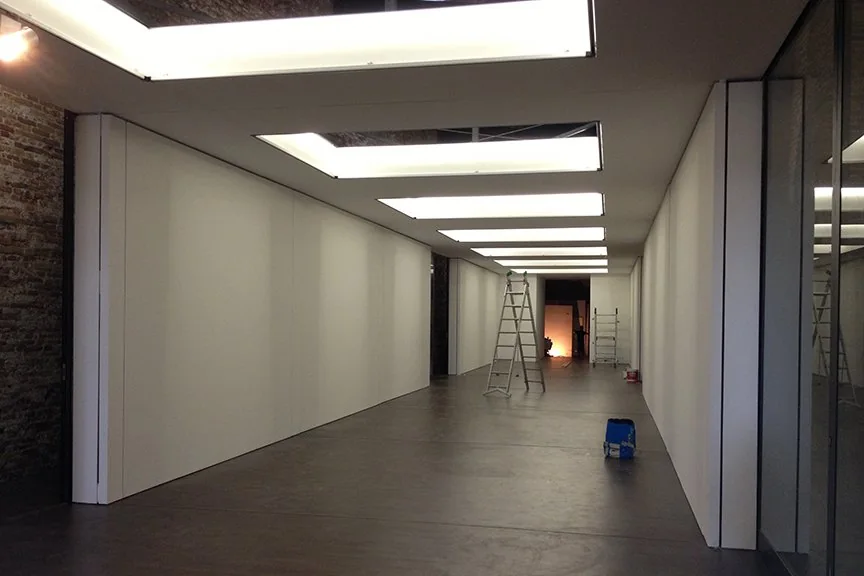
Magazzino del Sale 3 serves as the academy’s exhibition space through an agreement with the Municipality of Venice. The historic salt warehouse was refurbished and reopened with the FORwART exhibition in 2013. Brickwork and exposed beams remain part of its character, alongside adaptable exhibition structures. Its programme develops from academy workshops and the research of young artists, while also accommodating exhibitions concerning established practitioners. The space is intended to connect teaching and artistic production with professional exchange and audiences in the city and beyond.
Sources: Magazzino del Sale 3 ↗