Visa
About Abdus Salam international centre for theoretical physics
An international scientific institution in Trieste
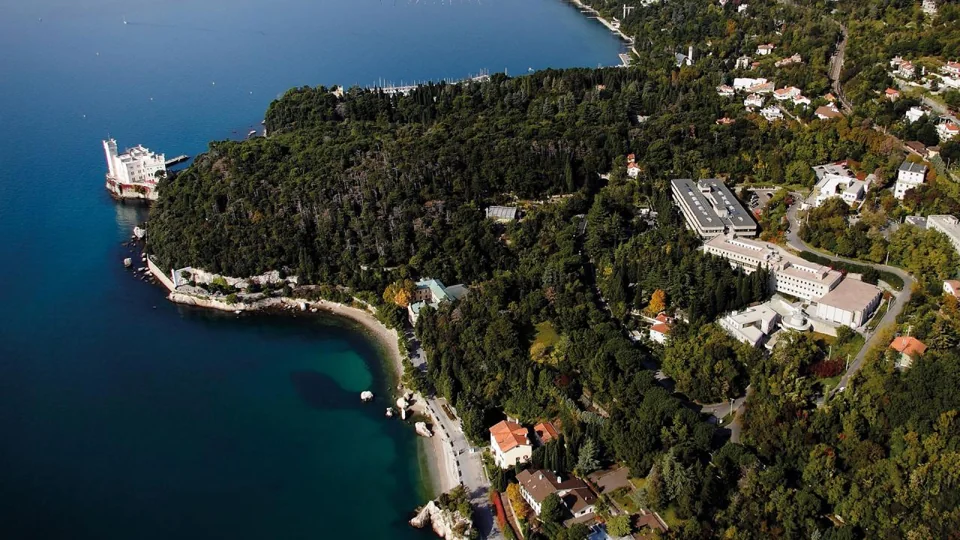
The Abdus Salam International Centre for Theoretical Physics, usually known as ICTP, is based in Trieste, Italy. Founded in 1964 by Abdus Salam and Italian physicist Paolo Budinich, it combines advanced scientific investigation with a sustained commitment to researchers in developing countries. Salam later received the Nobel Prize in Physics. The institution connects fundamental research, opportunities for scientific development and international cooperation, treating these as related parts of its purpose.
ICTP operates through an agreement involving the Italian Government, the International Atomic Energy Agency and UNESCO. It is a UNESCO Category 1 Institute. This international structure helps explain why its work extends beyond its Italian location. Its institutional account places inclusion and the reduction of inequalities in scientific opportunity alongside research excellence. The centre seeks to help scientists participate in international research while strengthening the institutions and scientific communities of their own countries.
Sources: Who We Are ↗
Research across physical and mathematical sciences
The centre began with a strong emphasis on theoretical high energy physics, but its research organisation has expanded. Its official directory now identifies High Energy, Cosmology and Astroparticle Physics; Condensed Matter and Statistical Physics; Mathematics; Earth System Physics; Quantitative Life Sciences; and Science, Technology and Innovation. Together, these areas connect fundamental questions about matter and the universe with mathematical methods, environmental systems and the analysis of living systems.
The research overview explains that this evolution has responded to the needs of physicists and mathematicians from disadvantaged countries. Educational and career development opportunities are connected with these scientific fields. The broader opportunities directory includes preparation for doctoral research, joint postgraduate programmes, laboratory experience and postdoctoral opportunities. This creates several ways of engaging with the centre at different stages of a scientific career. The relevant programme pages define their individual academic focus, eligibility and application arrangements.
Sources: Research Fields ↗ · Education and career development opportunities ↗
Preparation for doctoral research
ICTP introduced its Postgraduate Diploma Programme in 1991 to help graduates prepare for PhD study. The one-year programme is taught in English and welcomes qualified graduates in physics, mathematics and related subjects. Selection considers university performance and academic recommendations. The programme combines courses and examinations with a dissertation that participants must submit and defend, giving structured advanced study a research component.
The published 2026–2027 courses illustrate the depth of this preparation. High energy study includes quantum mechanics, general relativity and quantum field theory. Mathematics includes analysis, algebra and topology, while Earth System Physics connects climate and solid-earth topics with numerical methods. Quantitative Life Sciences brings probability, ecology, evolution and statistical approaches into the curriculum. These examples describe a particular published academic year. They also show that the diploma has specialist pathways rather than a single identical syllabus for every participant.
Sources: Postgraduate Diploma Programme ↗
Long-term links through the Associates Programme
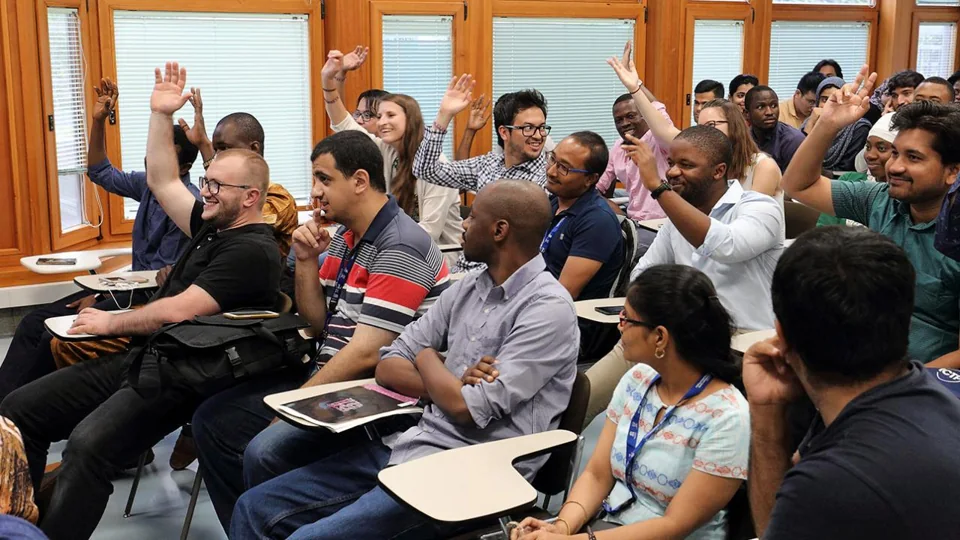
The Associates Programme dates to ICTP’s foundation in 1964. It supports continuing relationships with scientists who hold a PhD and work in developing countries. Rather than requiring a permanent move to Trieste, it enables recurring visits through which researchers can exchange ideas with specialists and follow developments in their subjects. The programme explicitly connects this contact with reducing scientific isolation and supporting research communities in participants’ home countries.
Its main categories are Junior, Regular and Senior Associates, reflecting different career stages. The published standard associateships run for six years, with travel and living support governed by the relevant category and award conditions. Associates remain active in their own institutions and are expected to contribute to education, research planning and scientific community building. The emphasis is therefore on a continuing professional relationship. An award provides an organised route to visits and collaboration, with the precise entitlement depending on its published terms.
Sources: Associates Programme ↗
Scientific capacity building beyond Italy
ICTP’s outreach work takes research and training into the regions it aims to support. Its science outreach description includes training activities, research networks and affiliated centres in developing countries. Scientists and scientific institutions in those countries initiate activities, which take place within the region. This structure gives local researchers a role in identifying the subjects and forms of cooperation most relevant to their circumstances.
The stated purposes include research and training connected with locally available resources or regional problems, stronger national and regional scientific communities, and better teaching in physics and mathematics. Supporting institutions and scientific societies forms part of that approach. Partner institutes, affiliated centres and networks offer different forms of connection with ICTP. These activities extend its educational work beyond individual visits to Trieste, linking the development of researchers with the capacity of the organisations where they teach and conduct investigations.
Sources: Science Outreach ↗
Library resources and scientific information
The ICTP Library supports research and teaching across the centre’s scientific subjects. It provides book and journal catalogues, electronic resources and assistance from library staff. Another responsibility is preserving documentation of ICTP’s institutional history. Its work also includes programmes that help disseminate scientific literature in least developed countries, connecting information services with the centre’s wider international mission.
At the November 2026 review, the library website reported an extraordinary renovation closure of its physical space while staff services continued. Readers could request physical books through the catalogue and access licensed digital resources on the ICTP network. The notice directed visitors seeking help to library staff in the Leonardo Building. This distinction matters when describing facilities: the library service and its resources continued to support academic work even while the reading space was temporarily closed. Visitors should consult the library’s current information for access arrangements.
Sources: ICTP Library ↗