Visa
About Academy of Fine Arts of Florence
An academy within Florence’s artistic history
The Academy of Fine Arts of Florence, or Accademia di Belle Arti di Firenze, is an institution of higher artistic education based at Via Ricasoli 66 in Florence, Italy. Its history connects the city's traditions of artistic training with the development of contemporary visual practice. The academy traces its lineage through Florentine professional associations and the sixteenth-century Accademia del Disegno associated with Giorgio Vasari and the patronage of Cosimo I de' Medici.
A decisive reorganization came in 1784 under Grand Duke Pietro Leopoldo of Lorraine. The institution took the name Accademia di Belle Arti and moved into the former Hospital of San Matteo. Its renewed educational project joined artistic instruction with ambitions for the improvement of Tuscan artistic manufacture. Painting, sculpture, architecture, ornament and copper engraving were established as teaching subjects. Art collections, plaster casts and a library provided resources for learning. Later generations included artists associated with the Macchiaioli, among them Giovanni Fattori, Telemaco Signorini and Silvestro Lega, linking the academy's history to changes in Italian painting.
Sources: Academy history ↗
Study across visual, design and performance disciplines
The academy's published course map brings together established fine art disciplines and applied or interdisciplinary fields. Its first-cycle offering includes painting, sculpture, printmaking, decoration for visual arts, graphic design, interior design, museum education and new art technologies. Scenography includes routes concerned with theatre, cinema, and costume for performance and fashion. The combination gives the institution a scope extending from the making of individual artworks to the design of environments, images and public cultural experiences.
Second-cycle study listed in the course map includes illustration, exhibit design, painting methodologies, new expressive languages and plastic design for theatrical scenography. Visual Culture provides directions in artistic curating and art education. The map identifies its course information with the 2025–2026 academic year and distinguishes active programmes from those being phased out. Specialist study also includes contemporary jewellery, developed with LAO Firenze. The different course titles reflect a teaching community spanning studio practice, communication, display, performance and the interpretation of art.
Sources: Published course map ↗
Learning to observe and draw the human figure
The Scuola Libera del Nudo preserves a particular strand of Florentine artistic teaching: working directly from the human figure. The academy describes it as open to people interested in drawing without restrictions based on age or previous educational background. Its teachers contribute approaches from artistic anatomy, painting and sculpture, including the modelling of small clay studies. Lessons address drawing, painting and modelling as related ways of observing and representing the body.
Participants may also attend printmaking techniques and art history courses during the academic year. There is no final assessment in this school; teachers instead support participants through focused instruction intended to develop specific technical abilities and knowledge. Its position within the academy keeps a longstanding method of artistic study in dialogue with contemporary work, while providing a form of participation distinct from the degree programmes.
Sources: Scuola Libera del Nudo ↗
Library resources and access to books
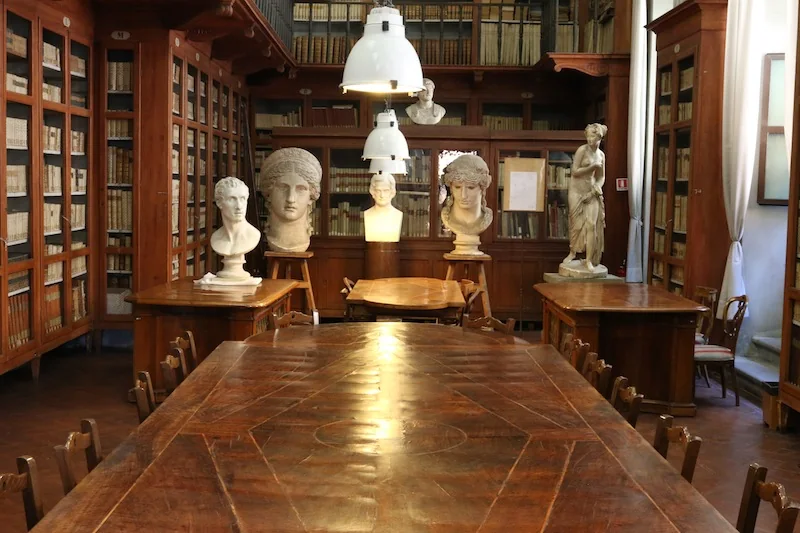
The academy library supports study through a reading room, an online catalogue and a managed system of consultation and lending. Its collaboration with the Humanities Library of the University of Florence allows academy students and teachers to access consultation and loan services at that university's library locations, including art history. This extends the resources available for research beyond the academy's own collection.
Library staff distribute material for consultation, while external loans are reserved for academy teachers and students. The published rules distinguish circulating books from protected or reference material. Older books printed before 1900, manuscripts, drawings and prints are among the materials normally excluded from lending, as are works in fragile condition. Exhibition catalogues, journals, encyclopaedias and dictionaries are retained for consultation. These arrangements serve both the practical needs of current study and the preservation of a historical collection.
Sources: Academy library ↗
An archive of artistic education
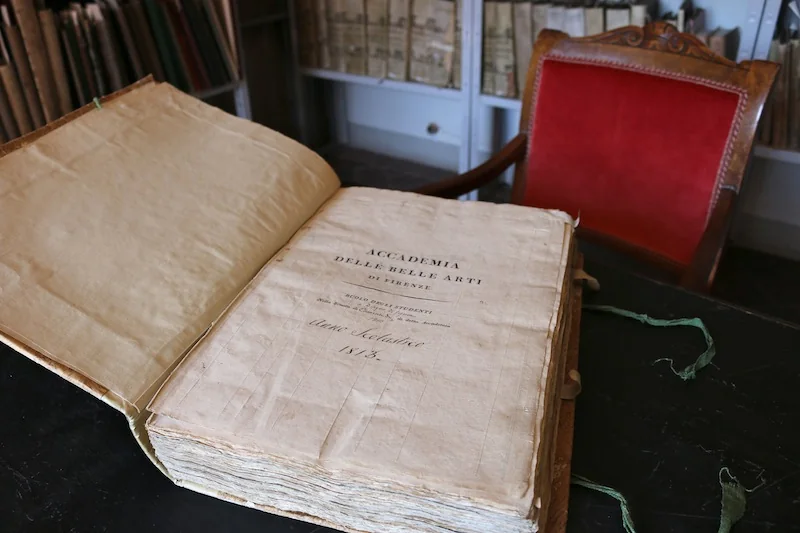
The Historical Archive preserves evidence of the academy and its predecessors, with documentation beginning in 1611. Its holdings allow researchers to follow institutional decisions, correspondence and the history of artistic education over long periods. Among the identified documentary series are academy acts from 1784 to 1873, letters and documents from 1784 to 1918, records concerning suppressed convents during French administration from 1808 to 1814, and registers of academy enrolment from 1812 to 1940.
The archive also holds a collection of drawings first organized by Felice Carena and Luigi Biagi in 1924 and subsequently updated. It documents Italian artists working from the late nineteenth century onward. Consultation is arranged by appointment, with researchers asked to identify their subject of study. Written records and visual material therefore provide complementary routes into the academy's artistic and educational history.
Sources: Historical archive ↗
Showing contemporary work through STARTpoint
STARTpoint began in 2009 from an initiative of academy president Paolo Targetti. It brought the institution's contemporary production into a shared public programme, creating opportunities for students and former students to show their work in cooperation with cultural organizations. The academy describes a format combining exhibitions and performances with encounters involving people active in contemporary art and culture.
Each edition reflects curatorial choices made by academy teachers together with external cultural professionals. The institution's graphic office develops its coordinated visual identity. STARTpoint thus links several kinds of practice: producing artworks, selecting and presenting them, designing communication and working with cultural partners. It extends the academy's educational activity into public settings across Florence and its surrounding cultural network.
Sources: STARTpoint ↗