Visa
About Accademia di Belle Arti di Roma
A historic institution for artistic education
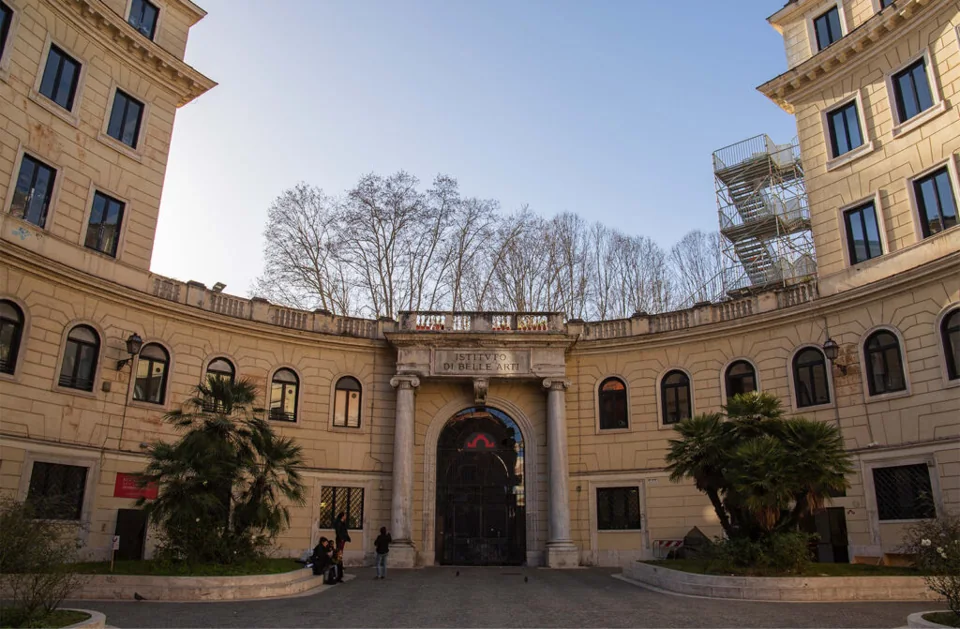
Accademia di Belle Arti di Roma traces its origins to the Accademia di San Luca, established towards the end of the sixteenth century as a centre for artistic study under papal authority. Its institutional history describes San Luca as both a meeting place for artists and an influential educational model. Italian unification and Rome’s emergence as the national capital brought demands for artistic education suited to the new state, including cultural research and professional activity connected with industry and craft.
The institution passed through the names Regia Accademia di Belle Arti denominata di San Luca and Istituto di Belle Arti before adopting its present name. Its historic Via di Ripetta complex, known as the Ferro di Cavallo, was built in the 1840s and adapted for academy use, with specially designed accommodation for the life-drawing school. The academy also identifies Campo Boario, Ex Fienili and Via del Corso among its locations.
Sources: History and locations ↗
Visual arts, communication and applied practice
The first-level offer is organised across Visual Arts; Communication and Art Education; and Design and Applied Arts. Visual Arts includes decoration focused on architectural spaces and landscape, art printmaking, painting and sculpture. Communication and Art Education encompasses communication and enhancement of contemporary artistic heritage, alongside art education and communication.
Applied subjects include photography and video, audiovisual theory and techniques, multimedia and technological arts, fashion cultures and technologies, design, editorial graphics and scenography. The range connects established studio disciplines with moving images, publishing, spatial work and digital media.
Second-level courses offer more specialised directions. The published list includes environmental art and experimental languages, illustration and art publishing, paper materials technology, and sculpture pathways concerned with environmental or public work and new technologies. Further options address curatorial practice, museums and exhibitions, art for therapy, cinematography, editorial photography and new artistic languages. Fashion-related pathways distinguish costume for performance, fashion design and jewellery design, while other programmes include graphic design, sustainable design and scenography for theatre or multimedia.
Sources: First-level academic courses ↗ · Second-level academic courses ↗
Library resources for study and research
The Linda Pisani Library supports the academy’s teaching and research through collections covering art history, visual arts, design, scenography, publishing graphics, audiovisual work, photography, fashion, theatre, cinema, architecture, museology and art education. It is named after the academy’s former cultural heritage lecturer and scholar of late Gothic and Renaissance Tuscan art. Her personal library, donated by her family, forms a distinct collection.
The library belongs to Italy’s national library service and participates in the RMS network catalogue. Registered internal and external readers can consult its resources. Institutional users have access to subscribed electronic journals and research platforms, while external visitors can use designated reading-room workstations with a guest account. Staff provide reference assistance with catalogues, databases and bibliographic research. Alongside books, the collection includes historical European periodicals on art, architecture, design, literature and aesthetics.
Sources: Linda Pisani Library ↗
Preserving institutional memory and exhibiting art
The historical archive holds documentation produced from the institution’s establishment as the Royal Institute of Fine Arts under the June 1874 royal decree. Its main series concern classified administrative records, professors, students, prizes, final competitions and registers. Located on the ground floor of the Ripetta building, it has an on-site digital ARCHIUI inventory and arrangements for scholarly consultation by appointment.
The Galleria Accademia Contemporanea provides a public exhibition space within the academy. Its neoclassical setting was designed by Pietro Camporese the Younger and comprises three aisles divided by Doric columns, with a coffered barrel vault above the central aisle. Following refurbishment in late 2023, the space became a setting for contemporary research and experimentation. Its temporary exhibitions bring artists and artistic projects into contact with students, teachers and the wider visiting public, with free admission.
Sources: Historical archive ↗ · Galleria Accademia Contemporanea ↗
International exchange and practical experience
The academy’s Erasmus arrangements encompass students, teaching staff and administrative personnel, with both incoming and outgoing mobility. Student opportunities distinguish study exchanges from traineeships. Teaching mobility can involve lectures, conferences or workshops agreed with a partner institution, while staff training supports professional exchange and the sharing of administrative practice.
The Placement Office manages curricular internships that complement academic study through practical activity with outside organisations in Italy or abroad. These opportunities concern students on first- and second-level academic diploma courses and other academy training routes. The internship’s educational project defines how the activity is organised, with credits linked to the student’s study plan. The office publishes the agreement and training-project documentation used to arrange placements, connecting academic learning with experience in external professional settings.
Sources: Erasmus ↗ · Placement Office ↗
Accessibility during the academic journey
The Inclusion Office supports students with disabilities, specific learning disorders, neurodivergence and particular accessibility requirements. Its work includes assessing requests for educational accommodations, arranging support for entrance and course examinations, managing tutoring requests and coordinating Italian Sign Language interpreting for deaf students. It liaises with teachers and other academy services where necessary.
Arrangements are considered in relation to the documentation supplied and the characteristics of the activity or examination. Examples include additional time, compensatory tools, adapted presentation of instructions and appropriate tutoring support. The academy states that accommodations preserve the course’s educational objectives and expected learning outcomes. Appointments take place at the Via del Corso location, with online meetings possible where appropriate.
Sources: Inclusion and accessibility ↗