Visa

About Accademia di Belle Arti di Macerata
An arts academy rooted in Macerata
Accademia di Belle Arti di Macerata, often abbreviated to ABAMC, is an institution of higher artistic education in Italy’s Marche region. It was established in December 1972 by a presidential decree signed by Giovanni Leone. Its creation followed efforts by local public bodies and the wider community to add an academy of fine arts to a city already associated with university education. The academy initially occupied Palazzo Buonaccorsi, remaining there until the 1997 earthquake that affected Umbria and Marche.
The institution belongs to Italy’s AFAM system of higher artistic, musical and choreographic education. Its academic identity brings practical artistic production together with theoretical study and research. First and second level academic diplomas form an important part of its provision, alongside specialist restoration education. Relations with cultural organisations, exhibitions and practical placements connect its teaching to artistic activity beyond the classroom.
Sources: The Academy: history and identity ↗
Visual arts, applied arts and design
The academy organises its teaching through departments and schools covering visual arts, design, applied arts, communication and art education, and restoration. Its visual arts provision includes painting, contemporary decoration, art graphics and illustration, and sculpture incorporating new technologies. These subjects appear within three year first level and two year second level pathways, with advanced options including illustration for publishing and contemporary painting.
Applied arts extend this range into photography, comics and illustration, stage design, visual and multimedia communication, and cinema directing and new media. Design programmes address graphic, fashion, lighting and interior design. Advanced study includes web interaction design, visual lighting design and fashion design for enterprise. Cultural heritage also has a distinct place: communication and enhancement of artistic heritage are complemented by second level study in museology and museum design. Together these fields connect image making with publishing, performance, digital communication, designed environments and the interpretation of collections.
Sources: Departments and schools ↗ · The Academy: history and identity ↗
Restoration and material knowledge
The academy’s five year single cycle restoration course combines conservation theory, scientific understanding, project development and practical work. In a May 2026 announcement, the school introduced the PFP1 specialisation for the 2026–27 academic year, adding stone materials and decorated architectural surfaces to its provision. This area addresses objects and surfaces such as plaster, stucco, marble, mosaics and mural paintings.
PFP1 complements the existing PFP2 pathway, which concerns paintings on wooden and textile supports, carved wooden objects, wooden furnishings and structures, and worked or painted synthetic materials. Teaching takes place in the restoration school’s laboratories in Montecassiano. The programme describes work on protected cultural property under professional restorers, together with restoration training sites devoted to different types of objects. This gives material investigation and supervised intervention a central role in the school’s approach.
A library for study and artistic research
The academy library acquires and preserves printed, documentary and multimedia resources for teaching, research and wider knowledge of the arts. It serves both the academic community and the public. Its holdings can be searched through Biblio Marche Sud, while the regional MLOL digital library extends access beyond printed collections. Periodicals cover art, photography, design, cinema, theatre and conservation, including titles such as Artforum, Domus, Cineforum and Kermes.
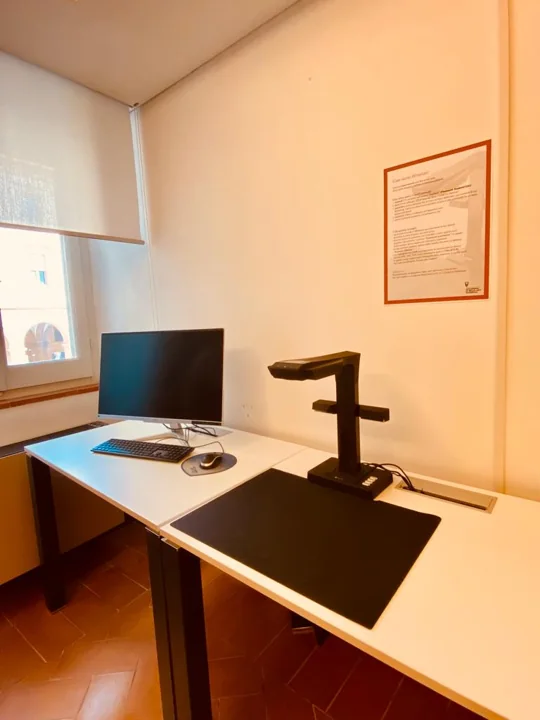
Study rooms, internet access and a book scanner support everyday research. A library equipment announcement published in December 2021 documents a computer workstation, scanning equipment with text recognition and tablet access. Library staff also assist with bibliographic searches and thesis preparation, including references, citations, layout and the treatment of images. Students can consult selected earlier theses as examples and request individual advice. A separate restoration library collection is available for consultation by appointment and remains on site to support specialist teaching.
Sources: Library and student research services ↗ · Library scanning and computer equipment ↗
GABA.MC and public encounters with art
GABA.MC, the academy’s gallery, was formally established in 2015. It is attached to Palazzo Galeotti, a property of Fondazione CARIMA made available to the academy through a free loan agreement. The gallery’s purpose is to sustain exhibitions and events involving established and emerging artists, with an emphasis on experimentation, research and contemporary visual culture.
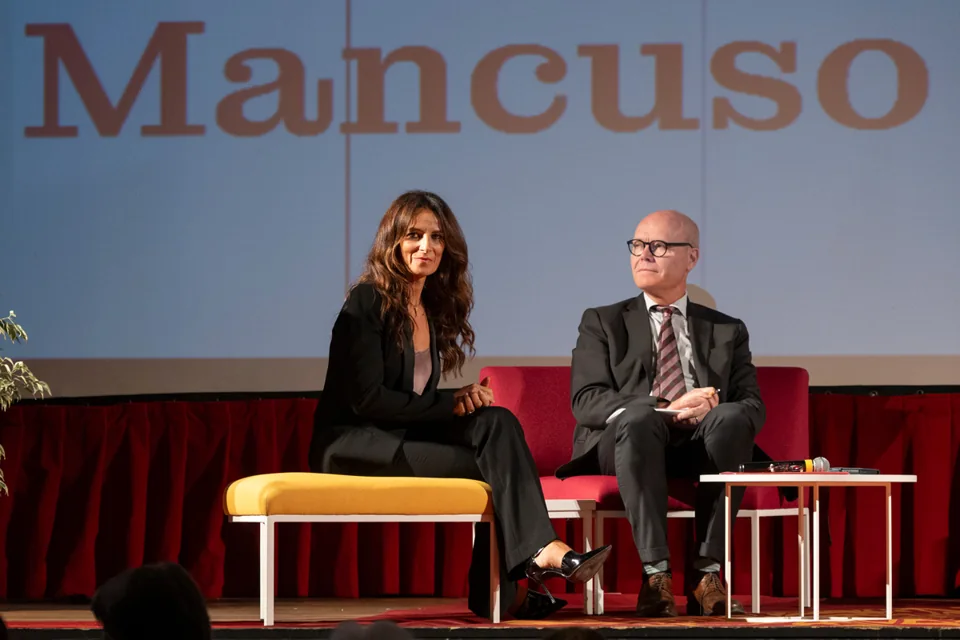
Its exhibition archive includes projects devoted to Grazia Varisco, Wladimiro Tulli, Adolfo De Karolis and photographer Emanuele Scorcelletti. The academy also maintains a Mediateca containing recorded events and conversations. Its listings include discussions with artists, photography encounters, sculpture initiatives and academic inaugurations. These resources document a cultural programme extending across different artistic languages. In October 2026, the academy announced an honorary research doctorate for plant scientist Stefano Mancuso at Cinema Italia in Macerata, accompanied by a public lecture within the Macerata Humanities Festival programme.
Sources: The GABA.MC gallery ↗ · GABA.MC exhibition programme ↗ · Mediateca: recorded encounters ↗ · Stefano Mancuso honorary doctorate event, October 2026 ↗
International study and practical exchange
Erasmus activity provides another connection between the academy and institutions beyond Macerata. Students can undertake study periods at partner institutions, attending classes and completing examinations that contribute to their ABAMC studies. Traineeship mobility offers a separate route through placements with organisations or companies. The academy publishes a partner list and encourages students to compare host curricula and language requirements with their own academic pathway.
A Learning Agreement records the proposed educational activities and involves the student, home institution and host organisation. Academic coordinators approve the relevant subjects and their recognition. This planning links the period abroad to the student’s existing programme, whether the experience centres on coursework, thesis research or practical training. The international office’s information therefore connects mobility with the substance of artistic study and its formal academic record.
Sources: Erasmus information and frequently asked questions ↗