Visa
About Accademia di Belle Arti di Carrara
An arts academy rooted in Carrara
The Accademia di Belle Arti di Carrara is an Italian fine arts academy whose history is closely connected with the city’s marble industry and artistic workshops. Its official foundation dates to 26 September 1769, under Maria Teresa Cybo, Duchess of Massa and Princess of Carrara. The founding project combined the development of the arts with support for the production and trade of marble.
Today its departments coordinate teaching, research and artistic production across a broader range of disciplines. Visual Arts includes decoration, printmaking, painting and sculpture. Communication and Art Education includes the art education school, while Design and Applied Arts brings together cinema, photography and audiovisual work, design, comics and illustration, new art technologies and scenography. This structure places traditional studio disciplines alongside contemporary forms of image-making and communication.
Sources: History ↗ · Departments ↗
Founding schools and later developments
An earlier proposal for an academy dedicated to San Ceccardo had received statutes in 1757 but did not become operational. The 1769 foundation established schools of sculpture and architecture. Giovanni Antonio Cybei directed sculpture, while Filippo Del Medico oversaw architecture and designed the academy’s first purpose-built premises. Construction began in 1771 on the building now known as Palazzo Rosso.
The academy’s teaching expanded during the nineteenth century, including history, mythology and pictorial anatomy. Elisa Bonaparte assigned it its present palace in 1810. The institution later added painting in 1969, scenography in 1978 and decoration in 1991, extending an educational identity that had long centred on sculpture.
Sources: History ↗
Learning through sculpture and materials
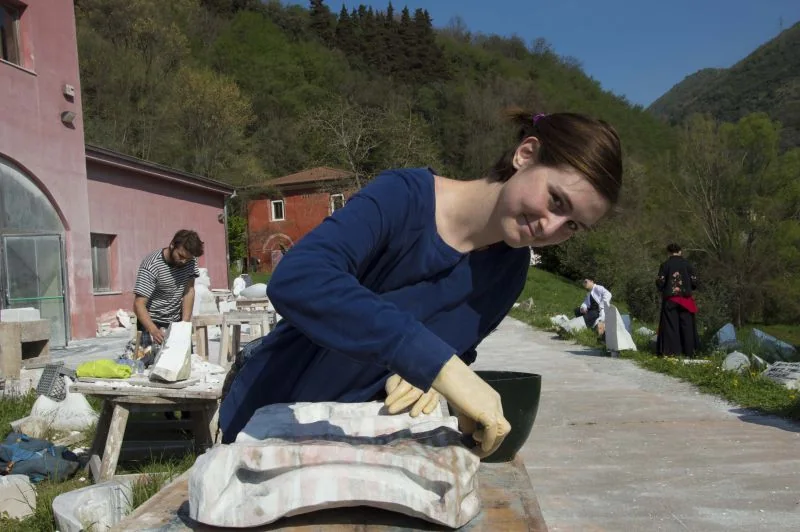
The School of Sculpture connects its work with the local culture of marble carving while encompassing installations, environmental work and projects developed for particular sites. First-level study combines sculpture studios with marble and hard-stone techniques, mould-making, material technologies and foundry techniques. The course aims to help students develop a personal artistic investigation through both established processes and new expressive languages.
Second-level sculpture studies provide more specialised practical and theoretical work. The school also describes digital sculpture study introduced in 2019, connecting complex forms with contemporary production methods. Its account includes projects, exhibitions, competitions and internships within the educational experience. The relationship between hand skills, material understanding and technological experimentation is central to the way the school presents its teaching.
Sources: School of Sculpture ↗
Digital scanning and robotic fabrication
The academy’s robotic facility connects three-dimensional digital records with physical production. Two structured-light scanners acquire digital models of statues and other objects. The resulting files can support documentation and study, as well as reproduction through computer-controlled equipment.
A robotic milling installation uses a KUKA robot fitted with a rotating head to work from scanned models. The official account identifies the production of twelve copies of Lunigiana statue-stelae for the Ubaldo Formentini museum in La Spezia as one application. This facility brings processes of recording, modelling and manufacture into the academy’s practical resources, linking the treatment of cultural objects with contemporary methods of fabrication.
Sources: Robotic fabrication ↗
Multimedia and new artistic technologies
The first-level Multimedia Arts course combines theoretical and technical preparation with experimentation across digital and interactive arts. Areas of practical work include video production and postproduction, sound design, three-dimensional modelling and animation, interactive environments, multimedia storytelling and creative uses of artificial intelligence. Critical examination of generative models accompanies their use as tools.
Second-level Net Art and Digital Cultures examines relationships between artistic practice, technology and contemporary culture. Its areas include live media, interactive installations, immersive environments, exhibition design and digital aesthetics. Studio and interdisciplinary work encourages students to develop audiovisual environments and performances while investigating how artistic ideas operate across physical and virtual settings. Projects with cultural organisations form part of the school’s described teaching approach.
Sources: School of New Art Technologies ↗
Palace and artistic collections
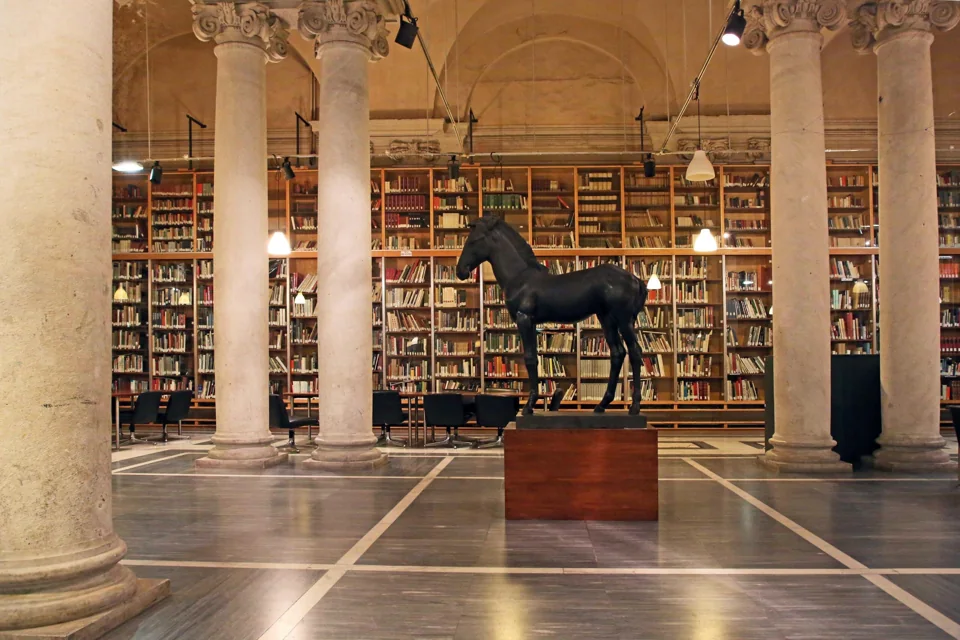
The academy’s headquarters combine a medieval stronghold with later princely architecture. Courtyards, historical rooms and surviving decorative elements preserve traces of Carrara’s political and cultural history. The Sala delle Colonne houses the library, while the Aula Magna occupies a former reception room of the prince, with a painted coffered ceiling and substantial plaster casts.
The Gipsoteca contains approximately three hundred plaster works, including casts after ancient sculpture, reliefs and models from the nineteenth and early twentieth centuries. It grew from materials used for sculpture teaching and benefited from donations by artists and local families. Works associated with Antonio Canova, Lorenzo Bartolini and Bertel Thorvaldsen appear alongside those of former students who became established sculptors, documenting changing approaches to figurative art.
Sources: Cultural heritage ↗ · Plaster cast collection ↗
Library, archives and public study
The library supports teaching and research through modern publications, historic books, graphic art and archival collections. Its historical records include administrative registers, inventories, correspondence and teaching reports. Special collections associated with Carlo Del Medico, Ezio Dini and Domenico Zaccagna add further documentary material, while local-history holdings explore Carrara and the surrounding territory.
Participation in the provincial Re.Pro.Bi library network connects the collection with an online catalogue and shared services. The Sala delle Colonne provides thirty places for reading and consultation. Services include local and interlibrary loans, document delivery and digital resources through MLOL and NILDE. Historic and archival documentation can be consulted by prior arrangement. These resources connect the academy’s specialised artistic studies with public access to its documentary heritage.
Sources: Library ↗