Visa
About Academy of Music Vincenzo Bellini
Palermo’s historic conservatory
The Academy of Music Vincenzo Bellini listing refers to the Palermo institution now called the Conservatorio di Musica Alessandro Scarlatti, formerly Vincenzo Bellini. It is a specialist centre of higher musical education in Sicily, combining instrumental and vocal training with composition, ensemble work and the study of musical heritage. Its current official website uses the Alessandro Scarlatti name and explicitly identifies its earlier Bellini identity.
The conservatory traces its origins to 1617, when Viceroy Count De Castro established the Orfanotrofio del Buon Pastore in the former convent of the Santissima Annunziata. Musical teaching began in 1721 under Giuseppe Biondo and became the institution’s exclusive activity in 1747. Its history therefore connects a charitable foundation with the gradual development of a dedicated musical school.
Sources: About the conservatory ↗ · Institutional history ↗
Four centuries of institutional development
The nineteenth century brought important changes under administrator Pietro Pisani, who took charge in 1831. He provided a theatre, new instruments and additional manuscript and printed music, and brought Pietro Raimondi from Rome to direct the institution. Later directors included Pietro Platania, Giorgio Miceli and Guglielmo Zuelli. During Zuelli’s directorship, the institution’s Bellini dedication was consolidated and a concert hall dedicated to Alessandro Scarlatti was built in 1905.
A monumental library and museum of valuable musical instruments had already been established in 1888. The conservatory suffered serious damage during the Second World War, including the destruction of its theatre and large concert hall in the bombing of May 1943. Many artworks, instruments, manuscripts and scores were saved. The surviving collections remain an important link between the institution’s educational activity and the musical history of Palermo.
Sources: Institutional history ↗
A range of musical study
The current first-level course directory illustrates the breadth of musical specialisation available at the conservatory. Its opening pages include harp, violin-related and other string study, electric bass, tuba, jazz drums and percussion, singing, jazz singing, Renaissance and Baroque singing, classical guitar, jazz guitar, clarinet and jazz clarinet. The directory identifies the departments and schools associated with individual courses, allowing students to move from a subject list to more detailed programme information.
The course organisation places historical and contemporary musical practices within the same institution. Jazz and newer musical languages appear alongside classical instrumental and vocal disciplines, while early music has its own specialist forms of study. The conservatory also publishes separate directories for second-level study and other educational routes. This structure supports different stages of musical development and a choice of repertoire, instrument and artistic approach within a specialist music environment.
Sources: First-level courses ↗
Collections within the historic building
The conservatory’s heritage route begins in the entrance vestibule, where a lapidarium brings together marble busts, commemorative inscriptions and architectural fragments. Among its objects is a bust of Vincenzo Bellini by Joseph Michel Ange Pollet, commissioned for the composer’s visit in 1832. The collection also includes portraits associated with the institution’s founder and other figures in its history.
On the first floor, the former refectory houses the picture collection in a room dedicated to Vincenzo Mannino. Portraits commemorate musicians and administrators, while historical display cases preserve documents and manuscripts. Paintings, photographic portraits, furnishings and musical objects extend the collection beyond scores alone. These spaces make the conservatory’s past visible within the building used by its present community, connecting musical education with architecture, visual art and the material evidence of earlier artistic life.
Sources: Art and historical collections ↗
A library for musicians and researchers
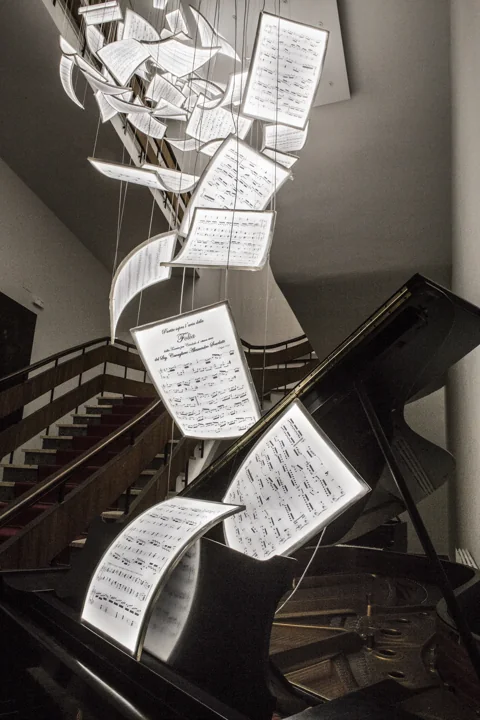
The library serves local students and teachers as well as researchers interested in Sicily’s musical past. Its general collection includes books, periodicals and complete editions of composers’ works. Historical holdings include early printed treatises and music, eighteenth-century cantatas and arias, and manuscripts of sacred, operatic, orchestral, chamber and piano music written or performed in Sicily during the nineteenth and early twentieth centuries.
Particular collections include rare piano editions associated with Gustavo Natale and his family, and jazz scores and recordings donated by Claudio Lo Cascio. Institutional documents preserve evidence of the conservatory’s own development. The library also identifies unusual surviving sources, including manuscripts associated with Pietro Raimondi and the oboist Antonio Pasculli. An online catalogue gives readers a route into the holdings, while staff contacts and consultation arrangements support more specialised enquiries.
The library’s RISM identifier is I-PLcon, linking its holdings with the international system used to identify musical source collections.
Sources: Library ↗
Orchestral work and international exchange
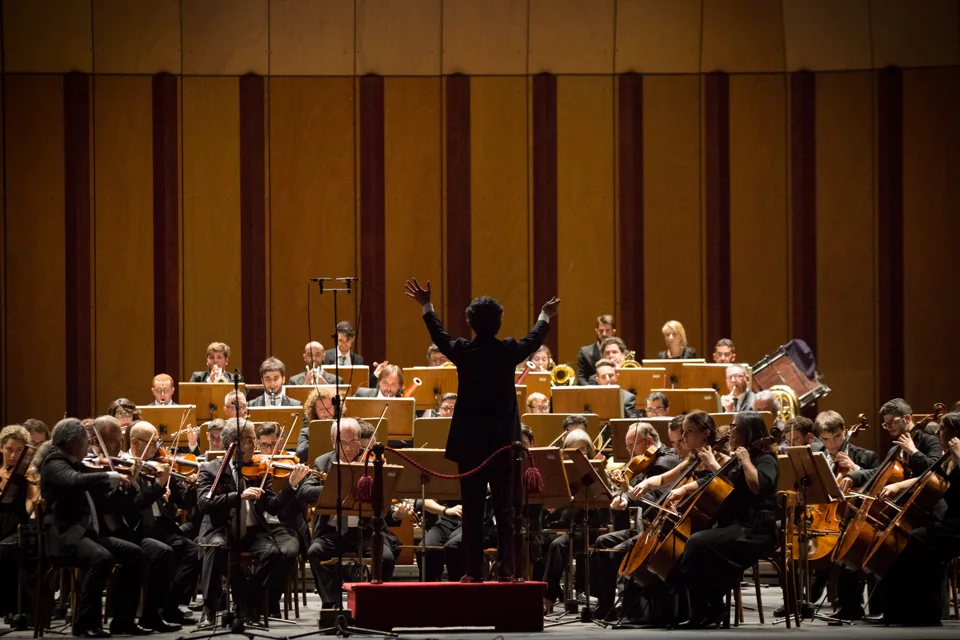
The conservatory’s symphony orchestra performs in its own programmes and as a guest ensemble at musical events in Sicily. Its repertoire extends from eighteenth-century music to contemporary work. The orchestra’s published account also links performance with research into the musical holdings of the conservatory library, showing how preserved material can return to public musical life.
International activity is supported through Erasmus cooperation. Incoming exchange students work with the conservatory’s Erasmus office and the relevant department to arrange study and teaching schedules. The published guidance identifies Italian as the teaching language and specifies B1 competence for incoming students. First- and second-level courses use the European credit transfer system, supporting the academic organisation of mobility periods. Alongside classroom and individual instrumental study, exchange students can encounter the institution’s artistic activities and its broad range of classical, early music and jazz teaching.
Sources: Symphony orchestra ↗ · Erasmus cooperation ↗