Visa
About Academy of Music "Georghe Dima" Cluj-Napoca
A music academy in Cluj-Napoca
The institution listed as the Academy of Music Georghe Dima Cluj-Napoca is today the National Academy of Music Gheorghe Dima, or Academia Națională de Muzică Gheorghe Dima. Located in Cluj-Napoca, Romania, it combines musical performance, composition, musicological study and artistic research. Its official history dates its founding as a state institution to 1919, while distinguishing that foundation from the earlier Hungarian conservatory established in the city in 1819.
The conservatory initially taught theory and solfeggio, harmony, composition, singing, piano, violin, cello, diction and declamation. Its curriculum later expanded to include additional instruments, music history, aesthetics, chamber music, acoustics and orchestral work. A music teacher training section opened in 1922 and became a faculty in 1933. Composers Sigismund Toduță and Cornel Țăranu are among the figures identified in the institution’s account of its teaching and scholarly development.
Sources: Institutional history ↗
Instrumental, vocal and stage study
The Faculty of Musical Performance prepares students in instrumental and vocal performance as well as musical theatre direction and choreography. Its departments group string, wind and percussion instruments; keyboard instruments and instrumental ensembles; and singing with the performing arts. This structure connects individual instrumental preparation with ensemble work and stage disciplines.
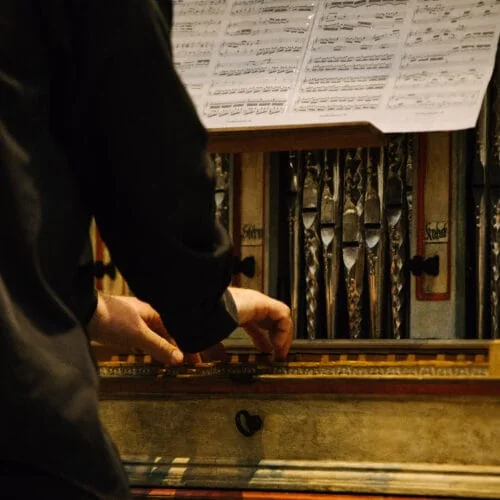
The instrumental programme encompasses violin, viola, cello, double bass, classical guitar and harp; woodwind and brass instruments; percussion; and keyboards including piano, organ and harpsichord. The published bachelor’s programmes in instrumental performance, singing, musical theatre direction and choreography each have a four-year duration and 240 credits. The faculty also lists instrumental performance taught in English. Its range therefore includes both concert performance and forms of musical presentation involving movement, dramatic interpretation and stage organisation.
Sources: Musical performance faculty ↗
Composition, musicology and conducting
The Theoretical Faculty provides another route into musical work through composition, musicology, conducting and music study. Composition connects contemporary musical language with formal analysis, the development of an individual compositional project and decisions about style and expression. The programme also emphasises documentation, reasoned artistic judgement, self-evaluation and collaboration.
Musicology combines musical literacy and listening with analysis, historical context and the writing of scholarly or critical work. Conducting study develops the ability to analyse orchestral, choral and vocal-symphonic repertoire and to communicate that understanding through practical interpretation. These programmes relate the written score to sound, form and style rather than treating theory as separate from performance. The faculty’s published music programme is three years and 180 credits, while composition, musicology and conducting are presented as four-year bachelor’s routes.
Across these subjects, the faculty identifies communication, teamwork and independent judgement as educational aims. Its course descriptions connect specialist musical skills with critical reasoning, ethical responsibility and the ability to assess one’s own developing work.
Sources: Theoretical faculty ↗
Library collections and digital access
The academy library supports study through books, scores, periodicals and specialist documentation. Its collections include dictionaries, biographies, musical analyses, folklore collections, critical studies, older treatises, doctoral theses and teaching materials. Scores cover solo instruments, chamber ensembles, vocal music, choirs, orchestral and vocal-symphonic repertoire, including full scores, reductions and orchestral parts. Romanian music is represented alongside international repertoire.
An online catalogue helps readers locate material and manage their use of the collection. Registered users can review loans and obtain mobile access to selected databases. The library identifies resources including JSTOR, Oxford Music Online, RILM and other music-related electronic services. Since 2022, a digital library using the Omeka platform has supplied electronic material through personal accounts. The Piatra Neamț extension also has its own library, linked with the larger Cluj collection for material not held locally.
The collection also includes literature, art albums, aesthetics, philosophy, psychology and pedagogy, placing specialist music resources within a wider intellectual setting.
Sources: Library ↗
Learning through orchestral participation
Performance is part of academic life across both the performance and theoretical faculties, including through conducting and vocal ensemble participation. The academy’s ensemble directory encompasses choirs, orchestras, chamber groups, traditional music and contemporary music formations. It also distinguishes academy ensembles from groups operating under other cultural institutions whose members include academy teachers.
The Antonin Ciolan Symphony Orchestra has carried that name since the 2012–2013 academic year. Students perform alongside teachers who serve as concertmaster and section leaders, an arrangement intended to support integration into orchestral playing. Its projects bring in guest conductors and provide opportunities for selected student soloists. The orchestra’s name honours a conductor and teacher associated with the academy’s orchestral and conducting classes.
Sources: Ensembles ↗ · Antonin Ciolan Symphony Orchestra ↗
Traditional music and scholarly publishing
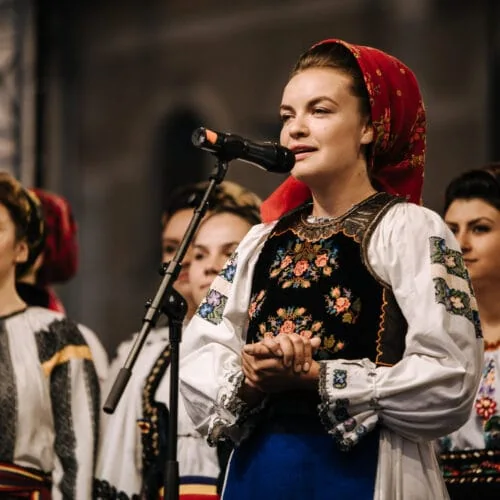
The Icoane Romanian traditional music ensemble grew from a group begun in 1995 and took its current form in 1999. It brings together students and graduates interested in folk tradition. Its performances draw on archival collections and field research, including material associated with life-cycle rituals and winter carolling. Vocal groups, individual performers and a Transylvanian instrumental trio contribute to its presentations.
The academy’s MediaMusica publishing house was established in Cluj-Napoca in 2001. Its work includes musical books with cultural, scholarly and teaching purposes, drawing on authors from the academic community. The publisher also has its own printing facilities. Alongside library services, ensemble activity and formal degree teaching, publishing provides a further means through which the academy’s musical knowledge, research and educational material circulate.
The ensemble’s documented recordings include Transylvanian carols and ritual songs, illustrating how performance and the study of musical traditions inform one another.
Sources: Icoane traditional music ensemble ↗ · MediaMusica publishing ↗