Visa
About Arts Academy in Split
An academy within the University of Split
The Arts Academy in Split, known in Croatian as Umjetnička akademija u Splitu, is a public higher education constituent of the University of Split. Its organisation brings together music, visual arts and theatre, supported by departments, a library and academic administration. The academy was established in 1997 from the existing art culture and music culture programmes. Its educational background extends further: art teacher education began at Split’s Pedagogical Academy in 1945, while a music teacher study group followed in 1957. These programmes passed through subsequent faculty reorganisations before the academy took shape. Theatre joined the institution in 2005. Alongside teaching, its stated activities encompass artistic creation, research, lifelong learning, publishing, exhibitions, concerts, performances and heritage conservation. This combination places the academy’s educational work within the wider artistic and cultural life of Split.
Sources: About the Arts Academy in Split ↗
Music and performance
Music education spans both creative and performing disciplines. The division lists studies in composition, music theory and music pedagogy, alongside piano, singing, violin, viola, cello, guitar, clarinet, flute and saxophone. Its departmental structure connects these subjects through areas such as strings and guitar, wind instruments, and composition and theory. Teaching combines lectures with mentored tuition and practical exercises. The division also describes guest teaching from Croatia and abroad, seminars, workshops and student productions. Concert activity is part of this environment: students encounter performance as an aspect of their studies, while the division contributes to cultural programmes in the city. Its account of student participation in competitions and public events illustrates how individual musical development is accompanied by experience of presenting work to audiences.
Sources: Music division ↗
Visual arts and conservation
The visual arts division covers painting, sculpture, art education, film and media, visual communication design, and conservation and restoration. These areas bring different forms of artistic practice into the same academy, from studio work and image making to the interpretation and protection of cultural objects. The division emphasises individual practical teaching and engagement with both traditional and contemporary artistic approaches. Its educational scope includes pedagogy as well as the development of artistic and design work. Exhibitions and workshops provide settings for presenting and discussing creative practice. Conservation and restoration connect the division with the heritage of Split and Dalmatia, extending learning beyond the studio to work with historic material. The division’s own history traces this broad provision back to the city’s earlier art teacher training programmes.
Sources: Visual arts division ↗
Acting and theatre education
Acting belongs to the theatre department established in 2005. Its educational approach centres on the development of an individual artistic personality, drawing on Croatian acting traditions, international theatre pedagogy and the Mediterranean cultural setting. The undergraduate programme is described as eight semesters carrying 240 ECTS credits. Practical work in acting, stage movement and speech is supported by subjects including dramatic literature, theatre history, dramaturgy, phonetics, art history, psychology and sociology. The master’s programme comprises two semesters and 60 ECTS credits, with mentored production and performance work accompanied by a written component. The department describes relationships with theatres in Split and other Croatian cities, festivals and cultural organisations. Collaboration with the academy’s film department also allows theatre students to encounter student film production alongside stage practice.
Sources: Acting studies ↗
A specialist arts library
Established with the academy in 1997, the library serves music, visual arts and drama. Its collections include reference works, monographs, periodicals, printed music, audiovisual material and graduate and doctoral work. The library supports academic study through access to databases and journals, interlibrary loans and assistance with student writing. Reading room computers, audio listening and digitisation contribute to its services. The catalogue uses the Metelwin system, enabling readers to search the holdings. Collections grow through purchases, donations and publication exchanges. Named bequests and donated collections include material associated with Kruno Prijatelj, Božidar Matas, Ranko Tudor, Silvije Bombardelli, Mirjana and Josip Škunca, and Miljenko Grgić. These holdings give the library a connection with the work of art historians, musicians and other cultural figures, alongside its support for current teaching.
Sources: About the library ↗
International academic exchange
The academy’s international student exchange information identifies Erasmus+ and CEEPUS as routes for academic mobility. Erasmus exchange is organised through agreements between a student’s home institution and the University of Split’s Arts Academy, with the relevant department involved in considering the proposed study period. The CEEPUS information identifies two subject networks: A.L.I.C.E. in visual communication design and ADRIART.CE in film and video. It also describes the possibility of CEEPUS freemover applications. These arrangements connect exchange activity with particular artistic disciplines rather than treating mobility as a separate course of study. The published guidance distinguishes the two schemes and explains their institutional framework, showing how incoming students’ plans are connected to the academy’s existing departments and teaching provision.
Sources: International student exchange ↗
Conservation fieldwork on Brač
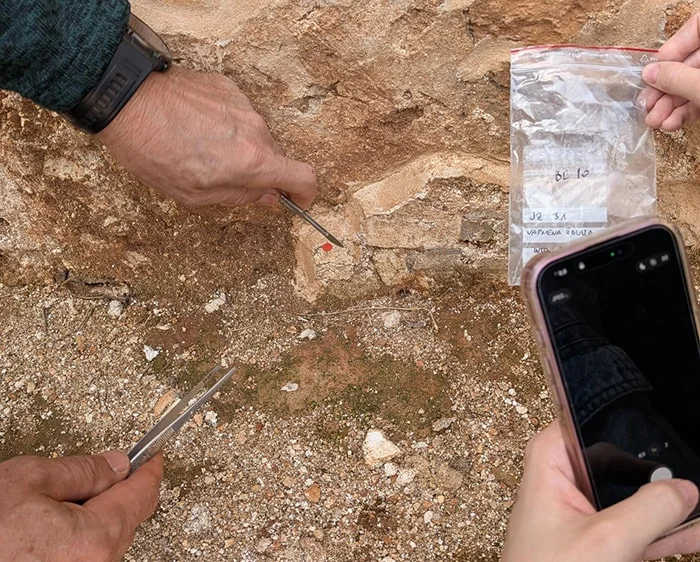
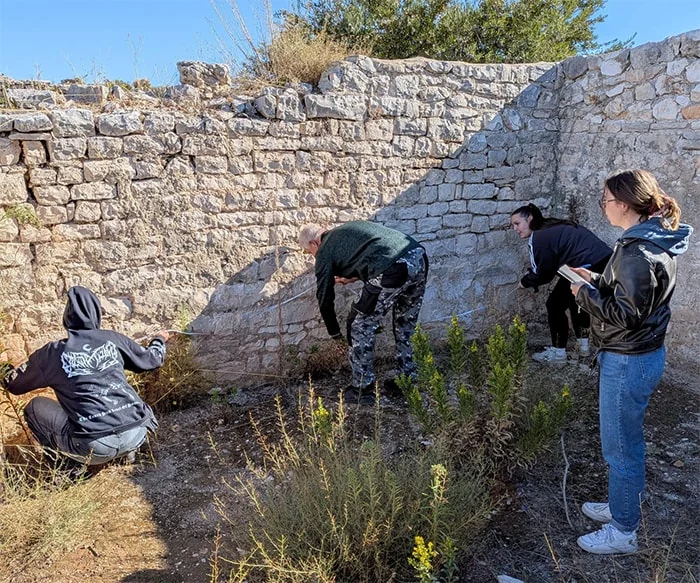
An academy report dated 25 October 2026 documents conservation work begun earlier that month at Mirje, above Postira on Brač. The conservation and restoration department investigated surviving late antique wall paintings, plaster and plastered floors. The programme included documentation, assessment of condition and research into materials and deterioration. Students in the second, fourth and fifth years of the integrated programme took part alongside academic staff. Postira municipality and Split-Dalmatia County cofunded the work, which was conducted under the supervision of the competent conservation department in Split. The project connects specialist teaching with the study and protection of archaeological remains.
Sources: Conservation work at Mirje, 25 October 2026 ↗