Visa
About Ansan University
From nursing education to a broader institution
Ansan University is located at 155 Ansandaehak-ro in Sangnok-gu, Ansan, Gyeonggi-do, South Korea. Its institutional history begins with the approval of the Saebit educational foundation in December 1971 and permission to establish a nursing school in Incheon the following year. The school opened on March 1, 1973, initially with a single nursing department.
The historical timeline records approval for nursing college status in 1978 and a move to new premises in Incheon in 1979. Its subject range broadened during the following decade. By 1981, the institution included nursing, clinical pathology, radiology, physical therapy, and food and nutrition. Early childhood education was added in 1984. These developments show how education originally centered on nursing expanded into other health professions and education. Today’s campus directions identify Sangroksu Station on Seoul metropolitan subway Line 4 as a public transport connection to the university.
Sources: Early history:1970s–1980s ↗ · Campus location and directions ↗
Names and academic development
The university’s official timeline records the Korean name Ansan Daehak from May 2011 and Ansan Daehakgyo from January 2012. It also documents the approval of a four-year nursing bachelor’s course in 2012. Later entries describe changes in study length, subject combinations and department names as the institution’s academic structure evolved.
The 2020s timeline identifies several more recent developments. Computer information and artificial intelligence software changed from two-year to three-year courses in 2023. Dental hygiene and emergency medical services were among the subjects added in 2024. In 2025, office administration and management were combined into marketing management, while smart content and multimedia design were combined into video design. The 2026 entries include the formation of public procurement from tax accounting and digital marketing, and the renaming of XR content design as game design. This sequence illustrates continuing reorganization across professional and creative fields.
Sources: University history:2010s ↗ · University history:2020s ↗
A library combining learning and institutional memory
The university’s Larchiveum provides an academic information service as well as preserving institutional records. Its stated role includes collecting and organizing materials needed for education and research, then making resources available in ways that respond to users’ learning needs. The department also supports the university’s integrated information services.
The academic information team’s listed responsibilities cover acquisition, registration, organization, management and use of library materials. Reference assistance and other user services form part of that work. The team operates reading rooms and resource rooms, along with a digital media center. Cultural events provide another dimension to its activities. Historical records are collected and managed, and a history exhibition room is maintained. The combination gives the Larchiveum a role in everyday study and in retaining the university’s own educational history.
Sources: Larchiveum library and academic information services ↗
Residence and shared student facilities
Yeji Hall is the university’s student residence. Its official description dates its opening to March 3, 2013, and describes a building with five floors above ground and two basement levels. The residence is presented as a place combining study, communal living and cultural activity. Educational and leisure programs are intended to support residents’ personal development.
The facilities list includes shared lounges equipped with televisions, tables, water dispensers, refrigerators and microwaves. Residents also have access to a fitness room and laundry facilities. A multipurpose room contains tables, seating, projection and sound equipment, and a table-tennis table. A dining room and convenience store are located in the basement levels. The residence’s emphasis on orderly shared living sits alongside these practical facilities, with its description connecting daily residential life to the university’s educational purposes.
Sources: Yeji Hall student residence ↗
Clubs for shared interests and subject study
Ansan’s club system includes both general-interest organizations and groups associated with academic departments. The university describes a registration process through AU-Wings, followed by recruitment and an application for club authorization. Announcements about the process are made through university notices and departments at the beginning of a semester.
General-interest examples include groups exploring generative artificial intelligence, the combination of AI with the Internet of Things, game creation, design projects, dance, music and badminton. Environmental and community service activities are also represented. Subject groups create additional settings for collaborative learning: computing students have DevCore, while design students share practical tools and ideas through Digital Design. Accounting groups bring students from different years together for study. Hotel and tourism groups explore coffee, beverages and service, and culinary groups work on cooking activities and competitions. The range connects shared interests with professional and creative study.
Sources: Student clubs ↗
Sharing a multidisciplinary project at Ansan Festa
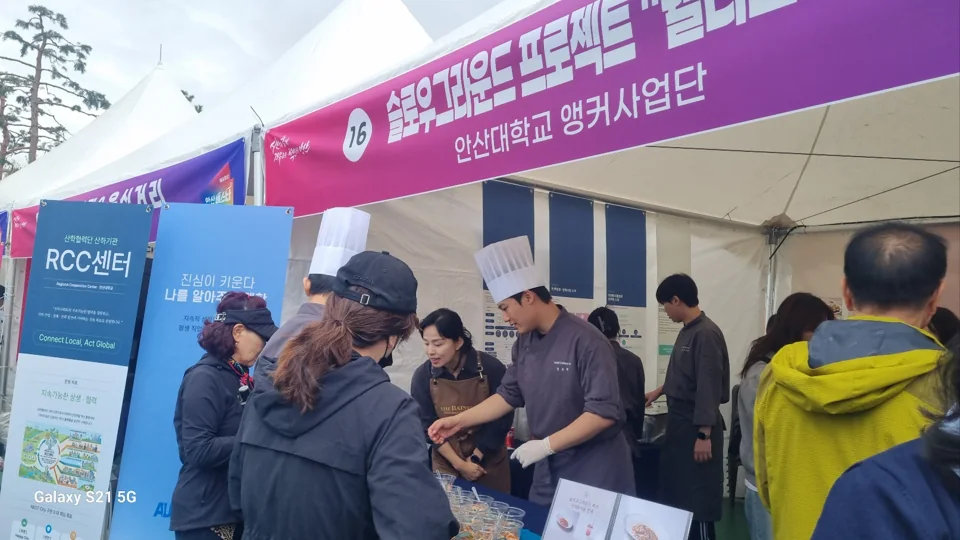
A university report published on November 3, 2026 describes participation in Ansan Festa on October 23–24. The Anchor project team and RCC Center operated a Slowground project exhibition involving work from four departments. Hotel culinary and food therapy departments had developed recipes during the summer and brought that work together in a booklet.
The exhibition introduced the project and its development to local visitors. Advertising design contributed the Slowground logo, while marketing management contributed an application demonstrated at the stand. Tastings allowed visitors to experience the food preparation work directly. Students and faculty gathered public comments as part of the activity. The report provides a concrete example of departments contributing different skills to one public event: culinary development, design, digital work and direct communication with the surrounding community.
Sources: Ansan Festa:Slowground project exhibition ↗
An academic event connecting coursework with professional discussion
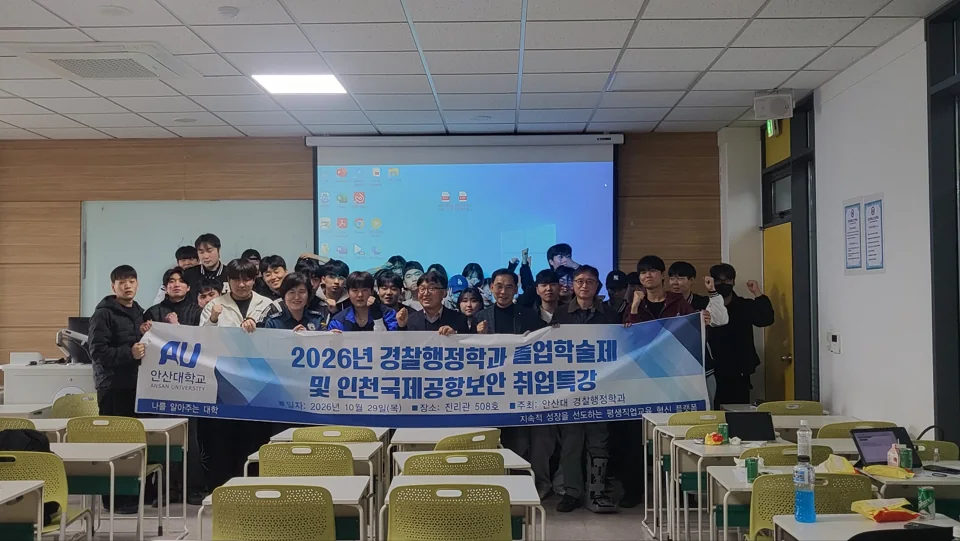
The Police Administration Department held its 2026 graduation academic festival on October 29, according to a university report published November 2. The program combined a discussion of airport security work with a lecture on preventing illegal gambling. An airport services executive introduced security screening, guarding responsibilities and preparation for work in that field. A serving police officer addressed gambling risks and related crime prevention.
The department described the event as an opportunity for students approaching graduation to connect their studies with information from practitioners. Its account identifies police martial arts, police security, security theory and crime prevention among the areas covered by its practical curriculum. The festival brought academic learning, professional perspectives and public safety discussion into the same classroom event, illustrating one form of contact between students and people working in their field.
Sources: Police Administration:2026 graduation academic festival ↗