Visa
About ACTS University
A Christian university in Yangpyeong
ACTS University is a Christian institution in Yangpyeong, Gyeonggi Province, South Korea. Its identity combines theological education, preparation for Christian service and an international interest in Asia. The university formerly used the English name Asia United Theological University. An official announcement issued in July 2021 records that its name changed to ACTS University on 1 July 2021. This distinction helps explain why older institutional pages and documents still carry the earlier name.
The university traces its beginnings to discussions at an evangelical conference in Singapore in 1968. Organisers envisaged an advanced centre for theological studies serving the region. A subsequent decision placed the proposed institution in Seoul. In 1973 its founding arrangements adopted the ACTS name, and its early development included theological study for students from other Asian countries. Graduate education expanded over the following decades: the university’s historical account records approval of a Graduate School of Theology in 1986 and doctoral theological study in 1989. A new library opened in 2004, while the chapel was reconstructed in 2013.
Sources: Historical background ↗ · Official announcement of university name change, July 2021 ↗
Educational purpose and Christian commitments
The educational philosophy describes a God-centred and evangelical approach to learning. It connects academic development with spiritual formation, personal character and service. International awareness and engagement with churches and society are part of this purpose. ACTS also emphasises cooperation across denominational boundaries, presenting church unity as a central concern rather than organising its identity around a single denominational tradition. Its stated ambitions therefore encompass both scholarly theological work and practical preparation for ministry. The philosophy also treats the student as a whole person: intellectual work is considered alongside attitudes, relationships and readiness to contribute. This gives academic instruction a role within a broader programme of Christian formation.
The university’s statement of faith sets out the religious framework underpinning this education. It affirms the authority of the Old and New Testaments, belief in the Trinity and Christian teachings concerning Jesus Christ’s incarnation, death and resurrection. It also addresses salvation, the church and Christian mission. These are the institution’s declared beliefs and explain the setting in which students encounter its teaching. The statement links Christian responsibility with concern for people facing poverty or oppression, giving its account of service a social dimension alongside worship and evangelism.
Sources: Educational philosophy ↗ · Statement of faith ↗
Undergraduate fields and interdisciplinary study
The English undergraduate overview identifies four departments: Theology, Christian Education and Media Studies, Christian Counseling, and Social Welfare and Intercultural Studies. It describes opportunities to combine a principal field with a double major or minor. This structure allows students to connect theological foundations with another area of practice. Beyond departmental coursework, the overview includes devotional training, small community groups and a student–teacher companionship programme as elements of personal development and career planning.
Theology concentrates on biblical and theological study, with faculty drawn from different denominational backgrounds. Christian Education and Media brings educational thinking together with creative communication for settings such as homes, churches and schools. Christian Counseling emphasises empathy, communication, counselling theory and its practical application. Social Welfare and Intercultural Studies connects community service with cross-cultural understanding and the university’s missionary outlook. Its description highlights attention to marginalised neighbours and field-oriented learning. Together these fields express the university’s attempt to relate Christian scholarship to educational, interpersonal and community concerns.
Sources: Undergraduate academic programmes ↗
Library and scholarly resources
The library supports study through books, periodicals, theses, dissertations and reference materials. Its institutional history begins in 1974, followed by relocation to Yangpyeong in 1982 and the opening of a new library building in 2004. These developments form part of the university’s longer investment in a setting for sustained academic reading and research.
The library’s English description also identifies cooperation beyond the campus. It lists interlibrary services involving Korean theological university libraries, the National Assembly Library and the National Library of Korea. Electronic research resources include the American Theological Library Association’s collections and Korean databases such as DBPIA, KISS and e-article. These services complement the physical collection by helping students locate journal literature and other scholarship relevant to theological and related studies. The page further describes digitally equipped lecture rooms and wireless internet access as tools for shared learning between faculty and students. Library resources therefore sit alongside classroom technologies within the university’s description of its learning environment.
Sources: Library ↗
Residential life and the campus
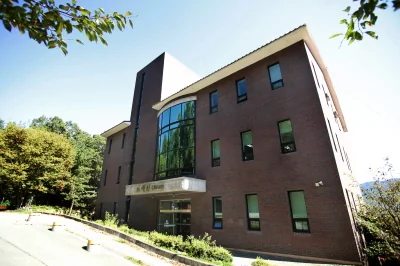
Residential education is presented as part of the university’s community life. The dormitory description links shared accommodation with devotional formation and preparation for service in an international setting. Residents have furnished study and sleeping space, including a bed, desk, chair and personal storage, while bringing their own bedding. The published arrangements place residence within the semester calendar and describe a dormitory student body involved in social activities. Chapel participation is also integrated into the residential framework.
The campus map places these residential facilities within a wider collection of teaching, worship and social spaces. It identifies the chapel, library, dining hall, student centre and Mission Hall, together with a lifelong education centre. Outdoor features include Siloam Pond, a sports field and a basketball court. The university gives its address as 1276 Gyeonggang-ro, Okcheon-myeon, Yangpyeong-gun. Viewed together, these facilities show how its academic, residential and religious activities share a common campus environment.
Sources: Dormitory ↗ · Campus map ↗