Visa
About Ajou Motor College
An automotive college in Boryeong
Ajou Motor College is an automotive-focused higher education institution in Boryeong, South Chungcheong Province, South Korea. Its campus address is 106 Daehak-gil in Jupo-myeon. The institution developed from Daecheon Junior College, whose establishment was approved in November 1994 and which opened in 1995. Its name became Daecheon College in 1998 and Ajou Motor College in September 2004. These milestones distinguish the college's own development from the earlier history of its educational foundation. They also locate it separately from Ajou University in Suwon. Automotive education is reflected in the Boryeong campus itself, with dedicated buildings for chassis technology, powertrain technology and design, alongside classrooms, workshops and student facilities.
Sources: History: 1990s ↗ · History: 2000s onwards ↗ · Campus map and facilities ↗
Educational principles
The college's founding philosophy links professional education with three principles: respect for people, practical investigation grounded in facts, and a view of humanity as one family. The first connects consideration for oneself with respect for others and responsibility towards wider society. The second emphasises knowledge that is useful in practice and research that contributes to human welfare. The third gives international exchange a place within the institution's educational outlook. The Daewoo educational foundation was established in 1977 with support from Kim Woo-choong. Its stated purposes included bringing the benefits of enterprise back into education, developing cooperation between industry and academic institutions, and encouraging academic, cultural and technical exchanges across national boundaries.
Sources: Founding philosophy ↗
Design through models and projects
Automotive Design combines artistic judgement with technical understanding of vehicles. The programme describes small-group project teaching that uses styling clay and computer-based three-dimensional modelling, including CATIA and ALIAS. Its educational objectives bring together digital modelling, clay modelling and composite-material modelling within the vehicle design process. Students work with faculty on projects, while the curriculum also addresses analysis of three-dimensional models, production and processing, and equipment maintenance. The department identifies Korea's National Competency Standards as a basis for its student-led approach to creative, integrated learning. This gives the design specialism a practical scope extending from the appearance of a vehicle to the modelling and production knowledge used to develop it.
Sources: Automotive Design ↗
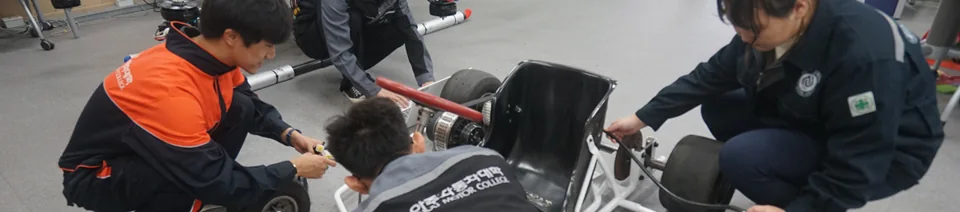
Vehicle customisation and electrical systems
The Automobile Tuning specialism separates its subject into exterior customisation, performance-related modification and adaptations for particular vehicle uses. Teaching includes body repair and painting, vehicle wrapping, paint-protection film, tinting and water-transfer decoration. Its account of special-purpose vehicles adds design and fabrication to those exterior subjects. Electrical and audio systems provide another strand of the programme, including systems used in ordinary cars and specialised vehicles. Faculty teaching responsibilities listed on the department page include digital tuning programming, practical vehicle sensors, audio tuning and human-machine interfaces. Together, these subjects place workshop processes alongside electronic control and vehicle equipment, rather than treating customisation solely as a matter of appearance.
Sources: Automobile Tuning ↗
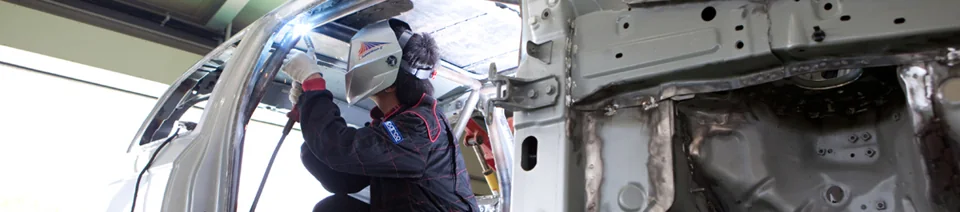
Education for electric mobility
Future Electric Vehicle is another named specialism within the college's automotive provision. Its educational objectives emphasise practical infrastructure resembling industrial workplaces and a curriculum organised around capabilities sought by industry. The teaching staff's listed subjects cover both mechanical vehicle knowledge and electrical systems: gasoline engines and electronically controlled chassis appear alongside electrical circuits, electric machinery, power electronics, sensors and actuators. The programme therefore presents electric mobility within a broader technical education about how vehicles and their control systems operate. Its focus is on practical technical instruction using training facilities, with the programme page identifying the relationship between workshop learning and the changing technologies used in the automotive sector.
Sources: Future Electric Vehicle ↗
Library and study resources
The library opened with the college's predecessor in 1995 and supports learning and research by students and staff. Its provision includes books and academic journals, together with electronic books accessible through the web and mobile devices. A public catalogue allows users to search its holdings online. The facilities listed by the library include collection and reading rooms, a study room, computers and self-service equipment for copying and printing. Students borrow physical materials using their student identification, and renewal requests can be made through the library's stated service channels. Readers can also suggest purchases online or complete a request form in the library. Cooperation with the National Assembly Library and membership of the Korean junior-college library association connect these campus services with wider information networks.
Sources: Library ↗
Student support and campus life
The career and psychological counselling office offers individual and group counselling and assessments related to university adjustment and self-understanding. Its stated areas of support include relationships, academic stress and career concerns. The college distinguishes this work from employment and entrepreneurship advice provided by its career support centre, and from learning counselling provided by the teaching and learning innovation centre. The campus map also identifies residential buildings with shower and laundry facilities, a dining building, club rooms and a student council room. Recreational facilities include a swimming pool, a fitness room, football and tennis facilities, and basketball courts. The practical teaching estate includes a driving practice ground and a joint automotive production technology training and research centre. The counselling office also sets out plans for peer support and cooperation with local organisations. Its published support framework specifically includes adjustment assessments and counselling for new entrants and international students, alongside efforts to make its services better known across the campus.
Sources: Career and psychological counselling ↗ · Campus map and facilities ↗