Visa


About Ajou University
From engineering college to university
Ajou University is located in Suwon, Gyeonggi Province, in the Republic of Korea. Its institutional roots lie in a 1971 agreement between Korea and France to establish a technology junior college that would support educational, technological and cultural exchange. Ajou Engineering Junior College opened in March 1973 under the Yusin Institute.
The first intake studied electronics engineering, precision mechanical engineering, fermentation chemical engineering and industrial management. The institution became Ajou Engineering College the following year and produced its first graduates in 1977. Its later development broadened the academic scope beyond engineering, including humanities and social sciences. The university’s published early history also records scholarship students travelling to France in 1978 under the bilateral cultural agreement. These beginnings explain the combination of practical education and international engagement that appears throughout Ajou’s institutional account.
Humanity, practical enquiry and global engagement
Ajou’s educational principles place respect for people alongside the pursuit of knowledge. The university describes respect for humanity as valuing oneself and others, with people understood as the purpose of education, research and public service. It connects the institution’s work with neighbours, the country and the wider world.
A second principle links academic enquiry with practical use. Research should be based on factual evidence and contribute to human welfare, giving learning a purpose beyond the production of knowledge alone. A third principle concerns a shared global society and openness to people and ideas beyond the Korean Peninsula. Together, these ideas provide a framework for understanding why the university connects specialist study with social contribution and international exchange.
Sources: Motto | Ajou University ↗
Engineering and a wider academic setting
Engineering remains a central part of Ajou’s academic identity. The College of Engineering lists departments covering mechanical, industrial, chemical, materials, environmental and safety, civil systems, transportation systems and integrative systems engineering, as well as architecture and applied chemistry-related study. This range connects the design of machines and materials with infrastructure, movement, environmental questions and the organisation of systems.
The university’s undergraduate structure also includes computing and informatics, ICT convergence, natural sciences, business, humanities and social sciences. Medicine, nursing and pharmacy form part of its broader professional provision. The engineering college’s educational objectives combine specialist knowledge with creative reasoning and management skills. Its place within a university containing scientific, social and professional fields gives engineering students an academic environment that extends beyond their own technical discipline.
Research that crosses disciplinary boundaries
Ajou’s research overview identifies cooperation between industry and academia as an important part of its approach. It describes collaboration around technology development, shared equipment and facilities, intellectual property, technology transfer and the development of people with practical expertise. Industry relationships are therefore presented as more than a source of individual research commissions.
The same account emphasises technological convergence, bringing information technology, biotechnology and nanotechnology into contact. It also describes support for interdisciplinary groups involving faculty from more than one major field. This provides a framework for projects that require several kinds of knowledge rather than a single departmental perspective. Practical application and cooperation across academic boundaries connect the university’s research approach with the educational principles expressed in its motto.
Sources: Research at Ajou | Ajou University ↗
Library resources and places to study
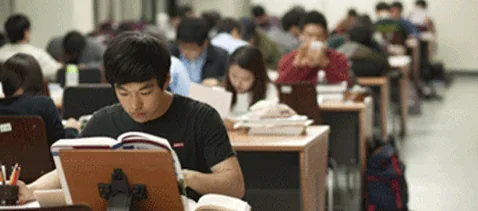
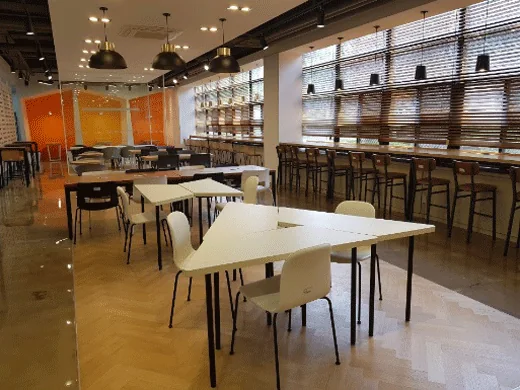
The Central Library was founded in March 1973 and began serving readers the following month. It supports the university’s study and research through the collection, organisation and provision of academic information. Its development accompanied the growth of the institution.
The published facility guide identifies a service desk for circulation and consultation, spaces for group study and seminars, and a multimedia area with computer, printing, copying and scanning facilities. Periodicals and reference materials have their own area, while books and course reserves occupy further floors. Study carrels, meeting spaces and presentation areas support different ways of working. The library therefore combines access to collections with places for individual concentration, collaborative discussion and the preparation of academic work.
Sources: Central Library | Ajou University ↗
Support for accessible learning
The Office for Students with Disabilities opened in October 2009 to support participation in campus life. Its services include help with course registration, learning assistants, tutoring and mobility support. Learning assistants are trained students who can assist with activities such as note-taking or movement between classes according to an individual student’s requirements.
The office also surveys the accessibility of campus facilities and describes arrangements concerning parking and dormitory access. Orientation sessions introduce newly admitted students to available resources, while roundtables provide opportunities to discuss needs and suggest improvements. Personal and career counselling form further parts of the service. This approach connects assistance with teaching and learning to the practical arrangements that allow students to navigate university life and make decisions about their studies.
Sources: Office for students with Disabilities | Ajou University ↗
Practical help with university administration
The Comprehensive Support Center provides a central point for academic administration and everyday student services. Located in the New Student Union Building, it handles matters such as certificates, student identification cards, changes to recorded family addresses and locker applications. Students can also seek information related to records and administrative documentation.
Its published service list extends to student insurance, lost property and access to scanners, fax machines and mobile-phone chargers. These services address the routine tasks that accompany academic life, providing a place to resolve practical questions alongside departmental teaching and specialist support. The centre’s role is distinct from the library and the disability office, adding another part to the university’s network of student-facing services.