Visa

About Angel Kanchev University of Ruse
A multidisciplinary university on the Danube
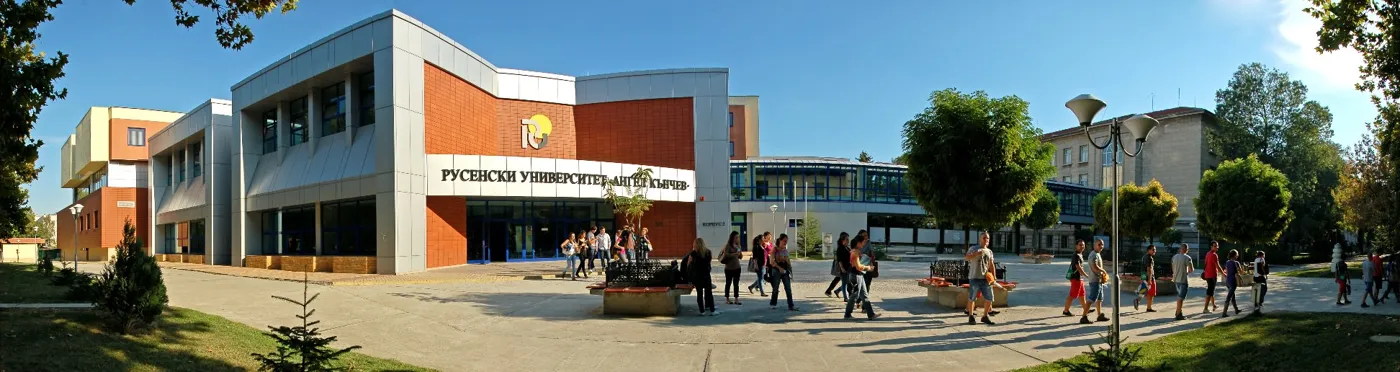
The University of Ruse “Angel Kanchev” is an autonomous state higher education institution in Ruse, Bulgaria. It developed from the city's higher technical school and received university status through a parliamentary decision of 21 June 1995. Its academic profile now extends beyond its technical origins to include education, social and economic subjects, law, natural sciences, agriculture and health-related fields.
The university offers bachelor's, master's and doctoral education. Its institutional description connects its work with Ruse and the surrounding Danube region, including cooperation across the Bulgarian-Romanian border. Its address is 8 Studentska Street in Ruse, and its regional educational activity includes branches beyond the city.
Sources: About the university ↗
Technical education and the city’s development
The university's historical notes trace local efforts to establish higher education to discussions by the Ruse Chamber of Commerce and Industry in 1940. The city's industrial base helped shape the proposal: local enterprises needed engineering specialists and could provide opportunities for practical training. A decree establishing the State Higher Technical School in Ruse was approved on 12 November 1945. Its structure included mechanical engineering, electrical engineering and industrial chemistry.
The original school closed in 1948. Higher technical education subsequently developed again in Ruse around agricultural mechanisation and electrification. In 1954, a faculty of the Agricultural Academy was transformed into an institute devoted to these fields. The first engineering class graduated in 1956, and additional programmes in internal-combustion engines and machine building and metal technology were authorised in 1959. The history records the contribution of practising engineers, agricultural specialists and visiting academics to the development of teaching during this period.
Sources: Historical notes ↗
Mission and academic priorities
The university's mission combines the dissemination of knowledge with fundamental and applied research and the practical implementation of innovation. Its stated purpose connects education with the sustainable development of the city, region and country. The mission also emphasises interdisciplinary approaches and the transfer of knowledge, experience and technology.
Academic freedom, equal opportunity, tolerance, freedom of expression and respect for individual rights appear among its principles. The development vision sets out ambitions for research, international cooperation, modern educational methods and links with the surrounding economy and public institutions. It identifies the value of collaboration with businesses, administrations, secondary schools, cultural organisations and other partners. These are strategic directions for the university's work, supported by an emphasis on planning, teamwork and the careful management of resources. Teaching, research and engagement with the region are presented as connected parts of institutional development.
Sources: Mission and development vision ↗
Library and information resources
The university library supports both the educational process and scientific research. Its oldest collection dates from 1946, placing its origins close to the establishment of higher technical education in Ruse. The library describes its role as a scientific and information centre serving the academic community and specialists in the region.
Its resources include books, periodicals, reference information and electronic learning materials. Online search systems provide access to scientific and specialist journals, bibliographic information and other documents. The service description also identifies open-access resources, textbooks and teaching aids in electronic formats, and electronic versions of periodicals. These different forms of information support literature searching and access to academic material. Automation is an important feature of the library's work, linking its physical collections with digital resources used in study and research.
Sources: University library ↗
Research support and the transfer of knowledge
The Scientific Research Sector was established in 1965 to organise and support research, development and implementation activities at the university. Its teams include teachers, doctoral students, students and technicians, working on fundamental investigations as well as development, consultancy and commissioned projects.
The university's account also describes centres concerned with intellectual property, technology transfer and entrepreneurship. Intellectual-property work includes training and advice about protecting research results. The Technology Transfer Centre links university expertise with organisations seeking technical solutions, while the entrepreneurship centre, established in 2008, supports students, teachers and small enterprises. A publishing centre followed in 2010. Educational-technology activity includes web-based courses and virtual laboratories, and an interdisciplinary social-science centre developed through cooperation with institutions in Romania and Ukraine. These units illustrate several ways the university connects research with teaching, publication, external partners and the practical use of knowledge.
Sources: Laboratories and research centres ↗
Support for distance learning
The Distance Learning Centre was established by the Academic Council on 19 April 2005. It is a university service unit responsible for supporting the organisation and technical development of distance education. Its primary function concerns the university's servers and internet-based distance-learning system.
The centre's description distinguishes its technical and support role from the responsibilities of faculties, which prepare educational documentation and learning materials and manage student status and teaching quality. It also identifies training for teachers, orientation for students, cooperation with course coordinators and monitoring of new educational technologies as parts of its work. The account recognises several forms of learning resources, from electronic versions of written material to interactive resources, online study modules and systems for independent learning. Distance education is therefore supported through both institutional technology and academic coordination.
Sources: Distance Learning Centre ↗
Continuing professional education
Continuing education has a separate institutional history. The university established a Faculty of Continuing Education in 1977, renamed it the Centre for the Advancement of Qualifications in 2000 and adopted the Centre for Continuing Education name in 2005. Its role concerns acquiring, extending and updating professional knowledge and qualifications.
The centre serves several groups, including university students, doctoral students, academic staff, graduates and people who have completed secondary education. Its listed activities include training within fields taught by the university, optional subjects for enrolled students, teacher-qualification development and foreign languages. It also describes programmes responding to social and economic needs. This service extends the university's educational work beyond initial degree study, providing a setting for further learning at different stages of a person's educational and professional life.
Sources: Continuing education ↗
An academic honour recorded in the university register
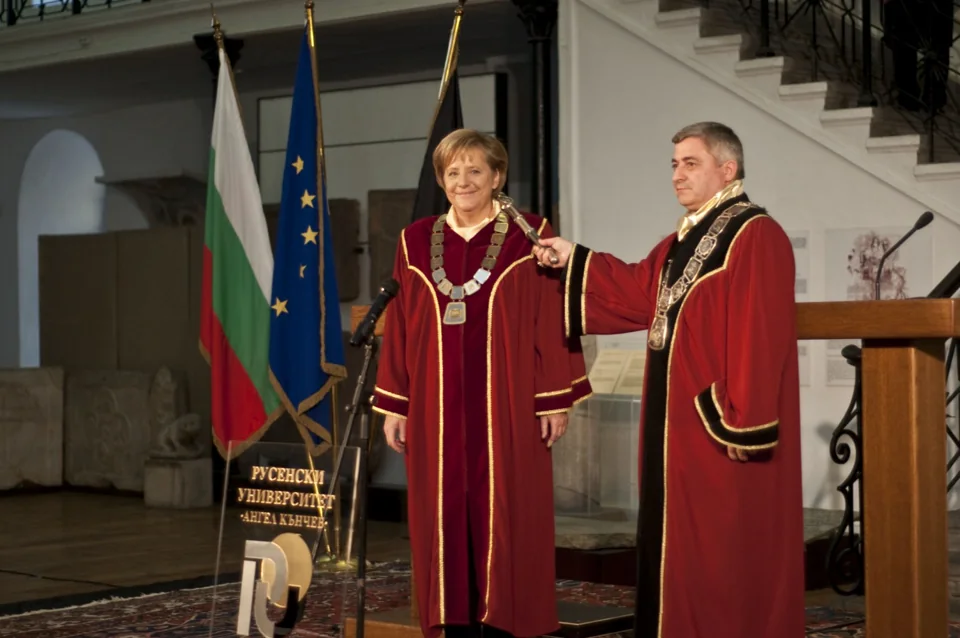
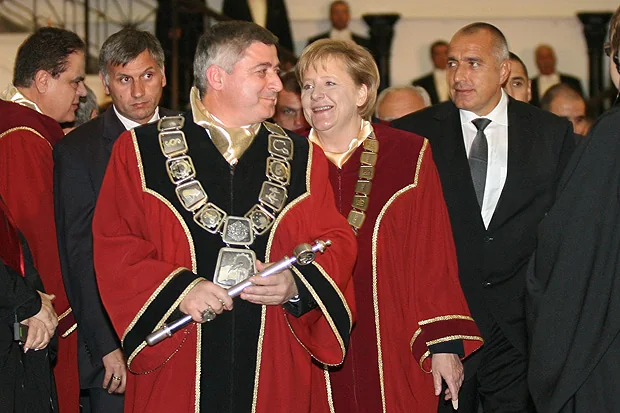
The university’s honorary-title register lists Angela Merkel among its honorary doctorate recipients, recording an award date of 3 February 2009. This register provides context for the historical ceremony photographs in the institutional overview.
Sources: Honorary titles ↗