Visa
About Academy of Music, Dance and Fine Arts
An academy bringing the arts together in Plovdiv
The Academy of Music, Dance and Fine Arts in Plovdiv bears the name of Professor Asen Diamandiev, a musician closely associated with its foundation. Its educational identity combines performing and visual arts with the teaching of those subjects. Music, choreography, design and fine art therefore sit within one institution, offering different ways of approaching artistic practice and cultural education. Its official introduction identifies study at bachelor’s, master’s and doctoral levels across a broad range of specializations.
The Academy’s mission emphasizes the preparation of highly qualified specialists in music, dance, visual arts and arts pedagogy. It also places artistic creation and research alongside teaching. Its stated values recognize artistic and scientific freedom, the right to education and participation in cultural life, and openness to different ideas, communities and forms of creative expression.
Since October 2022, the Academy has been an official partner of the New European Bauhaus initiative. Its mission page connects that partnership with cultural enrichment, environmental sustainability and inclusion, bringing artistic and cultural perspectives into discussion with science and technology.
Sources: Official academy introduction ↗ · Mission and values ↗
Origins in music education and the development of new disciplines
The institution began in 1964 as a Plovdiv branch of the Bulgarian State Conservatoire in Sofia. Professor Asen Diamandiev played a central part in the initiative, supported by the conservatoire’s leadership. In 1972 the branch became an independent Higher Institute of Music and Pedagogy, with Diamandiev as its first rector. Training in musical folklore developed during this period and became an important part of the institution’s character.
Choreographic training was added during the 1970s. The expansion beyond music was reflected in the 1995 name Academy of Music and Dance. Visual-art specializations followed, giving the institution the broader artistic scope reflected in its present title. This sequence helps explain why traditional music, dance, performance, teaching and visual expression remain closely connected within the Academy rather than forming unrelated additions to its work.
Sources: Institutional history ↗
A broad range of artistic studies
The Academy’s published offer includes music and visual-art pedagogy, classical performance, traditional instruments and singing, and pop and jazz performance. Conducting extends to classical and folk choirs and orchestras. Other areas include Bulgarian folk choreography, ballet, sound engineering and arts management. The range brings together the preparation of performers, creators, teachers and people working with the organization and technical realization of artistic activity.
Visual-art fields listed by the Academy include graphic design and photography, scenography, mural painting, clothing design, printmaking and sculpture. Multimedia and virtual reality add a digital dimension to this offer. A separate Design Department was established by the Academic Council on 29 May 2020. The combination of established artistic media and newer technologies is consistent with an institution whose remit extends across music, movement and visual communication.
Sources: Official academy introduction ↗ · Design department ↗
Choreography and the transmission of dance traditions
The Choreography Department traces its foundation to Professor Kiril Dzhenev in 1974. Its historical account describes the development of higher choreographic education through a programme initially named Choreographic Directing, renamed Bulgarian Folk Choreography in 1986. The approach connects the preparation of creators and educators with Bulgarian folk traditions and with wider developments in dance.
Ballet Art was introduced in 1994 through an initiative associated with Professor Petar Lukanov. The department also describes Arts Management among its specializations. Its account of ballet teaching notes contributions from Bulgarian and visiting international educators. This history shows how the dance provision grew from a strong foundation in folk choreography into a wider field incorporating ballet, teaching, directing and the management of artistic work.
Sources: Choreography department ↗
Ensemble performance and shared artistic practice
The Academic Folklore Ensemble was created in 2000. Its official description brings together a folk choir, folk orchestra and dance group, with performers drawn from Academy graduates. The choir’s repertoire includes songs from different Bulgarian regions, while the orchestra uses traditional instruments such as kaval, gaida, gadulka, tambura and tapan alongside double bass. The dance component complements the vocal and instrumental work.
The ensemble performs both arrangements and traditional material, bringing songs, instrumental pieces and dances into staged programmes. Its description also includes music and dance associated with other Balkan countries. The three components can work in different combinations and sizes according to the performance setting. Such activity gives the Academy’s folklore expertise a public form through coordinated music and movement, national costume and repertoire drawn from several regional traditions.
Sources: Academic folklore ensemble ↗
Library collections and recording resources
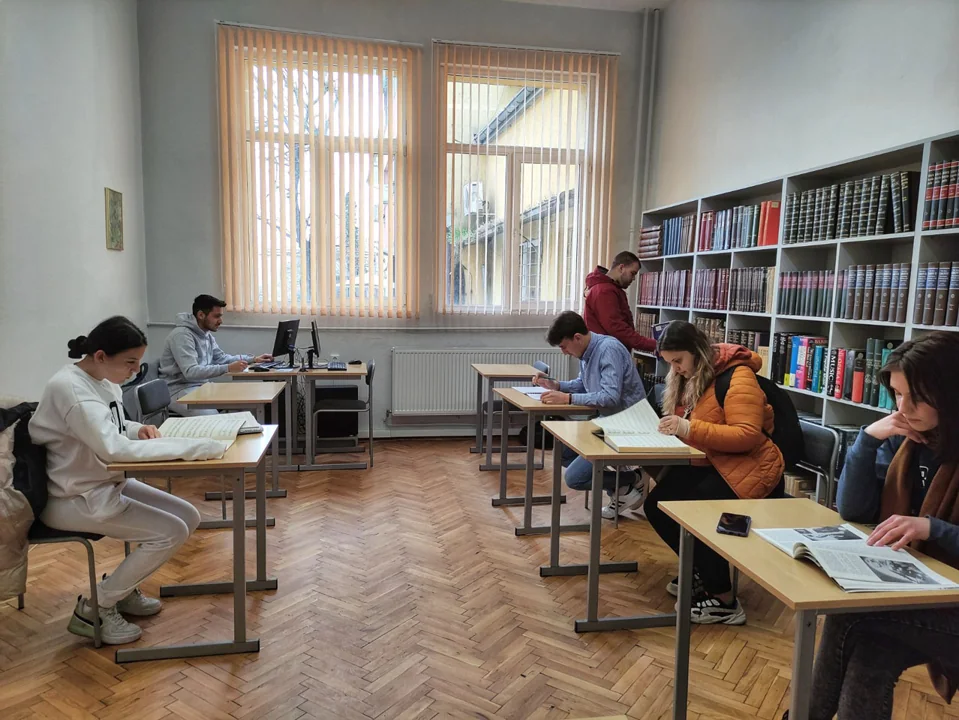
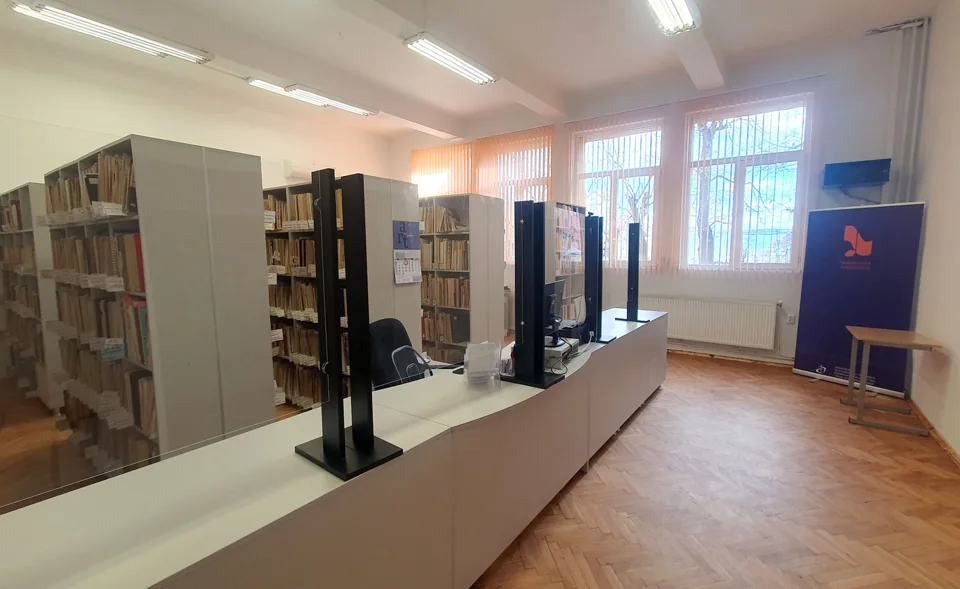
The academic library supports teaching, research, creative events and the preservation of the Academy’s cultural memory. Its holdings include books, printed music, reproductions, audio and video recordings, with dedicated sound and video collections. Particularly notable are the donated personal libraries of composers Konstantin Iliev and Ivan Spasov. Other collections include the Nikola Kenov fund, donations from Serres in Greece, antiquarian publications and copies carrying their authors’ personal dedications.
The library primarily serves the Academy’s students, teachers and staff, with materials available for reading-room use and borrowing. Students can also use recordings from the sound collection. A separate audio and video studio provides multichannel recording and subsequent editing and processing. It accommodates work ranging from individual performers and chamber ensembles to larger concert groups. The studio also contributes to practical training for sound-engineering students, linking technical production with the Academy’s performance and educational activity.
Sources: Academic library and sound collection ↗ · Audio and video recording studio ↗