Visa

About Academy of Economics "Dimitur A. Tscenov"
An economics academy in Svishtov
The institution listed as Academy of Economics “Dimitur A. Tscenov” presents itself in English as the Dimitar A. Tsenov Academy of Economics. Based in Svishtov, Bulgaria, it specialises in economics, business, administration, management and tourism. Its origins are closely associated with the commercial and educational traditions of the town and with the philanthropy of Dimitar Apostolov Tsenov, whose gift supported the creation of a higher school of commerce.
The academy formally opened in 1936. Its institutional mission combines education at bachelor’s, master’s and doctoral levels with research and relationships with business, public administration and the nonprofit sector. The academy describes a commitment to connecting established educational traditions with new methods in teaching, management and scholarship. Its central contact address is 2 Emanuil Chakarov Street, Svishtov, placing the institution within the town whose educational development inspired its foundation.
Sources: History ↗ · Institutional mission ↗
Four faculties and their subject areas
The academy’s departmental structure identifies four faculties. Management and Marketing brings together business informatics, marketing, international economic relations, management and strategic planning. Industry and Commerce includes agricultural economics, tourism economics and management, industrial business and entrepreneurship, commerce, and social sciences and law. These combinations link the organisation of enterprises with the sectors and social settings in which they operate.
The Faculty of Economic Accounting includes accounting, control and analysis of economic activities, statistics and applied mathematics, and physical education and sport. The Faculty of Finance includes finance and credit, insurance and social security, general economic theory and foreign language teaching. The range demonstrates that economic education at the academy includes quantitative methods and communication as well as specialist financial and commercial knowledge. Departments provide distinct disciplinary homes within a broadly connected economics and business institution.
Sources: Faculties and departments ↗
Bachelor study and modes of attendance
The published bachelor programme table for academic year 2025–2026 illustrates the academy’s academic range and different attendance formats. It lists International Business, Business Economics, and Tourism Business and Management with English-language teaching. Finance, Banking and Insurance is listed with English and Russian language options. The table distinguishes full-time, part-time and distance learning, with availability varying by programme rather than applying uniformly to every subject.
Bulgarian-language entries include finance, insurance and social security, macroeconomics, marketing, project management and business informatics. Other listed programmes concern international economic relations, accounting and control, business and financial control, statistics and analysis, entrepreneurship, agricultural economics, commerce, tourism, public administration and business management. This dated catalogue shows how the academy translates its departmental expertise into named undergraduate pathways. It also makes the language and form of study visible alongside the programme title.
Sources: Bachelor programmes 2025–2026 ↗
Research, enterprise and knowledge transfer
The Institute for Scientific Research was established by a Bulgarian Council of Ministers decree in December 2016. Its mission is to encourage research, creativity, entrepreneurship and innovation among academic staff, researchers, doctoral candidates and other students. The institute connects fundamental and applied research with teaching and with the transfer of research results into business.
Its responsibilities include administering research activity, building partnerships with companies and public bodies, and supporting projects of regional, national and international relevance in economics and management. The academy’s research infrastructure includes a small business and entrepreneurship research centre, a technology transfer centre, and specialist laboratories concerning banking, financial sciences and control. Other units bring doctoral and master’s students into finance research and work on world economics and international economic relations. The institute also administers competitions and reporting for research projects supported by the state budget. Its work involves maintaining contacts with local administration, government representatives and other research organisations, making cooperation part of the process of developing and implementing research initiatives. These structures give research an organisational place alongside the faculties.
Sources: Institute for Scientific Research ↗
Mobility and European cooperation
The academy hosts incoming exchange students through its Erasmus arrangements. Its mobility information identifies academic buildings, a library, canteen, dormitory and sports centre among the facilities available to visitors. The Erasmus office coordinates study information and helps with accommodation, transport and other practical matters. Incoming students prepare learning agreements using the foreign-language course list in the academy’s ECTS information package, connecting their period in Svishtov with studies at their home institution.
The academy also participates in KreativEU, an alliance of eleven higher education institutions from eleven European countries. The alliance’s published objectives connect education, research, innovation and service to society with cultural heritage and local identities. Its plans include cooperation across disciplines, physical and virtual mobility, and a shared European campus approach. The academy’s alliance information identifies 2025–2028 as the pilot phase, distinguishing its developing cooperation programme from later implementation ambitions.
Sources: Student mobility ↗ · KreativEU history and objectives ↗
The academic museum and institutional memory
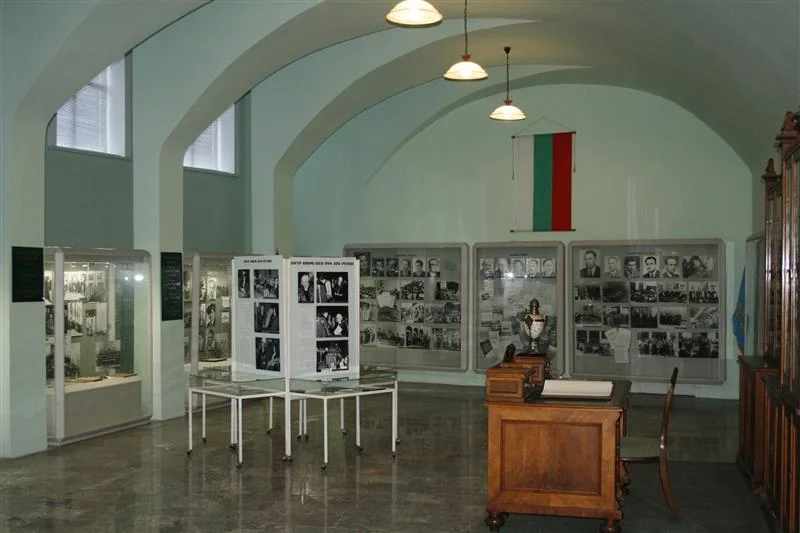
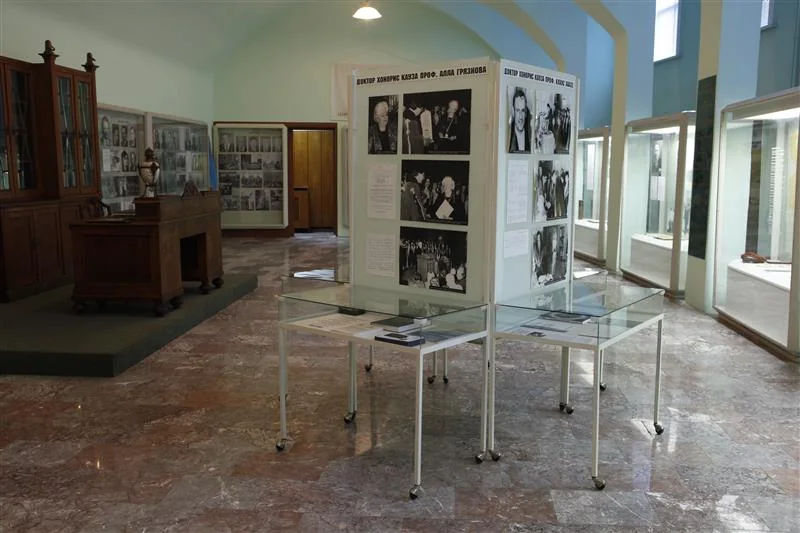
The academic museum presents the academy’s history through photographs, documents and objects arranged chronologically. Its exhibition places particular emphasis on Dimitar Tsenov and the philanthropic act that made the higher school possible. It also records the ceremonial opening on 8 November 1936 and follows subsequent institutional development through displays about lecturers, alumni, buildings and academic life.
Photographs and exhibition panels introduce honorary doctorate recipients and illustrate the academy’s international relationships. The museum gives the institution a place to preserve its own educational memory through material records, complementing its active teaching and research functions. Its exhibits connect the founder’s contribution with the people and facilities through which the academy developed in Svishtov.
Sources: Academic museum ↗