Visa


About Andalas University
A university rooted in West Sumatra
Andalas University, known in Indonesian as Universitas Andalas or UNAND, is based in Padang, West Sumatra. Its principal campus is at Limau Manis, with additional campuses in Payakumbuh and Dharmasraya. The university's educational provision spans undergraduate and postgraduate study, professional education and specialist programmes. Its academic community brings together agriculture, science, health, engineering, economics, law, cultural studies and the social sciences.
The university's cooperation directorate describes a setting supported by laboratories, sports facilities, educational corners and production centres. It also identifies Indonesian-language training as a resource for students who face language barriers. The Limau Manis address places the university in Padang's Pauh district. Its regional campuses extend the institution's presence within West Sumatra, while its academic provision connects a broad range of subjects within one university.
Origins and the Limau Manis campus
The university's origins lie in the development of higher education across West Sumatra during the early years of Indonesian independence. A law institution opened in Padang in 1951. Teacher education and agriculture institutions followed in 1954, with medicine and mathematics and natural sciences established in Bukittinggi in 1955. These institutions formed the foundations of Universitas Andalas, which Vice President Mohammad Hatta formally inaugurated in Bukittinggi on 13 September 1956.
Regional conflict disrupted university activity in the late 1950s. Teaching was subsequently rebuilt in Padang, where faculties used several different locations. The later development of Limau Manis brought much of this dispersed university community together. Construction began with a foundation-stone ceremony in March 1986, and the rectorate building started to be used in 1989. Faculties moved over several years, and the campus was formally inaugurated in September 1995. This history explains the university's connection with both its earlier urban sites and its larger campus to the east of central Padang.
Sources: Campus history ↗
Education, research and public contribution
UNAND's stated vision combines academic prominence with institutional dignity. Its mission sets out four connected priorities: academic and professional education, innovative research and community service, adaptable university governance, and productive national and international cooperation. These are the university's objectives for its work across teaching and public engagement.
The mission gives particular attention to applying research and learning beyond the campus. It describes contributions through science, technology, arts and the humanities, alongside innovation that supports national development. Expanding access to higher education is another stated objective. Character and entrepreneurship appear within its educational aims, while collaboration is presented as a means of increasing benefits for the wider community. The university therefore frames education, research and social contribution as related responsibilities rather than separate activities.
Sources: Vision and mission ↗
Academic breadth
The undergraduate education directory places bachelor's and diploma provision across fifteen faculties. Agriculture, animal science and agricultural technology form one substantial group of disciplines. Mathematics and natural sciences, engineering and information technology provide further scientific and technical fields. Economics and business, law, cultural studies, and social and political sciences add other academic perspectives.
Health-related education is represented by medicine, pharmacy, public health, nursing and dentistry. These faculty groupings show the breadth of UNAND's educational organisation, encompassing the study of society as well as natural systems, technology and health. Students' academic homes are organised through these faculties, with the university directory providing links to the respective units and their educational information.
Sources: Undergraduate education ↗
The development of engineering
Engineering developed from mechanical and civil engineering programmes introduced in 1985 under the Faculty of Mathematics and Natural Sciences. The Faculty of Engineering's historical account describes the importance of support from other institutions, including Institut Teknologi Bandung and regional industry, during this early period. By the following phase of development, industrial, environmental and electrical engineering had joined the original subjects.
The faculty's move to Limau Manis took place in stages. Civil, mechanical and electrical engineering began using the new site in 2000; industrial and environmental engineering followed in 2005. Postgraduate provision developed during the next decade, including civil engineering in 2010, mechanical engineering in 2012, electrical engineering in 2013, industrial engineering in 2014 and environmental engineering in 2015. Doctoral programmes in mechanical and civil engineering followed in 2017 and 2018 respectively. This sequence records the expansion from initial undergraduate programmes to advanced research education.
Sources: Faculty of Engineering: history ↗
Shared scientific facilities
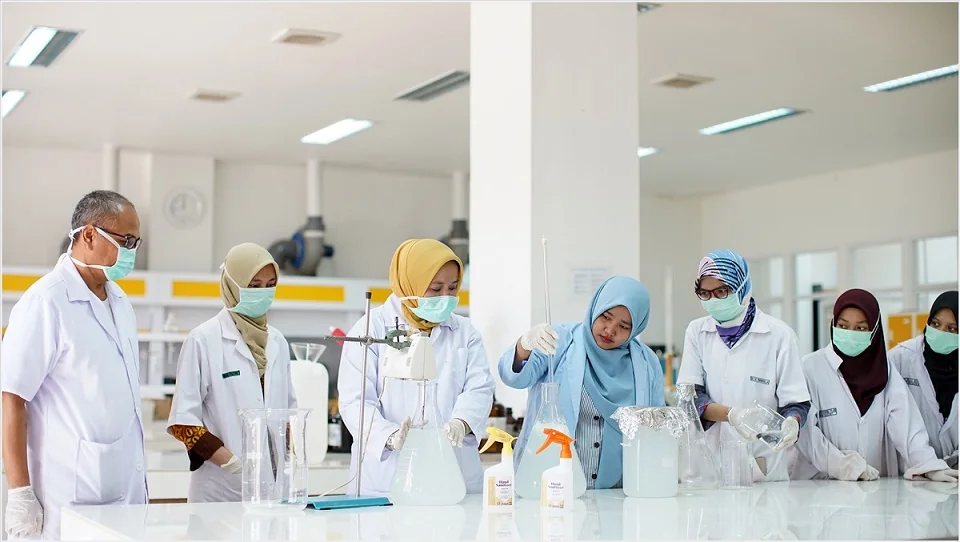
The Central Laboratory at Limau Manis supports scientific investigation, education and experimental work. Its facilities are grouped around optical analysis, biological analysis, chemical and physical analysis, testing and sample preparation. This shared laboratory structure provides an institutional resource for students and researchers working across scientific subjects.
The laboratory website lists microscopy and spectroscopy equipment alongside instruments used for chromatography and other forms of analysis. Its service information includes procedures and application forms for practical teaching, research, testing and equipment use. The laboratory also publishes professional development activity: a September 2026 workshop addressed the validation and verification of testing methods. These facilities and activities connect research equipment with organised laboratory services and the development of staff expertise.
Sources: Central Laboratory ↗
Spaces for campus life
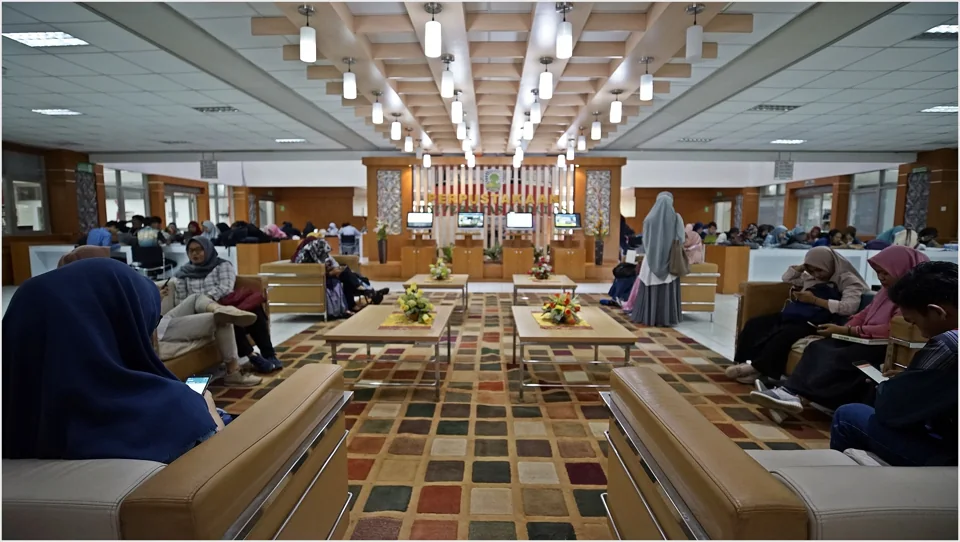
Campus facilities include meeting spaces, student organisation rooms, sports grounds and places for religious activity. The Convention Hall, inaugurated in November 2012, is used for seminars, workshops and university celebrations. The auditorium also accommodates graduation ceremonies and academic gatherings. Nurul Ilmi Mosque provides a place for worship and community activity, with additional prayer facilities distributed around the university.
The Student Activity Centre, inaugurated in November 2001, houses student executive and legislative organisations. Sports provision includes football, tennis, basketball, badminton, volleyball and futsal facilities, as well as a climbing facility. The university's facilities account also describes student accommodation and banking services. Environmental management is represented by an integrated waste-processing centre, developed with engineering expertise, which turns organic material into compost for campus planting and other uses. These resources support daily university life alongside classrooms and laboratories.
Sources: Campus facilities ↗
Institutional administration
UNAND's administrative history records a change to public-service-agency financial management in 2009, followed by its establishment as a state university with legal-entity status under Government Regulation Number 95 of 2021. The latter framework provides autonomy in academic and nonacademic management.
An organisational revision in 2022 created the Directorate of General Affairs and Asset Management from earlier administrative functions. Its responsibilities cover general services, maintenance, campus security and university assets. The directorate is divided into units for general and household affairs and for asset management, including inventory, logistics and equipment. This administrative structure supports the university's teaching and research environment through the care and management of its physical resources.
Sources: University governance and asset directorate: history ↗