Visa
About Aisyah University
A university in Pringsewu
Aisyah University is Universitas Aisyah Pringsewu, commonly abbreviated UAP, in Lampung, Indonesia. Its address is Jalan A. Yani No. 1A, Tambahrejo, Gadingrejo, Pringsewu. The university was established on 21 May 2019 under ministerial decision 417/KPT/I/2019 through the merger of STIKes Aisyah Pringsewu, Sekolah Tinggi Teknologi Aisyah and Akademi Kebidanan Medica Bakti Nusantara.
Its academic fields extend across health, technology, education, business, medicine and dentistry. A May 2026 graduation report identifies nursing, midwifery, pharmacy and nutrition among the programmes represented, together with professional nursing and midwifery education. These subjects connect the university’s present provision with the health-education institutions involved in its formation. Within Technology and Informatics, the faculty describes education, research and community service as connected responsibilities grounded in ethical values.
The faculty’s development aims include partnerships with government, business and industry, alongside the production of technological work through research. Its published framework also addresses curriculum design, teaching and assessment, with an emphasis on learning outcomes. These aims provide an institutional setting for the undergraduate and postgraduate computing programmes described by the faculty.
Sources: University history, academic fields and May 2026 graduation ↗ · Technology and Informatics faculty profile ↗
Library collections and learning support
The university library traces its beginnings to 2009, when it was established alongside the earlier STIKes Aisyah institution. Its own history distinguishes this earlier origin from the university’s establishment in 2019. The library is located within the university grounds at Tambahrejo, linking its collections with the campus’s academic work.
Published holdings include textbooks, journals, conference proceedings, scientific magazines, student final projects and theses, as well as newspapers. Digital materials include electronic books, electronic journals and learning CDs. The library’s mission addresses staff development, improved facilities, cooperation with other libraries and information-technology-based administration. It also promotes reading and the use of information resources in support of education, science and technology.
Technology and software education
The undergraduate Software Engineering programme connects computing knowledge with the design, implementation and evaluation of information-technology solutions. Its published aims include application development, research and community service, together with cooperation involving businesses, educational organisations and government institutions. Mobile application development is specifically identified within its educational mission.
The programme’s learning outcomes address foundational informatics concepts and adaptation to new methods in changing problem settings. Communication, collaboration, leadership and entrepreneurship appear alongside technical knowledge. Its stated graduate profiles include software engineer, systems analyst, webmaster and technology entrepreneur. These are descriptions of the programme’s educational direction, showing a combination of software development, analytical work and professional communication within its published framework.
Postgraduate computer science
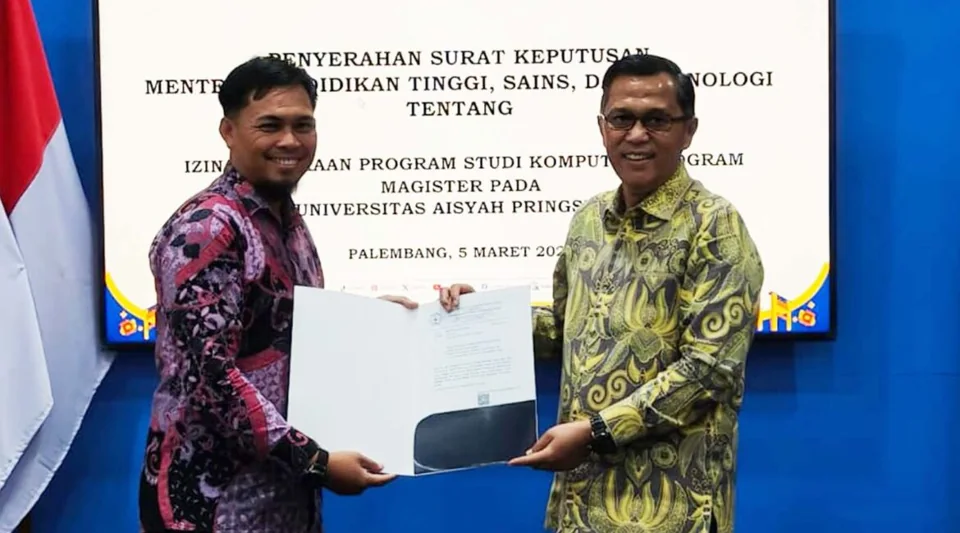
The university announced the opening of its Computer Science master’s programme in March 2026 following a ministerial decision dated 25 February 2026. The faculty’s report describes the presentation of that decision through the regional higher-education service institution, LLDIKTI II. This development added postgraduate computing study to the university’s academic range.
The published curriculum includes computational mathematics and statistics, advanced algorithms and optimisation, research methodology, artificial intelligence and database management. Later subjects include machine learning, project management, big data and thesis work. Specialist entries include computer vision, cloud computing, medical data science and health decision-support systems. Research writing and publication are also part of the curriculum, connecting advanced technical subjects with the preparation and communication of scholarly work.
Sources: Computer Science masters curriculum ↗ · Computer Science masters opening, March 2026 ↗
Digital collaboration with community organisations
In April 2026, university academics participated in discussions with the Indonesian Red Cross organisation in Pringsewu about developing digital services. The meeting at Graha Pamungkas involved the Faculty of Technology and Informatics and a cross-disciplinary community-service team. Its focus was the design of an application intended to support information access and the organisation’s humanitarian activities.
The report describes a collaborative planning process rather than a completed, evaluated system. It connects the university’s computing expertise with an organisation working directly with the community. The involvement of academics from different backgrounds illustrates how community service can bring technical development into conversation with health and public-service needs outside the university.
Technology applied to hydroponic enterprise
A separate 2026 community-service project, TIGA DIGIT, received funding through the BIMA programme. Its partner was the HidroponikGEH enterprise in Lampung. The proposed work connects three aspects of a small business: production, marketing and accounting, rather than treating digital adoption as a single isolated activity.
The project describes internet-of-things technology for monitoring hydroponic production, a website for digital marketing and SIAPIK-based accounting records. Its planned process includes consultation, training, implementation, mentoring and evaluation with the partner. These activities place academic expertise within a practical local enterprise setting, while retaining an emphasis on the partner’s ability to manage the systems over time.
Student activity beyond classes
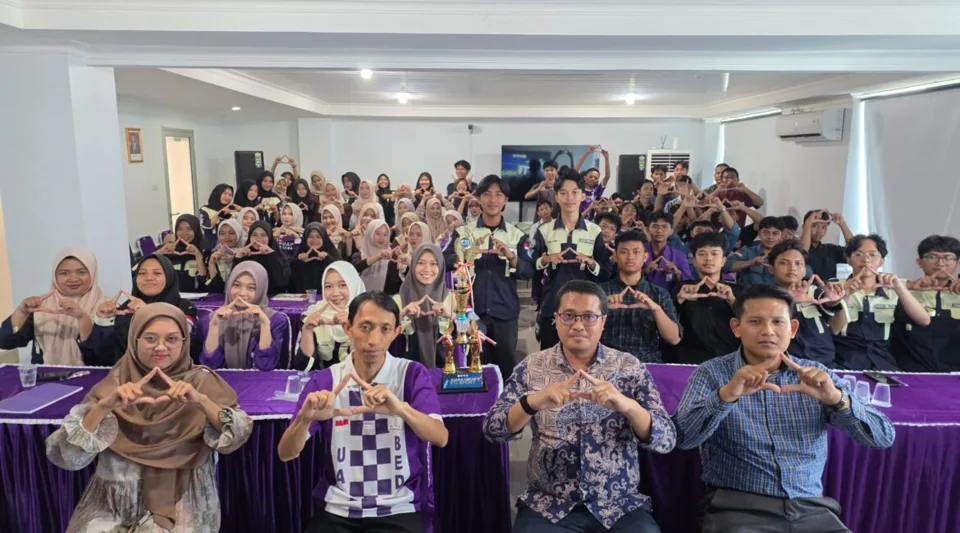
FTI SPORT 2026 brought together Technology and Informatics students from different semesters for an event scheduled for 10–12 April on the university campus. Its opening report emphasises sportsmanship, solidarity and opportunities for interaction beyond classroom assignments. The faculty presented the activity as part of student development alongside academic and technical study.
The account also connects sport with teamwork, leadership and discipline. Students from different classes participated within a shared faculty event, creating a setting for contact across year groups. The photograph accompanying the report shows students and staff gathered with a trophy, documenting a campus activity that complements the university’s teaching, research and community-service work.
Sources: FTI SPORT 2026 ↗