Visa
About Airlangga University
A university with roots in Surabaya
Airlangga University, known in Indonesian as Universitas Airlangga or UNAIR, is based in Surabaya, East Java. The modern university was inaugurated on 10 November 1954 under Government Regulation Number 57 of 1954. Its history also includes earlier medical and dental institutions in Surabaya, among them the medical school established in 1913 and the dentistry school established in 1928. These antecedents explain the depth of its connection with health education while remaining distinct from the university’s formal establishment.
Over subsequent decades, UNAIR expanded into a much wider range of disciplines. Its institutional history records the establishment of pharmacy in 1964 and veterinary medicine in 1972. More recent development includes advanced technology and multidisciplinary study, with a school established in 2019 becoming a faculty in 2020. The university’s development therefore combines longstanding professional education with newer technical fields.
Sources: History - Universitas Airlangga ↗
Academic breadth and campus organisation
UNAIR’s current academic overview describes diploma, bachelor’s, master’s, doctoral, professional and medical specialist programmes. Its faculties span medicine, dentistry, law, economics and business, pharmacy, veterinary medicine, social and political sciences, science and technology, public health, psychology, humanities, nursing, fisheries and marine sciences, vocational studies, advanced technology and multidisciplinary study, and health-related study in Banyuwangi.
The university identifies its Surabaya locations as Dharmahusada-A, Dharmawangsa-B and MERR-C, alongside the Banyuwangi campus. Its postgraduate school is listed at Dharmawangsa-B. International undergraduate programmes provide another route through parts of its academic provision, bringing Indonesian and international students into internationally oriented study. This structure makes UNAIR a university with several disciplinary and geographic centres rather than a single specialised professional college.
Sources: Academics - Universitas Airlangga ↗
Economics and business education
The Faculty of Economics and Business connects its mission with ethics, sustainability and a global perspective. Its history traces economics teaching in Surabaya through the Surabaya College of Economics Foundation, established in January 1954, and academic activities that began that September. The institution was integrated into Universitas Airlangga as its Faculty of Economics on 1 September 1961. Accounting was added in 1963.
Later changes included the introduction of a corporate administration programme in 1975 and the move to a semester credit system in 1979. The faculty’s history also records the development of taxation and marketing management programmes during the 1980s. These milestones show how its provision developed from an initial corporate economics focus into a wider collection of business and economic subjects.
Sources: Sejarah, Visi, Misi, dan Nilai - Faculty of Economics and Business - Airlangga University ↗
Chemistry within science and technology
Chemistry illustrates the development of UNAIR’s natural sciences. The chemistry programme dates to 1982, while the faculty’s name changed from Mathematics and Natural Sciences to Science and Technology in 2008. The department’s published history identifies biology, physics, chemistry and mathematics within that faculty.
The chemistry department describes bachelor’s and master’s programmes and five principal subject areas: analytical chemistry, inorganic chemistry, organic chemistry, biochemistry and physical chemistry. These areas connect the investigation of substances and reactions with biological processes, measurement and physical theory. Located at MERR-C in Mulyorejo, the programme adds a laboratory-based scientific dimension to a university often associated with its medical origins. Its history also distinguishes the development of the programme from later changes to departmental and faculty organisation.
Sources: History - S1 Kimia Fakultas Sains dan Teknologi Universitas Airlangga ↗
Research support and specialist centres
Research is supported through university-level structures as well as individual faculties. The Directorate of Research and Innovation coordinates policies, roadmaps and strategic programmes, helps researchers access funding and supports research capacity. A separate institute for journal development, publications and intellectual property works on scholarly journals and publication support. Its intellectual property services cover patents, copyright and trademarks.
The university’s research overview lists specialist centres addressing subjects such as tropical diseases, biomolecular engineering, emerging infectious diseases, patient safety, dementia and ageing, cardiovascular innovation and sustainable business. This range places biomedical investigation alongside organisational, technological and economic questions. The university presents the practical application of research as an important part of its role in society.
Sources: Research - Universitas Airlangga ↗
Learning with communities
UNAIR’s community service programmes connect academic work with settings beyond the classroom. Their coordination sits with the Institute for Sustainable Community Development. The university describes activities involving education, health, environmental sustainability and social development, with students working alongside communities.
Several formats are available. Regular Learning with Communities projects take place in designated locations, while Back to Village activities are based in students’ hometowns. The Citra Harum format addresses environmental conservation around the Citarum watershed in West Java. National programmes follow arrangements organised by host institutions, and international formats can include research, community service and scientific presentations abroad. These different structures allow community learning to respond to particular places and purposes rather than following only one model.
Sources: Community Service Programs - Universitas Airlangga ↗
The library as a learning and discussion space
A university library report published in June 2021 described facilities across the A, B and C campuses. Alongside printed and electronic collections, it identified individual study rooms, discussion rooms and spaces for events. Special collections included publications written by the university’s own academic community.
The same dated account described workshops, seminars, exhibitions of student work and outreach supporting reading spaces in surrounding educational institutions. American Corner and Aussie Corner resources introduced cultural and language perspectives. The report provides a useful picture of the library’s educational role: supporting reading and research while also making room for conversation, student activity and engagement with a wider public.
Sources: Not only books, UNAIR Library provides facilities for learning and discussion – Unair News ↗
Welcoming a new student community
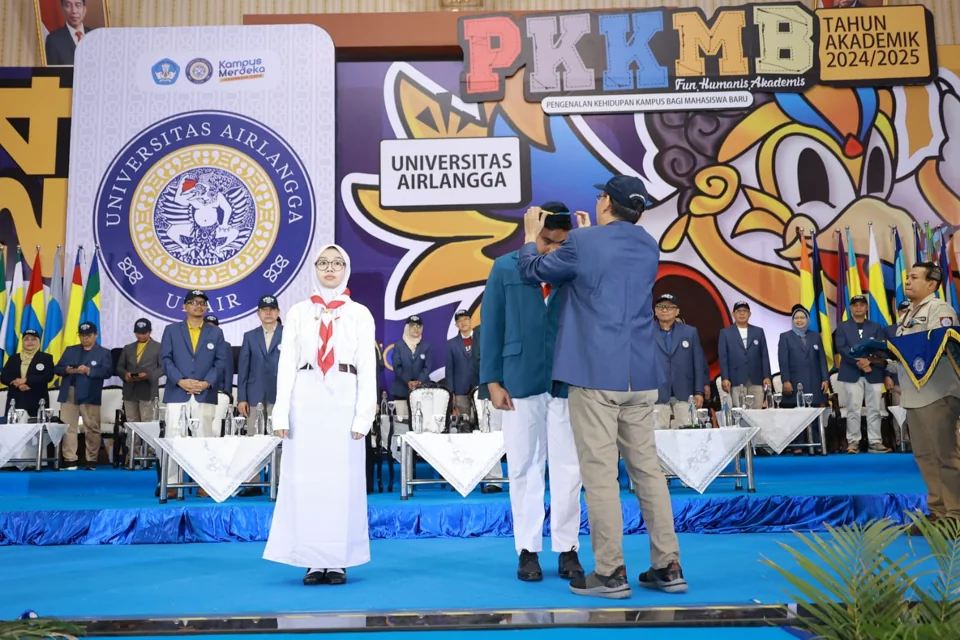
The university’s August 2024 new-student inauguration took place at the Airlangga Convention Center on MERR-C Campus as part of its orientation programme. Representatives of the incoming students received academic robes from the rector. A recorded ministerial welcome encouraged students to explore their interests and develop their potential during university life. The event brought students from different faculties into a shared institutional ceremony at the beginning of their studies.
Sources: Education Minister welcomes UNAIR new students - Universitas Airlangga ↗
A recent example of engineering innovation
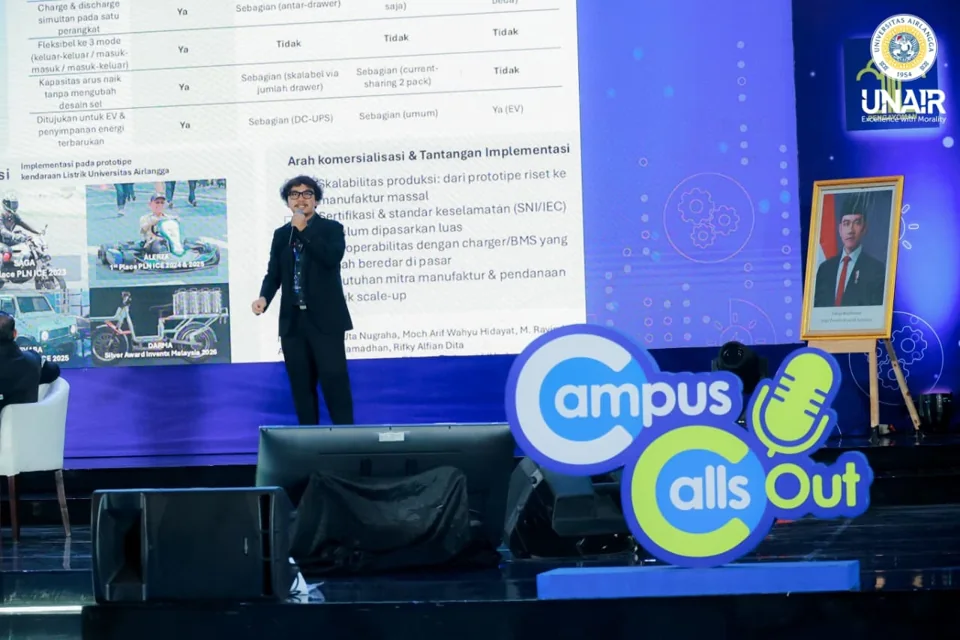
A September 2026 university report described a battery research presentation at the Airlangga Convention Center. A lecturer from the Faculty of Advanced Technology and Multidisciplinary Science introduced a system with two independent ports and several charging and discharging modes. The report connected the work with internal electric-vehicle research and potential renewable-energy applications. It presented further collaboration and larger-scale production as future ambitions, giving a concrete example of research development rather than an already established commercial product.
Sources: FTMM introduces dual-function battery innovation at Campus Calls Out event ↗