Visa

About Amsterdam University of the Arts
Six arts academies
Amsterdam University of the Arts, known as AHK and in Dutch as Amsterdamse Hogeschool voor de Kunsten, brings together six academies in Amsterdam. They are the Conservatorium van Amsterdam, Netherlands Film Academy, Academy of Theatre and Dance, Reinwardt Academy, Academy of Architecture and Breitner Academy. Together they cover music, film, theatre, dance, heritage, architecture, fine art and arts education. The university offers bachelor's programmes alongside advanced and master's study. Its educational approach connects the development of an individual artistic identity with practical skills and knowledge of artistic traditions. The academies form a multidisciplinary institution while retaining the specialist subjects through which their students enter the fields of art, culture and heritage.
Sources: Six arts academies ↗
Organisation around artistic disciplines
AHK's organisational structure reflects the different traditions and teaching requirements of its academies. Its institutional account emphasises the relationships connecting students, graduates, tutors and professional practice. Those relationships help shape teaching organisations that can respond to developments in their respective fields. Governance and shared services sit alongside the academy structure: the university identifies an Executive Board, Supervisory Board, Service Bureau, advisory committees and participation councils. This arrangement combines specialist artistic teaching with university-wide administration. The academy remains an important point of contact for students and tutors, while the wider institution provides common governance and organisational support.
Educational purpose
AHK's mission places artistic and personal development at the centre of education. It describes intensive teaching that combines specialist expertise with experimentation, innovation and collaboration. Students are encouraged to look beyond disciplinary boundaries as they develop their own artistic direction. The mission also connects artistic practice with wider social questions: teaching and research are intended to contribute both to professional innovation and to public discussion. Inclusion is part of that stated educational ambition, with attention to respect, responsibility and a safe working and learning environment. Its strategic framework for 2024–2029 provides the context for these commitments to arts education, research and engagement with society.
Sources: Educational purpose ↗
Research across the arts
Research at AHK connects artistic investigation with social questions. Its common research profile centres on engagement through critical creative practice, allowing specialist research groups to pursue their own programmes within a shared institutional direction. The university's research overview identifies areas including cultural heritage, theatre and dance, film, arts education, music, architecture, landscape architecture and pluralism in research and the arts. The AHK Research Centre helps researchers exchange expertise and communicate their work. Other initiatives, including the Artist in Residence programme, sit within this broader environment of research and experimentation. The emphasis is on inquiry that can contribute to artistic practice as well as discussion beyond the university.
Sources: Research across the arts ↗
Arts, science and educational innovation
CASE, the Centre for Arts and Sciences Education, is a national initiative concerned with educational innovation across disciplinary boundaries. Its two research lines address the intersection of arts, technology and science, and the relationship between education and social engagement. It spans the learning pathway from primary and secondary education to vocational and higher education. Professors and researchers participating in CASE are based across Dutch universities of applied sciences and vocational education. Its activities include practice-based research projects, knowledge exchange, professional networks, educational tools and teacher training. Within AHK's research environment, CASE therefore connects questions arising in arts education with a wider educational community and with technological, ecological and social concerns.
A campus distributed through Amsterdam
AHK describes its campus as a network of locations rather than one building. The different settings connect students, teachers, researchers and practising artists with the city around them. Studios, rehearsal rooms, workshops, cinemas, concert halls and other creative workspaces support the range of artistic disciplines. Collaboration with museums, theatres, cinemas, local government and cultural institutions forms part of this city-based learning environment. The proximity of the academies also provides opportunities for exchanges between subjects such as music, dance, architecture and heritage. This distributed campus reflects both the specialist spaces required by individual arts programmes and the university's interest in collaboration across them.
Sources: A campus distributed through Amsterdam ↗
Shared spaces at the Marineterrein
The Marineterrein on Amsterdam's Kattenburg island is an important shared setting for AHK activity. Formerly used by the Admiralty and Royal Navy, the site has developed into a place for experimentation involving innovators, researchers and entrepreneurs. AHK identifies four communal workshops there. MakerSpace supports work with materials and digital fabrication; VRAcademy introduces immersive technologies; Culture Club provides a setting for meetings, presentations and experimentation; and LearningLab connects research and education across art, science and technology. These facilities allow students, alumni and researchers from different academies to work within a broader community. Their role complements the specialist teaching locations elsewhere in Amsterdam by providing shared spaces for projects and exchange.
Sources: Shared spaces at the Marineterrein ↗
Culture Club and exchange between academies
Culture Club is a meeting place for students, teachers and researchers from across AHK. Its programme includes opportunities for students to show work at Club Nights and in the Club Gallery, a student art space. It also serves as a home base for the university-wide student platform AHKSI. Teachers and researchers use it for lectures, dialogue and collaborative activity. AHK Lectures allow researchers to share their work, while AHK Dialogues address questions concerning the institution as a whole. Temporary Club Take Overs allow an academy to use the space for its own teaching and research. These formats give the shared venue a role in both student participation and academic exchange.
LearningLab and arts education
LearningLab occupies building 024 beside the water at the Marineterrein. It provides space for meeting, project work, research, discussion and the sharing of ideas. Its activities bring arts education into contact with science and technology. The Master of Arts Education is among the programmes based there, alongside arts-education research and networks. ArtechLAB Amsterdam contributes workshops, professional-development courses, inspiration sessions and a digital resource bank for students and teachers. These activities focus particularly on developing educational design and linking art with technological learning. The space also accommodates projects and research conversations involving people from different academies and the wider community.
Sources: LearningLab and arts education ↗
Practical work in MakerSpace
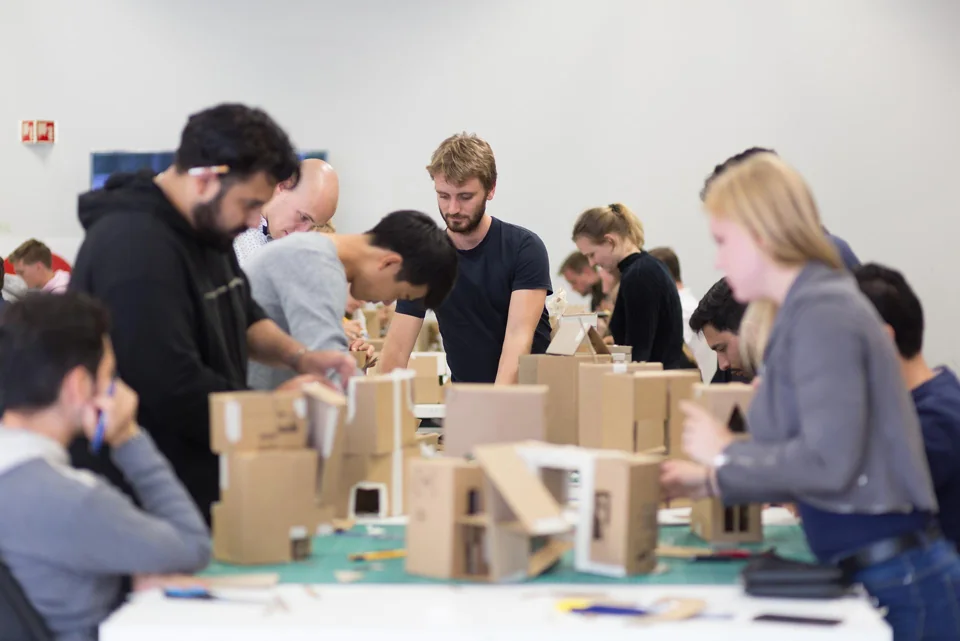
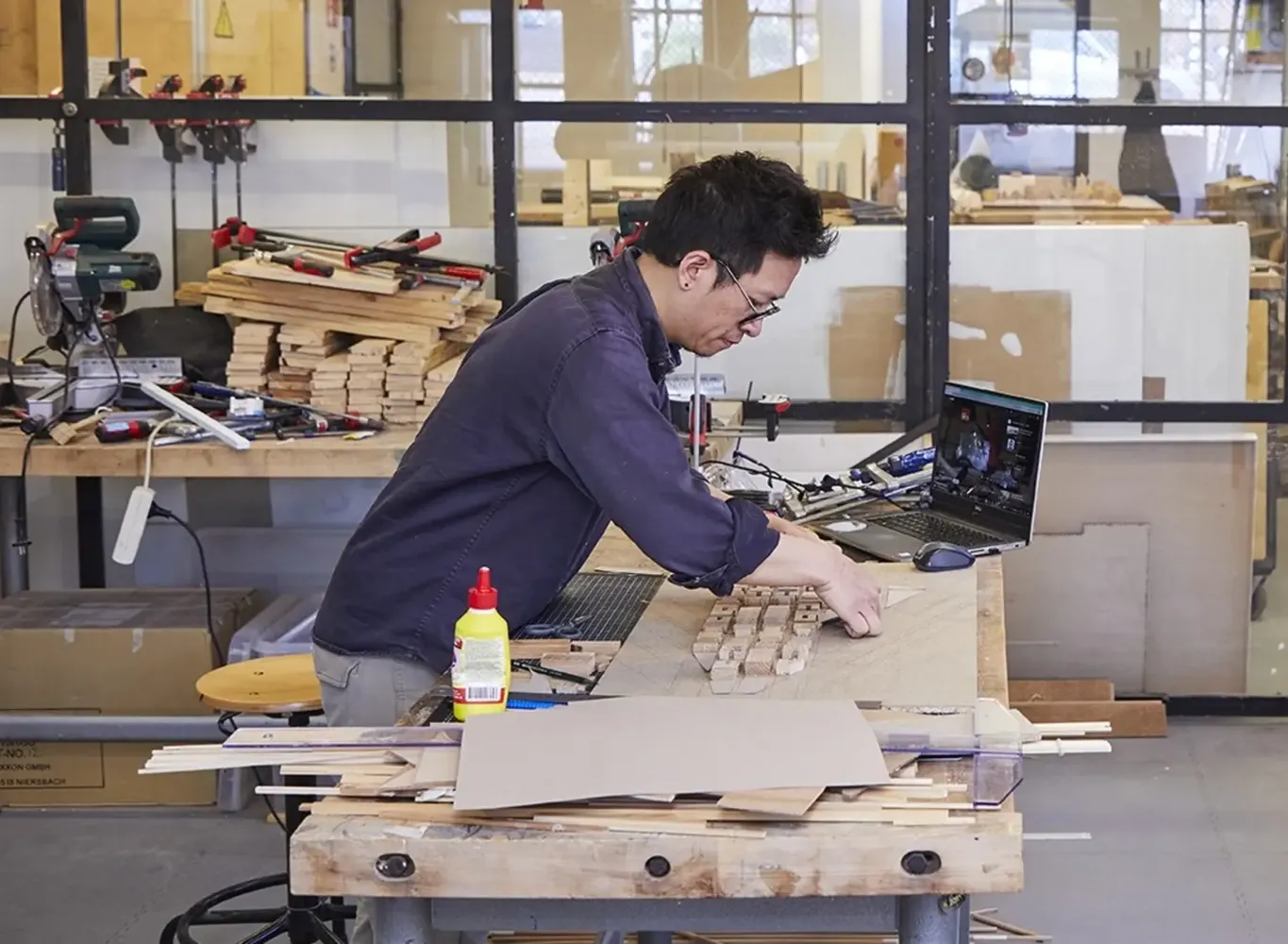
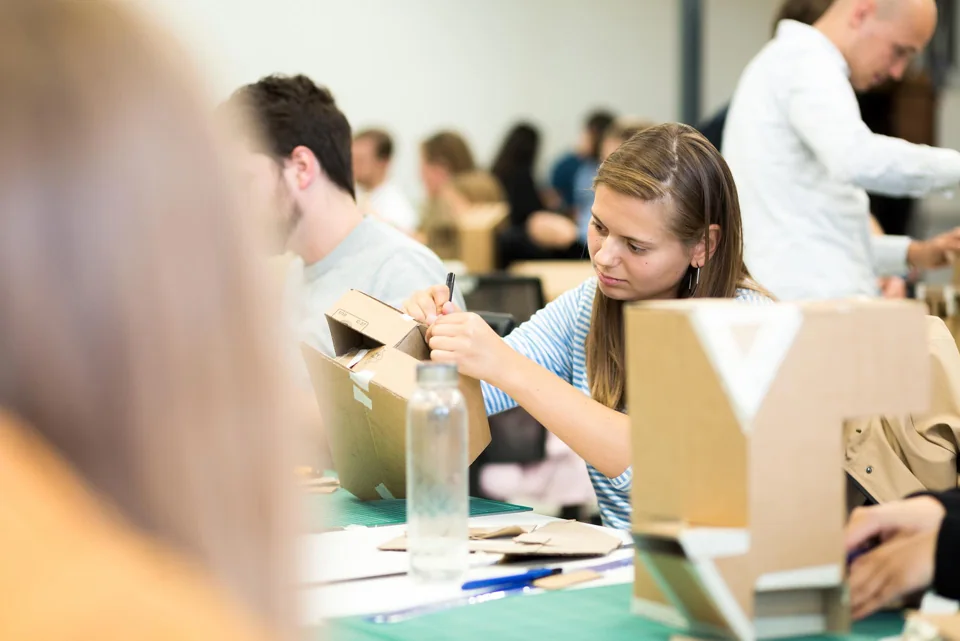
MakerSpace is a shared workplace available to AHK students at the Marineterrein. Its resources include virtual-reality equipment, laser cutting, CNC milling and three-dimensional printing. Access to the machinery is organised around compulsory instruction and the presence of instructors. Students can also use the workplace for tasks that do not require the machines. This combination of materials, equipment and supervised introduction provides a practical setting for developing models and other projects. Its published photographs show students developing physical models together, illustrating the workshop’s practical role within arts education.
Sources: Practical work in MakerSpace ↗