Visa

About Aeres University of Applied Sciences
One university, three faculties
Aeres University of Applied Sciences, also known as Aeres Hogeschool or Aeres UAS, is a Dutch institution with faculties in Almere, Dronten and Wageningen. This profile concerns the university as a whole, rather than one individual location. Its roots lie in tertiary agricultural education, and it belongs to the Aeres Group, whose activities connect education, research and the application of knowledge.
The faculties share an institutional mission while retaining different academic identities. Almere focuses on green and healthy urban environments, Dronten on agribusiness, and Wageningen on learning and professional development. Aeres describes its educational purpose as developing professionals able to make responsible decisions in a complex world. Sustainability is part of that outlook, including awareness of the consequences that professional decisions have for society and the immediate environment. The institution places learning in the context of professional practice.
Sources: Institutional overview ↗ · Mission and values ↗
Agribusiness and practical facilities in Dronten
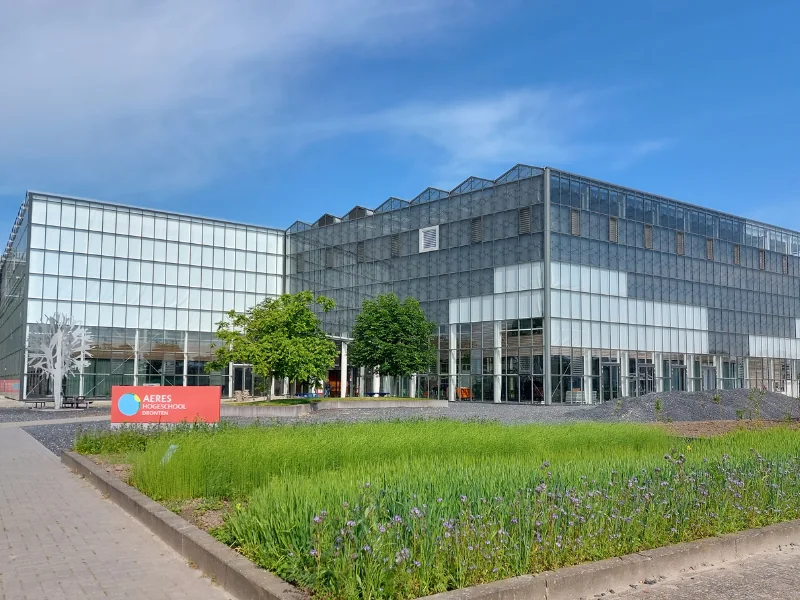
Dronten's teaching themes include agribusiness, food business, horticulture and animal husbandry. Its faculty account emphasises contact between students and teachers, cooperation with companies and the availability of practical facilities. Student associations and the possibility of living on campus form part of its description of the study environment.
The faculty's resources include a technology centre for agricultural technology and a multimedia library. Its research orientation connects responsible entrepreneurship with sustainable food production. Animal welfare, data-driven operations, profitability and the closing of resource cycles appear among its concerns. These interests bring production methods into contact with business strategy and social expectations. Dronten therefore combines learning about food and agriculture with questions about how organisations operate and how their decisions affect the environments in which they work.
Sources: Dronten faculty ↗
Learning and professional development in Wageningen
The Wageningen faculty prepares teachers, educational professionals, learning innovators and knowledge managers for vocational education, business and social organisations. Its educational approach places particular importance on workplace learning: students practise and learn within the reality of the professions they are preparing to enter or develop within.
Its research programme concerns sustainable learning and development through transitions. It addresses professional capability, expertise and the capacity of people and organisations to continue learning. The faculty also houses the European Floral Design Academy, which offers professional floral-design training at different levels. These activities reflect a broad understanding of applied education, encompassing professional teaching, organisational knowledge and specialist creative practice. Wageningen's focus complements the environmental and agribusiness themes of the other faculties.
Sources: Wageningen faculty ↗
Research with professional partners
Aeres describes its research as practice-oriented work conducted by professors, teacher-researchers and students with partners in education, industry and government. Businesses and public or semi-public institutions help formulate research questions. The aim is to develop knowledge that contributes to professional practice while also informing education and wider scientific understanding.
Each faculty has its own research focus. Almere's Healthy Living in Green Cities programme examines sustainable urban society, urban farming business models, lifestyles and nutrition. Dronten's Sustainable Entrepreneurship programme addresses food production and business development in agrifood and horticulture. Wageningen examines sustainable learning and development. Research areas are connected with professorships, bringing researchers, students and professionals together in projects. This structure gives the university a common applied-research approach while allowing different fields to pursue questions relevant to their own communities.
Sources: Practice-oriented research ↗
Sustainability across production systems
The Sustainable Entrepreneurship programme provides a detailed example of Aeres's research approach. Its plant research concerns the use of energy and raw materials, soil and agricultural water management, precision agriculture and data-driven technology. These subjects connect environmental questions with the decisions made by producers and other businesses in the food system.
Animal research addresses animal health, welfare and management alongside the effects of production on soil, water, air and crops. A further research area examines bio-based and circular economies, including the reuse of materials, residual waste and suitable business models. The programme links these concerns through technical and strategic innovation. Research takes place through professorship projects, practical and graduation investigations, and internships, with meetings between research and education teams helping bring findings into teaching.
Internships and graduation work
Aeres invites companies, institutions and project groups to propose internship and graduation assignments for its students. Its collaboration arrangements follow the faculties' different themes: green and healthy urban living in Almere, agribusiness in Dronten, and learning in green and consumer-oriented sectors in Wageningen.
This provides a route through which external questions can become part of student work. Organisations can submit research or business assignments as well as opportunities for internships or workplace learning. The process reflects the university's view that close contact with the field of work is essential. It gives professional partners a point of contact for bringing practical questions into the educational setting.
Guidance and student support
Students have a mentor or academic career coach as an initial point of contact for study progress. Additional support is available through student deans, student coaches, confidential advisers and Impuls. The university describes assistance with planning, effective study, stress and circumstances in a student's personal life that may affect their education.
Support also addresses barriers associated with disabilities or long-term conditions. Students can discuss anticipated difficulties and possible arrangements with a dean or coach. Confidential advisers provide another contact where concerns cannot comfortably be raised with a mentor. The university also describes support for students developing their own businesses, including possibilities in Dronten to connect assessments and final assignments with an enterprise. These services accompany academic teaching with guidance tailored to different study situations.
Sources: Student support services ↗