Visa
About Academic Center for Dentistry Amsterdam
A shared dental academic centre
The Academic Centre for Dentistry Amsterdam is widely known by its Dutch abbreviation, ACTA. It is a collaboration between the dentistry faculties of the University of Amsterdam and Vrije Universiteit Amsterdam. The centre brings dental education, scientific research and patient care into the same institutional setting on the VU campus in Amsterdam's Zuidas district.
ACTA also works closely with the oral health sciences department of Inholland University of Applied Sciences and the Foundation for Special Dentistry, both of which use its building. ACTA Dental Education provides postgraduate courses for practising dentists alongside the centre's university programmes. This arrangement brings together different forms of dental learning and care, from the preparation of students to further professional education. The shared location also provides a physical connection between academic research, clinical departments and organisations with related oral healthcare responsibilities.
Sources: Collaboration ↗ · The Building of ACTA ↗
A building combining clinical and academic work
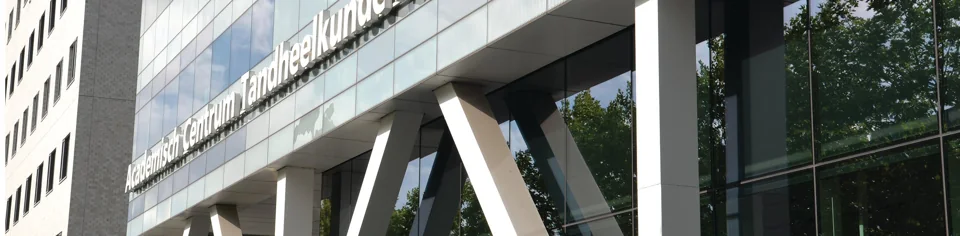
The ACTA building was designed by Benthem Crouwel Architects. Its published description identifies approximately 25,000 square metres devoted to the combination of care, education and research. The design received third prize in Amsterdam's architectural competition in 2011, an acknowledgement included in the centre's account of its facilities.
The building accommodates ACTA's university teaching and scientific work together with the Foundation for Special Dentistry and Inholland's oral hygiene education. This concentration of activities is a defining feature of the institution's organisation. Students and researchers work within a setting that also includes patient care, while the presence of related educational and clinical organisations supports cooperation across professional roles. The building therefore expresses ACTA's academic model through the way different functions share the same premises.
Sources: The Building of ACTA ↗
The bachelor programme in dentistry
ACTA's Bachelor of Dentistry is a three-year, full-time programme taught in Dutch. The centre describes its focus through working with people and caring for oral health. Its international information page makes clear that proficiency in Dutch is one of the entry requirements, reflecting the language used throughout the programme.
Applicants holding qualifications from outside the Netherlands must have those qualifications evaluated against Dutch educational standards before they can enter the selection process. Application information is provided through both partner universities, with student service offices supporting questions about procedures and qualification evaluation. The bachelor's programme forms one part of the centre's dental education structure, alongside the separate master's programme, postgraduate professional study and doctoral research. Its language and full-time format are therefore important characteristics of the particular degree rather than a description of every learning opportunity available at ACTA.
Sources: Bachelor Dentistry ↗
Clinical learning in the master programme
The Master of Dentistry is also presented as a three-year, full-time programme in Dutch. Its description places diagnostics, decisions about care and treatment planning at the centre of study. Students spend more time treating patients and developing the ability to explain and justify their treatment choices through relevant knowledge and clinical reasoning.
The programme adopts a multidisciplinary approach to these activities. Students work under the supervision of lecturers who are qualified dentists and staff from clinical departments, including cariology, endodontics and periodontics. This links academic study with supervised patient care and brings different dental disciplines into the learning process. The programme's published emphasis is on understanding both what care is appropriate and the reasoning supporting those decisions, within a clinical educational environment.
Sources: Master Dentistry ↗
Postgraduate Oral Health Sciences
ACTA's postgraduate Master in Oral Health Sciences is a three-year, full-time programme taught in English. It is intended for Dutch and international dentists who already have experience in general practice and want to develop their knowledge further. The programme combines theoretical study with clinical skills and profile-specific teaching.
Its structure includes seminars and clinical courses across different graduation profiles. The centre describes the approach as interdisciplinary, with laboratories, clinical facilities and specialist educational activities supporting advanced learning. This makes Oral Health Sciences distinct from the Dutch-language bachelor's and master's sequence in dentistry. It is designed for dentists building on an existing professional foundation, with opportunities to deepen, broaden and complement their expertise through a focused postgraduate academic programme.
Sources: Oral Health Sciences ↗
Doctoral training and research development
Doctoral researchers at ACTA may work as employees or participate as guest researchers. Their scientific work is supervised by a team of promoters or co-promoters, while the ACTA School of PhD Studies provides training alongside the research itself. The doctoral structure therefore combines an individual investigation with supervision and organised academic development.
The courses expected of doctoral researchers cover several purposes. Some are directly related to research methods or the thesis, while others develop broader academic abilities such as writing in English. Career-oriented learning can include preparing funding applications or studying subjects outside the immediate research field. ACTA also publishes information about upcoming doctoral defences. These activities place research training within a continuing scholarly community rather than treating the thesis as an isolated task.
Sources: PhD Research ↗
Laboratory research and external collaboration
ACTA conducts laboratory, preclinical and patient-related research and offers collaboration through commissioned projects and research consortia. Its capabilities include testing antimicrobial activity, investigating how materials interact with cells, measuring the release of substances from dental products and assessing mechanical durability. The centre describes methods for examining strength, hardness, wear and fatigue, with microscopy used to investigate failures.
Research partnerships connect this work with wider questions in oral health. Listed collaborations include ORANGEHealth, bringing together Dutch oral-care and dentistry institutes; MetaHealth, concerned with children's weight and dental health; and DELIVER, a European research programme concerned with affordable oral care. These examples show how ACTA links specialist facilities with partners investigating biological, technical and societal questions. The research activity complements its educational and clinical roles through shared attention to oral health.
Sources: Contract Research and Valorisation ↗