Visa

About Amsterdam University College
A residential liberal arts and sciences college
Amsterdam University College, usually called AUC, is a joint initiative of the University of Amsterdam and Vrije Universiteit Amsterdam in the Netherlands. It offers a three-year undergraduate honours programme in Liberal Arts and Sciences, taught in English and leading to a joint bachelor’s degree from the two universities. Dutch and international students study within the same residential community at Amsterdam Science Park.
The college combines a broad education with the opportunity to develop depth in particular subjects. Its institutional introduction places discussion of significant questions in science and society at the centre of learning. Small classes and shared campus life support this approach. The AUC Scholarship Fund is described as one way the college seeks to broaden participation within its international student community.
Sources: About Amsterdam University College ↗
Values and an international outlook
The college’s mission connects undergraduate learning with innovation and participation in a culturally diverse society. Its values emphasize academic effort, respect for others, integrity and cooperation. The published statement describes excellence as something that can take different forms and includes creating conditions in which other people can succeed.
Diversity and inclusion are explicit commitments. The college identifies differences in nationality, language, background, beliefs and ability as part of its community and encourages discussion among people with different ideas. Its statement also addresses discrimination and social injustice. Global perspectives are linked to engagement with communities and organizations beyond the college, including attention to inequality and the climate emergency. These are presented as principles guiding institutional life and education.
Sources: Mission and values ↗
Connecting disciplines through study
AUC’s account of liberal arts and sciences describes an education that develops specialist understanding while teaching students to consider arguments from other disciplines. The programme draws on the Sciences, Social Sciences and Humanities. Reading, critical analysis, writing and the ability to connect ideas are identified as central academic skills.
Its interdisciplinary approach concerns problems that extend across conventional subject boundaries. Globalization and climate change are examples used in the college’s explanation of this approach. Students are expected to connect analytical work with applied experience and to consider how different methods illuminate the same issue. The programme is full-time and comprises 180 European credits over three years. This provides a common framework within which students develop their own academic interests.
Sources: Liberal Arts and Sciences ↗
Building an individual curriculum
The curriculum combines a common Academic Core with courses in a major, study outside that major, electives and a final research project. Students work with an academic tutor to create an individual plan. Courses progress from introductory study toward more specialized work, allowing a sequence of learning rather than a collection of unrelated subjects.
AUC divides the academic year into semesters containing a longer teaching block and a shorter intensive block. Alongside their main field, students take courses in the other two major areas. Electives provide further room for exploration or specialization. In the final year, the Capstone bachelor’s thesis brings together research on an original topic. Community projects or internships supply another required element, connecting the curriculum with experience outside ordinary classroom study.
Sources: Programme structure ↗
Shared academic skills
The Academic Core extends across the three years of study. Its requirements include academic writing, advanced research writing, logic, programming, an interdisciplinary Big Questions course and the Global Identity Experience. Community projects or internships also form part of the shared foundation. Language courses are available as optional electives rather than a compulsory requirement for every student.
Writing courses develop academic communication and prepare students for the Capstone thesis. Logic teaching examines the validity of reasoning and information, while the Global Identity Experience considers issues in an international and multicultural setting, including group research in Amsterdam. Big Questions courses bring together perspectives from several disciplines. Their subjects include artificial intelligence, bioethics, consciousness, language, the environment and time, illustrating the range of questions addressed through this shared curriculum.
Sources: Academic Core ↗
Majors and fields of concentration
Students choose a major in the Sciences, Social Sciences or Humanities and confirm that choice at the end of their first year. Within each major, fields of study provide more focused areas of learning. Courses are classified by level, from introductory to intermediate and advanced work, helping students build a coherent progression.
The published fields span subjects such as mathematics, physics, biology, chemistry and information within the Sciences. Social Sciences fields include economics, law, sociology, anthropology and sustainability. Humanities fields include literature, film, philosophy, history, culture, art history and media. Students select major courses with guidance from their tutor, developing depth through related subjects and advanced study. The college’s course listing provides a more detailed view of the options available in a particular academic year.
Sources: Majors and fields of study ↗
Academic guidance through the tutoring system
Each admitted student is assigned a tutor drawn from the teaching staff. The tutor supports the transition into university study and helps the student make academic choices. A tutor may also teach the student, although this is not required by the system.
The relationship continues beyond the first year. Tutors advise on course selection for the second and third years and help students consider the balance between breadth and specialization. Discussions can address electives, the direction of the major and preparation for the Capstone. Tutors also help students examine how their choices relate to the requirements of possible master’s programmes, connecting immediate decisions about courses with longer-term academic interests.
Sources: Tutoring system ↗
Student-led activities and participation
The Amsterdam University College Student Association, known as AUCSA, was founded in 2010. It serves as an umbrella organization for social activities at the college, working through its board, committees and members. The college’s account encourages students to join existing projects or develop ideas of their own.
Activities provide opportunities to meet beyond classes and pursue interests alongside academic work. The examples listed include sports tournaments, Model United Nations conferences, art, music and charity. Students can approach the association with proposals or feedback on its work. This makes participation a practical part of the residential community: students help organize events and projects as well as attending them. The association provides a continuing structure for these extracurricular initiatives.
Sources: Student Association ↗
Living and learning at Science Park
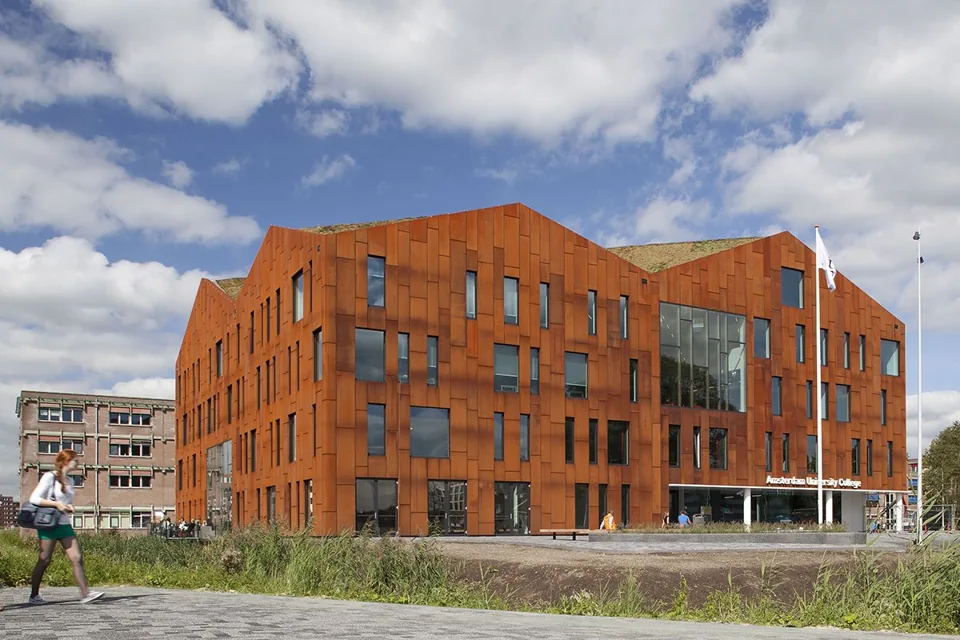
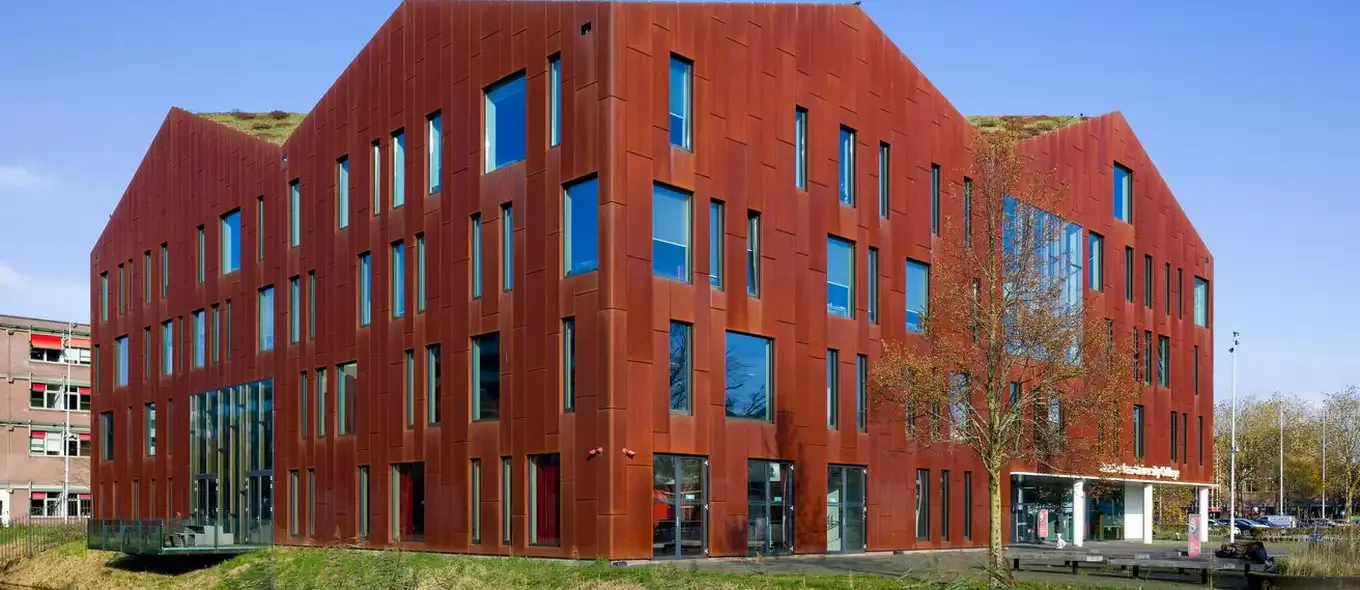
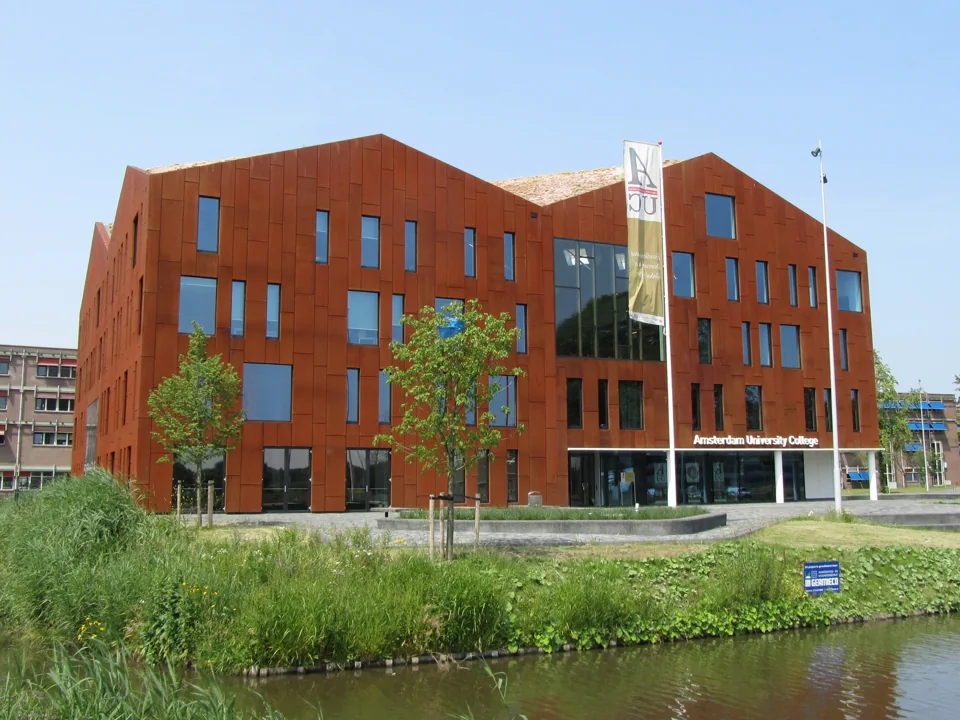
The college’s academic building and student residences are located in Amsterdam Science Park, in the Watergraafsmeer neighborhood of Amsterdam East. The academic building was completed in July 2012 and is within walking distance of the residences. Its facilities include classrooms, study areas, a reading room, common space and a café.
The campus account identifies access to laboratories at the University of Amsterdam or Vrije Universiteit Amsterdam for practical work required by the programme. Residential life is presented as an integral part of education, with students living together during their studies. The arrangement connects teaching spaces, independent study and everyday social contact within one local community. The historical photographs show the academic building in 2013 and 2015, rather than implying that they depict its present-day appearance.
Sources: Campus and housing ↗