Visa
About Amsterdam Institute for Advanced Metropolitan Solutions
Research and learning through the city
Amsterdam Institute for Advanced Metropolitan Solutions, usually known as AMS Institute, brings urban research, education and innovation together in Amsterdam. Its work is rooted in its founding institutions, Delft University of Technology, Wageningen University & Research and the Massachusetts Institute of Technology, and in its partnership with the City of Amsterdam. The institute describes the city as a real-world setting for research, design and experimentation.
AMS Institute works from Marineterrein Amsterdam and organises collaboration around interconnected urban challenges. Its account identifies mobility, energy, circularity, digitalisation, food and climate adaptation as areas of work. The institute’s stated values include openness, learning through experimentation and scientific rigour. It aims to connect researchers, cities and other participants in developing metropolitan solutions, while providing a setting in which students and professionals can learn from those collaborations.
Sources: About AMS Institute ↗ · AMS Institute location and organisation ↗
A joint master’s hosted at AMS Institute
The MSc Metropolitan Analysis, Design and Engineering (MADE) is hosted at AMS Institute. Students enrol at Wageningen University & Research and Delft University of Technology, and graduates receive a diploma issued by both universities. AMS connects the programme with its research, living-lab and entrepreneurship activities.
Study combines urban engineering, design, data science, entrepreneurial thinking and social-science methods. The first year develops theoretical and practical knowledge through challenge-based work. Second-year living-lab projects and thesis research involve public and private partners. The MADE IT study association contributes to education design and student events. Young Urban Engineers, a student-based consultancy, connects students with companies, municipalities and non-governmental organisations on urban and environmental projects.
Sources: MSc Metropolitan Analysis, Design and Engineering ↗
Learning for urban professionals
AMS Academy is the institute’s professional-learning environment for practitioners, researchers and entrepreneurs. Its approach brings academic knowledge together with the skills involved in putting ideas into practice. Participants work in teams on real-life cases, with an emphasis on collaboration, taking responsibility for change and developing solutions with others. Entrepreneurial thinking is presented as part of that learning process.
The professional-education page describes activities at the intersection of urban research and implementation. Examples include training on the reuse of assets, learning activities on citizen engagement in energy-related measures, and a masterclass concerning biobased construction and environmental law. These examples illustrate the academy’s focus on questions that arise in municipal work, infrastructure and sustainability. Its intended role is to connect new knowledge with the practical decisions and collaborative skills required in urban projects.
Online learning about metropolitan challenges
AMS Institute combines on-site learning, distance education and massive open online courses as part of its educational approach. Its online catalogue includes Sustainable Urban Development, Co-creating Sustainable Cities, Nature Based Metropolitan Solutions and Sustainable Building with Timber. The subjects bring together different aspects of urban life rather than treating the city as a single technical system.
Sustainable Urban Development considers metropolitan challenges and the part played by cities and their inhabitants. Co-creating Sustainable Cities examines relationships between citizens, service providers, technology and infrastructure developers, policymakers and researchers. The nature-based-solutions course focuses on developing implementation strategies, while the timber-building course addresses developments in architecture, engineering and manufacturing. The institute presents these online routes as ways to develop knowledge about metropolitan solutions beyond the physical classroom.
Sources: Massive Open Online Courses ↗
Learning the urban living-lab approach
An e-learning course on the Urban Living Lab Way of Working was developed by AMS Institute and TU Delft within the Future-Proof Living Environment programme. It draws on the institute’s handbook and is available in English and Dutch. The course is organised around the complexity of urban challenges, the characteristics of living labs, a multilevel view of innovation ecosystems and the activities used to organise a project.
Reading material, interactive images and short tutorial videos are combined with a fictional but realistic case. The intended audience includes project managers, designers, policymakers, process facilitators and implementers in municipalities, engineering firms and knowledge institutions. The method emphasises learning through small-scale tests of technologies, collaborations and processes, so participants can examine how an innovation might work before attempting wider implementation.
Sources: Urban Living Lab e-learning ↗
Entrepreneurship and developing urban ideas
The AMS Startup Booster supports people developing urban-technology ideas, including students, researchers and professionals. Its published programme combines workshops and masterclasses with mentoring, individual coaching and access to working and making spaces. Participants work on the foundations of a venture, from market research and a value proposition to business models and a minimum viable product.
Additional subjects include team alignment, marketing, branding, funding and intellectual-property rights. The described working pattern combines on-site workshops with pitching and coaching, culminating in a demonstration event where teams present prototypes to experts, investors and entrepreneurs. This places entrepreneurship alongside research and education within the institute’s activities. The emphasis is on testing an idea, refining it through feedback and connecting with people who bring different forms of practical and technical expertise.
Sources: AMS Startup Booster ↗
Celebrating the MADE community
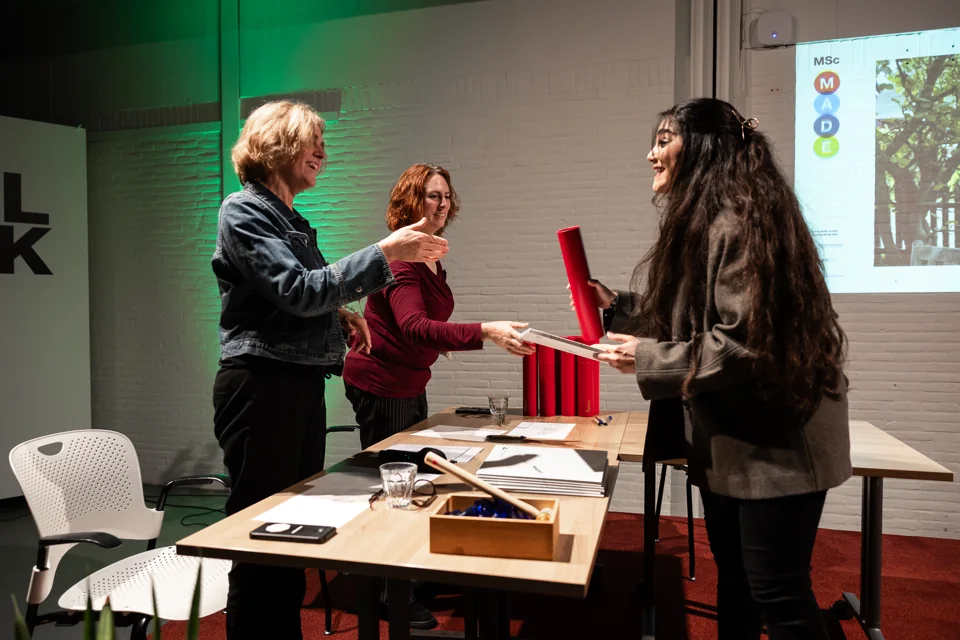
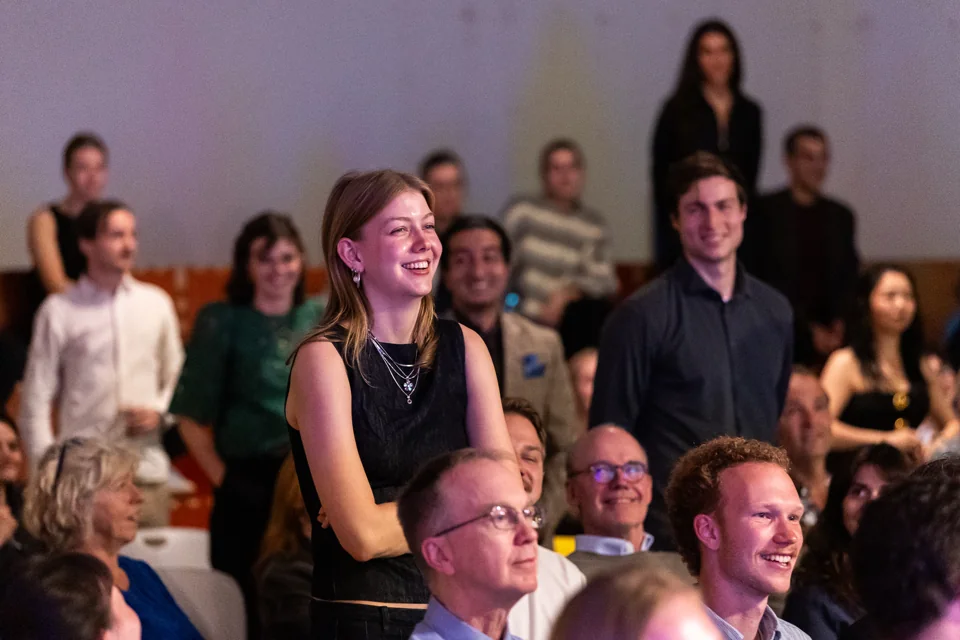
The institute’s 2026 graduation report describes a MADE ceremony at CRCL Park, attended by graduates, families, friends and members of the programme and institute communities. Speeches reflected on interdisciplinary urban engineering, while personal video messages recalled the students’ experiences.
The report also records contributions from the MADE IT association and a closing activity in which graduates placed pins on an Amsterdam map representing the alumni community. The event illustrates the social connections that accompany the programme’s academic and project work.
Sources: MSc MADE graduation ceremony, 2026 ↗